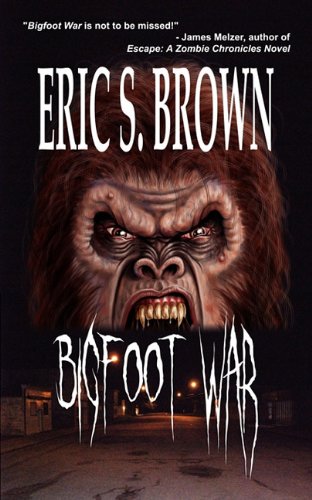
Bigfoot War: Eric S. Brown

What with the success of Seth Grahame-Smith’s Pride and Prejudice and Zombies, it became a virtual certainty that both publishers and writers would try to tap into the idea of taking a classic and adding a supernatural flair in the hopes of emulating his accomplishment.  And attempt they did, with novels such as Adventures of Huckleberry Finn and Zombie Jim, Robin Hood and Friar Tuck:Zombie Killers, and just this past Fall, The War of the Worlds, Plus Blood, Guts and Zombies  by Eric S. Brown.

Being a complete Sci-fi junkie, it took about five seconds of rationalizing before I ran to the counter with my copy of this new take on H.G. Wells classic.  Later, after a sober second thought regarding my purchase, I decided to look into the author’s (No, not Wells, the other guy!) previous works just to see if it was going to be worth it.  Long story short, a quick search on the Kindle came up with Bigfoot War by the aforementioned Mr. Brown.  At the low-cost off $4.99, my choice was made.

Brief synopsis:

Jeff Taylor is back in the town of Babble Creek, North Carolina, roughly twenty years after the death of his father and brother at the hands of…oh, c’mon now, is that really a mystery?  He’s back, and looking to settle the score with the huge man/ape that ate his family.  Jeff enlists his army buddy Tom (now a disgruntled football coach at the local highschool) and they set out  to extract some revenge.  Tom is having a hard time believing his buddy’s story, right up until the moment a Bigfoot reaches out of the woods and takes his head off.  Jeff and a couple of local sheriff’s deputies manage to finish off the Bigfoot and the local authorities take the body into town for autopsy and quick disposal.  Wouldn’t want to scare the locals after all.

However, it wouldn’t be a war if there was only the one Bigfoot, and sure enough, this particular Bigfoot was not alone.  By the end of the day, Babble Creek and its citizens would be on the receiving end of a bloody rampage by a tribe of Big(feet?).  Pretty straightforward plot.

My review:

Clocking in at 128 pages, Bigfoot War seems more like a long novella than a full length novel.  It also feels somewhat amateurish, like that novel you’ve been writing in your spare time on the weekend, only to be self published and shopped around at whatever small bookstore that will let you set up a table.  Bigfoot War  has some continuity and spelling errors, nothing too glaring, but when a character is referred to as Anna one moment and then mistaken for Rachael the next, well, that’s something a competent editor should catch.  In another scene, the author means to write “vicious” but ends up with “viscous” which turns a scene of horrific violence into something comical.

(Spoiler alert!  Spoiler alert!) 

The author also can’t seem to decide who the protagonist is going to be.  The novel initially revolves around Jeff Taylor and his righteous vendetta, but within twenty pages his body is in several pieces and the story has moved on to various other characters.  Each receives a few pages of background, and just when you’re beginning to root for them, oops, they’re dead.  No character is safe in this novel, and while that can keep the reader on edge rather than letting them become complacent in their assumptions and is certainly a refreshing change, after a while it gets tiresome.  Why take the time to invest in a character when they’re only going to be gone in a few pages?

All this aside, Bigfoot War was a fun way to spend a few hours, literary masturbation of sorts for monster junkies.  Brown knows how to write, and this novel feels like a first draft of something that can be improved on with a little editing and perhaps a bit of practice.  Eric S. Brown has been on the Zombie scene for a while now and has certainly been a prolific writer.  Although Bigfoot War isn’t a horribly good book, it certainly has its moments, and is appealing enough to make me want to try again.  Maybe World War of the Dead: A Zombie NovelWar of the Worlds plus Blood, Guts and Zombies?  Most definitely!

 

Monster Hunter International- Larry Correia

Monster Hunter International: Larry Correia (Baen Books, 2009; 713 pp.)
Owen Zastava Pitt is just your average mild-mannered accountant working in the finance department of a small firm in downtown Dallas.  Sure, he’s over 300 lbs of solid muscle and worked his way through school engaging in back street bloodsports, but still, he’s an accountant.  An accountant with your stereotypically angry boss.  Seems like nothing he does pleases Mr. Huffman, not even working late.  However, when Huffman calls Pitt into his office one night, Owen expects another irrational dressing down, not a company dinner.  Especially when Huffman has decided that the dinner is going to be Owen.

You see, Huffman’s developed a case of Hypertrichosis as the result of an encounter on a recent camping trip, and as a side effect, developed a hunger for human flesh.  However, Owen’s not about to send a memo to Human resources about Huffman’s behaviour, and thanks to Texas’ very liberal conceal and carry laws (and Owen’s very literal interpretation of  the second amendment), he takes matters into his own hands in the form of a .357 Smith and Wesson.  However, Huffman’s not having any of that, and owing to the fact that Owen generally doesn’t carry around silver bullets, things get a little hairy.  Luckily, the law of gravity is on Owen’s side, and his former boss ends up a Lycanthropic splotch on the pavement after a 14 storey fall from a window office.  Owen fares little better.  Hey, let’s see you go ten rounds with a werewolf and see how you feel afterward.

Cue hospital scene:

When Owen awakes from his injuries (five days later), he’s in the company of a couple of federal agents.  Their role…to either put a silver bullet in his head in the event that his blood tests come back positive for lycanthropy, or in the event that Owen’s not going to go all Wolfman next time the moon is full…to threaten him into signing a nondisclosure agreement.  After all,  it is the official policy of the American government that supernatural creatures do not exist.  The penalty?  Prosecution to the fullest extent of the law under the Unearthly Forces Disclosure Act.  However, shortly thereafter Owen is visited by Earl Harbinger, an associate with MHI (Monster Hunters International™), a for profit mercenary group along the lines of the infamous Blackwater.

Monster Hunter International has its own private army, dedicated to pretty much what their company logo says…hunting monsters and making the world safe for your average person…at a price.  Harbinger is both a founding member and head hunter of new talent, and he thinks Owen fits the bill.

As for Owen, he’s not got much else going on.  While still in the hospital he finds out that he’s been terminated from employment at the accounting firm (apparently he was in violation of their no weapons in the workplace rule) and shortly thereafter finds himself convalescing in his apartment and pondering his future employment prospects.

Luckily for Owen, when next Harbinger visits, he brings along Julie Shackleford, a member of Monster Hunters International™’s founding family.  She’s drop dead gorgeous, shares his fascination with all things ordinance (did I mention she’s gorgeous?), and wants to offer Owen a job.  Hunting monsters.  For profit.  She’s also brought along what could be termed his first pay cheque: $50 000 in government bounty for his first supernatural kill owed due to the P.U.F.F. act (Perpetual Unearthly Forces Fund) instituted by Theodore Roosevelt (something else you won’t read in the history books!).  Needless to say, that makes his choice simple, and he decides to sign on.

From there the action really takes off as the novel follows Owen’s training, integration into one of MHI’s hunting teams, and eventual first mission, which, if he doesn’t play his cards right, could be his last.  Oh, and might result in THE END OF THE WORLD.

But I’ve said too much.  Read the rest for yourself.

Cue review:

Monster Hunter International is written from Owen’s point of view, and the writing flows so that you get a great idea of his ideals and motivations.  He’s got a sense of justice and honour that may not be mainstream, but he sticks by his guns (both literally and figuratively) in any situation and shows a strong, unswerving character.  There’s no grey areas here.  The bad guys are bad (really, really bad), the good guys are good (except when they work for the government), and when the two mix, the result is explosive.

Monster Hunter International is not going to win any awards for high literature, but if you want a rip-roaring ride full of non stop action, violence and confrontations of the supernatural sort, it’s the book for you.  713 pages go by in a flash of silver bullets, Vampire Masters, Trailer Park elves, giant gargoyles, one extremely nasty conquistador, a prophecy that if fulfilled would open a doorway to another dimension and let loose the demons within…and young love.  Reading this book I was reminded of John Steakley’s Vampire$ (a great book in its own right) and why not?  They’re both about a group of mercenaries hunting down the supernatural both to keep humanity safe and for a crapload of money.  So, if you like a dose of guns, girls and gore, Monster Hunter International has it.

But wait!  There’s more!

MHI was published in 2009, and in the meantime Larry Correia hasn’t rested on his laurels.  The sequel, Monster Hunter Vendetta ,was released in paperback just this past September.  Larry’s also a blogger, and if you’re interested in reading about his work (and thoughts) you can check in with him at Monster Hunter Nation and read about his work on the third novel, Monster Hunter Alpha.

Night of the Living Trekkies-Kevin David Anderson and Sam Stall


  “They thought Space was the Final Frontier–They were wrong.”


Jim Pike is a man tortured by the events of his past.  An Afghanistan veteran in the throes of Post Traumatic Stress Disorder, Jim has seen the bloodiest aspects of war and no longer wants the responsibility that came with his service.  In fact, he doesn’t want any real responsibility whatsoever, haunted as he is by the loss of several members of his platoon.  So, security guard at the Botany Bay Hotel and Conference Centre in the lovely town of Houston seems like the perfect fit. After all, the worst thing he’s going to have to deal with this weekend is a bunch of Star Trek geeks attending the annual GulfCon Star Trek convention.  Or so he thinks…(cue ominous music)

Just down the road the  Johnson Space Centre has been put into lockdown mode and convention goers are complaining about poor to nonexistent cell phone reception.  Even the televisions seem to be on the fritz.  To top off his day, Jim’s supervisor is missing, half the staff hasn’t shown up for work, and his sister Rayna is coming to town, bringing along a motley collection of Star Trek fans such as:

  • Matt Stockard–Wunderkind software developer drunk on his own dubious fame and possible paramour of Rayna’s (at least in his mind)
  • Gary Severin–Matt’s nominal boss, a stereotypically obese Sci-fi nerd and the foil of Matt’s excessive personality (picture comic book guy in a trek outfit)
  • T’Poc—Matt’s executive assistant and the girl who’s looking to hook up with Jim while wearing a suggestive outfit from the Star Trek Mirror Universe.

During the course of the next several hours, Jim’s finely honed sense of danger (which he first exhibited in Afghanistan while on patrol with his squad) keeps going off, but he’s too overwhelmed with the staff disappearances and his desire to connect with his sister to listen to them.  That is, until his manager points out that anyone leaving the complex for a smoke…never comes back.  Things quickly degenerate from there to an all out battle to stay alive in a convention centre populated by what at first glance appears to be the living dead.  Jim soon comes to realize that things are not what they seem, they’re even worse, and that the monstrous hordes may have an extraterrestrial connection to recent events at the Space centre involving the Genesis probe.  Luckily, a NASA exobiologist by the name of Sandoval may have the answers to their dilemna…if only they can find him before the Zombies do.

In the course of rounding up Rayna and her friends and trying to find a safe haven within the Hotel complex to hole up and wait for help, Jim comes across a girl dressed in a slave outfit (a la Princess Leia from Return of the Jedi).  Strangely enough, she’s handcuffed to a bed with a video camera set up.  Leia (not her real name) got herself mixed up in a little Star Trek dominatrix video and like everyone else, just wants to get out of Dodge.  Add one Klingon with a Bat’leth,  a guy in a red shirt with the unfortunate name “Willy Makit” (sound it out phonetically and you’ll get the joke) and the carnage begins.

The authors of Night of the Living Trekkies have created a unique perspective  on the Zombie genre.  Rather than those horror novels that leave the explanation of the Zombie outbreak to the reader’s imagination, they come up with an explanation of Zombism that has a scientific element to it.  The pathogen is extraterrestrial, much like in the Andromeda Strain with one twist…this time those affected don’t stay dead. 

Anderson and Stall are clearly Star Trek fans and have jam packed their novel with references both obvious and obscure.  Each chapter title is an homage to the original episodes, and Jim Pike’s name is a subtle reference to both Jim Kirk and the Enterprise’ first captain, Christopher PikeEven Dr. Sandoval’s name is a reference to a character in the original series (spoiler alert!) with a similar problem. 

Night of the Living Trekkies departs from your usual fan fiction…it’s actually good!  With a fast pace and interesting (although predictible) cast of characters, Night of the Living Trekkies takes the reader on a bloody yet satisfying journey into the world of Star Trek fandom while adding more than a dash of horror to complete the picture.

Publisher Quirk books has engaged on a unique marketing campaign to promote this book, investing in a faux movie trailer on youtube to showcase their author’s work.  Here’s hoping a full length feature is in the future.

.

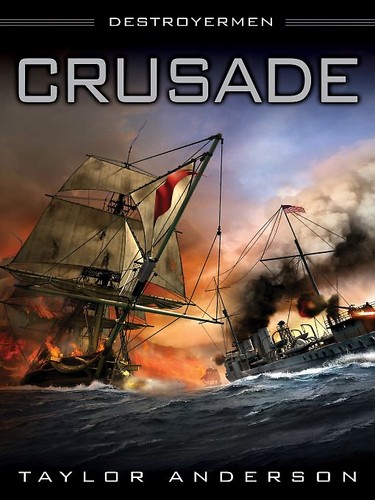
Crusade: book two of the Destroyermen Series

Crusade: Taylor Anderson (Roc Books, 2008; 395pp.)

Crusade is the  sophomore novel in the Destroyermen series by Taylor Anderson and a welcome addition to the story he began back in 2008.  Equal parts naval fiction in the vein of Douglas Reeman, and alternate history in the vein of Harry Turtledove, Anderson has created a unique World where evolution took a right turn and chose Saurians to become the dominant species on the planet.
 
Before we begin, a little recap.  Into the Storm recounts the story of the men of  U.S.S. Walker, a worn out World War One era destroyer of the Pacific fleet, fleeing the onslaught of Japanese forces shortly after the start of World War Two.  Harassed by a Japanese Battlecruiser, she and her sister ship Mahan sail into a strange squall in an attempt to escape certain destruction, only to find themselves transported to what would be described as an alternate Universe, one where human society never evolved.  No modern cities, no modern technology, and no humans.  However, they are not alone.
 
In a land much like Sir Arthur Conan Doyle’s Lost WorldAnderson’s characters contend with deadly sea creatures that make any foray into the water a certain death, and once on shore, the danger comes in the form of many species of dinosaur.  During the course of their search for human inhabitants, they come across a massive sailing vessel, home to a species of creature that resembles a walking, talking Lemur, engaged in mortal combat with what appear to be British warships of the sailing age.  However, these are no English privateers they fight, but rather the saurian counterpart to the “Lemurians”, a species of sentient dinosaur modelled on the velociraptor known as the “Grik”, and exhibiting their same ferocity.  It seems the Lemurians have fought a holding action against the Grik for millenia, and both societies have benefitted from previous encounters with humankind.  The Grik have taken technology in the form of fighting ships, and the Lemurians in the form of “sacred” navigational charts and the language of their priestly sect … namely, Latin.
 
 Needless to say, the humans of the story are forced by circumstances and ideology to side with the Lemurians versus their common enemy while they resupply and repair their damaged vessels and decide on what to do next.  In the meantime, the  Americans train their Lemurian counterparts in the art of war, and attempt to advance the Lemurian’s technology to the point where their inferior numbers might be able to hold their own against the Grik hordes and maybe even go on the offensive.
 
In the second volume the Americans have managed, through a lot of ingenuity and a little luck, to put Walker back in a fighting trim and assure themselves a dedicated source of fuel.  They’re well on their way to fortifying the Lemurians against the inevitable Grik invasion and creating a fighting force of home-grown (Lemurian) troops, when a new threat arises.  The Amagi, a Japanese battlecruiser, has also been caught up in the transition, and Amagi’s captain has allied his forces with the Grik.  It’s an alliance of convenience  to be sure, but tips the scales in the favour of the Grik.  With the help of the Japanese, a massive  invasion force is coming, with the expressed purpose of wiping out the Lemurian race.  In a sequence of events that parallels the early stages of the war in Pacific, it’s up to the Americans and their two tiny destroyers to fight a holding action until the Lemurians can be ready for the inevitable fight.
 
So, what’s not to like?  Anderson has drafted a great tale of ingenuity against adversity, and goes to great lengths to examine the problems (and their solutions) incurred by the protagonists of the story.  For instance, in this new world, there are only a couple of hundred humans, of which six or so are female.   Integration with the local society becomes an issue, especially in the face of a lack of female comfort, and there’s a stirring scene in which the sailors deal with one of their own who breaks the rules of civilized society.
 
And then there’s the problems associated with technology.  The destroyers are hundreds of years in advance of any local technology, but suffer from the problems of resupply and repair.   How are they to be fueled and resupplied with ammunition once it’s been expended?  In a world where basic metallurgy is in its infancy and the combustion engine isn’t even a thought on the horizon, their solutions are ingenious, and at times…a little unbelievable.  However, Anderson makes it work. 
 
One note of disappointment in an otherwise thoroughly enjoyable book.  The Japanese characters (by the end of this book) have not been fully fleshed out, and remain caricatures, much like any of the Nazi thugs in an Indiana Jones movie.  Hopefully he will expand on their story in the third volume, entitled Maelstrom.  All in all, Anderson has written a page turner and taken his place amongst the greats in the genre of alternate history. 
 
As mentioned in my earlier post on his first novel, there’s a great interview with Taylor Anderson about the Destroyermen series on Peter Hodge’s website.  Maelstrom is out in paperback April 6, 2010.


Von Neumann’s War

Von Neumann’s War :Travis S. Taylor (Baen Books, 2008; 522 pp.)

Man has always seemed to have a fascination with our closest neighbour.  Little green Men from Mars have been a staple of Science Fiction (both literary and film) since, well, forever.  My (and I suspect everyone’s) first experience with this phenomenon was H. G. Wells, The War of the Worlds (1898).  Amazing guy…already plotting the destruction of life as we know it at the hands of our Martian neighbours, 71 years before Man landed on the moon.

Since then, the idea of invasion from above has been a staple of written fiction and film.  War of the Worlds was updated to modern times by Douglas Niles (War of the Worlds: New Millenium) and rewritten as an account from the eyes of H.G. Wells by Gabriel Mesta (The Martian War).  In film, there was the classic War of the Worlds and the less than classic remakeMars Attacks spoofed the idea and Harry Turtledove spun the idea on its head with man intruding on Mars (A World of Difference)…although he sets it in an alternate Universe and substitutes the fictional planet of Minerva for Mars.

Now Travis S. Taylor and John Ringo have spun a worthy tale about invasion by our Celestial neighbours in Von Neumann’s War.

A little background…in the near future, astronomers discover that the surface Albedo (how strongly an object reflects light from  a light source such as the sun) of Mars is shifting from the familiar Red spectrum to something much more gray.  Several probes on the planet, such as NASA’s Mars Exploration Rovers, have gone disconcertingly silent, raising alarms within both the defense and scientific community around the World.  NASA is tasked with developing a new probe for a fly by in a ridiculously short period of time, but using off the shelf parts and a fair bit of ingenuity, they manage to get a mission underway…only to have it destroyed within seconds of reaching the outer atmosphere of Mars.  Alarmed, both the Military and Scientific communities team up in efforts to prepare for what appears to be imminent (relatively speaking) invasion.  Within months the same effect is observed on the Moon, and with a little help from the Hubble Telescope, the nature of the threat is determined.

Von Neumann machines have come…and they are not friendly.

These self replicating machines have been stripping the Solar System of any metal both to repair and replicate themselves, and it seems that Earth’s turn has come.  Helicopters, jeeps, tanks, jet aircraft; none have any usefulness in combatting such a foe.   So, what to do when you’re facing a nemesis  light years (literally) beyond your technology who eats pretty much any weapon system you might throw at it? 

Well, the answer is…you get innovative pretty damn quick!

That’s much of the fun of this novel…reading the inventive ways in which the protagonists combat an enemy which is essentially invulnerable to any weapon system mankind has created within the last century.  The protagonists become creative with their weaponry…paint ball guns firing plastic explosives…ceramic bullets, aircraft, and engines…advanced laser technology…and frankly, once in awhile…a good old stick. 

So, is it a good book?  Definitely.  Yet there are a few flaws.  The characters have a tendency to come up with the technology needed to combat the machines  in an inordinately short period of time.  Furthermore, the climax of the novel revolves around a “God in the Machine” moment, in which one character (whose back story is nicely ramped up during the course of the novel) finds that “fatal flaw” that delivers the “Hail Mary” moment that kind of irked me.  It’s not even the solution that irks…but rather the swiftness with which the problem is solved.  And finally, it could use a damn good glossary of terms.  DARPA anyone?

However, if you are a Sci-Fi junky looking for your next fix of planetary devastation…then this is the book for you.

(Note:  Travis Taylor has put a lot of thought into the idea of Alien invasion and defense from such.  For further (serious) reading on the subject, try An introduction to Planetary Defense: A Study of Modern Warfare Applied to Extra-Terrestrial Invasion)

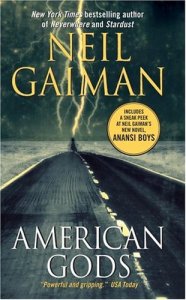
American Gods:An Odyssey.

AmericanGods_MassMarketPaperback_1185415388Belief is a powerful concept.  A loaded concept.  One man’s belief can be anothers heresy, and belief has been the driving factor behind most historical events, both eminently Good and supremely Evil.  Belief fueled the race to land a man on the Moon, the Civil Rights Movement, and the virtual eradication of many diseases.  It has also resulted in the Jim Jones Massacre, Slavery, and the  insane ideologies of both Fascism and Communism…two world views that have demonstrably  cost more lives in the past century than any Religion.  Yet we all yearn to believe in something, whether it be secular or metaphysical…even the Atheist has faith in something…or rather…nothing.  We need belief, in ideas, in movements, in various Deities.  Without belief, life would be empty and meaningless. 

Neil Gaiman decided to look at the the opposite side of the coin, asking, “what if these various Gods and ideas we pray to need our belief just as much as we do?”  What if their very existence depends on our belief and that without it, they wither and die?  Furthermore, what if, in these days of science and technology, the old Gods were being superseded by the new: Gods of Television, Fashion, and all those things we worship in our everyday life without even realizing it?   Finally, what if they decided the World was not big enough for the both of them?  American Gods is that story.

Gaiman’s novel tells the story of a war between those ascendant (the new Gods of Science and Entertainment) squared off against the diminished (think of the Norse, the Greek, the Egyptian…any Gods no longer actively believed in but relegated to mythic status) in a land that does not hold room (or belief) for both.  It is told through the eyes of one human participant, aptly named Shadow, an ex-con down on his luck.  Recently released from prison only to find his wife is dead, Shadow expects to live a listless existence, no longer caring about the world at large.  He’s not really alive, it’s just that he hasn’t died yet, and when a mysterious grifter going by the name of “Wednesday” makes him a simple offer, he reluctantly agrees…after all, he’s got nothing better to do.

During the course of his travels with Wednesday, Shadow interacts with almost the entire Pantheon of human belief, from the old Gods Odin, Osiris, and the less well known Anansi,  to the new Gods of Television and Technology.  (Technology himself ironically appears in the form of a pimply teenager, supremely confident in his abilities until he comes across a dead zone for cell signals…a bit of a nod to nerds everywhere)  He comes to find these Gods as vain and petty as man, obsessed with being remembered and desired, and in the midst of the war, finds himself a small part in a con game being played on man and Deity alike.  Yet his small role turns out to be pivotal to the conflict and to thwarting the machinations of those who want neither side to win but are rather more concerned that the conflict take place.  As does his parentage.

American Gods is a masterfully written tale and food for the fantasy junky. 

 (American Gods, William Morrow Publishing: 461 pp.)

Outliers: The Story of Success.

outliers-malcolm-gladwellWhat is it that makes a man or woman successful?  Is it sheer intelligence?  An undefinable drive to succeed?  Or is the difference between a failure and a success belong in such a simple thing as the date of one’s birth?  Maybe  the intensity of their parents involvement in their upbringing?  Simple tradition and social background? Malcolm Gladwell , former business and science reporter for the Washington Post, and staff writer for the New Yorker, attempts (and succeeds) in asking and answering these questions in “Outliers:The Story of Success.” (Little, Brown and Company, 309 pp.)  It’s a convincing argument, that the measure of success can sometimes be found in a person’s heritage (their family), where they were born and raised, and even when they were born. 

For instance, Gladwell looks at the statistics surrounding minor league hockey in Canada, and Soccer in other countries, and comes to the conclusion that those born early in the year have a much greater chance of success in their respective sports.  Now why is this?  Gladwell suggests it’s the result of simple happenstance.  The cut off date for enrollment is January, therefore, the biggest kids  playing will be those born near the start of the year.  That means a lot when one player is physically more mature than another, especially when the changes are more dramatic at an early age.  Put a 10 year old up against a child that won’t turn 10 for another 8 months, and it’s statistically provable that everything else being equal, the older child will have an advantage.  This advantage snowballs when the older player– by virtue of size or coordination that comes with age– gets more ice time, hence more practice, and generally becomes a better player.  Gladwell supports these assertions with a series of tables chronicling certain winning teams and their player’s birth-dates.

Not convinced yet?  Try chapter 3, “The Trouble with Geniuses,” and the story of Chris Langan, the “smartest man in America.”  Here’s a fellow who is a genius, literally, and yet lives a modest life, unable to function in the world of academics.  Gladwell interviewed him about his upbringing, and found that his parents pretty much abandoned their role in guiding his social life.  Chris was smart…brilliant even, but he did not have the social skills to work the system.  Something as simple as applying for academic assistance would simply not occur to him, a guy with a measured I.Q. of between 195 and 200.  He was able to grasp elusive concepts with ease…and yet couldn’t get through college.

Contrasted with Langan was the story of Robert Oppenheimer, another genius and a theoretical physicist best known for his work on the Manhattan Project.  Oppenheimer had a family that was very interested in his upbringing, and even though he proved to have an unstable nature (once he set a poisoned apple on the desk of his tutor), he had the social skills to get himself out of trouble and generally excel.

 Gladwell also has sections on Bill Gates and Bill Joy, computer software geniuses who were given advantages that allowed them to be ready when the opportunity came to be on the ground floor of the computer boom.  Simple things, like access to computer time in an age where it was generally prohibitively expensive, allowed these men to train the magic “10 000” hours that Gladwell posits is the number that guarantee’s proficiency in any field.   There’s even a neat little section on the Beatles and their 10 000 hours in Hamburg!

Another interesting section of the book deals with pilot proficiency and the pilot’s country of origin.  He demonstrates convincingly that different societies create better (or worse) pilots, and it’s all a matter of their societal traits.  A society rigid in hierarchy, such as Brazil or South Korea, will create pilots less willing to question their superiors when they see  a problem, but societies that believe in equality of social standing, such as the United States, will create pilots willing to speak up, and therefore a safer flight environment.  With minute by minute accounts of the crashes of Avianca flight 52  and KAL flight 801, he presents a terrifying example of societal tendencies creating a situation bound for disaster.

Finally, Gladwell examines his own parentage, to try and discover how a family only a few generations removed from slavery was able to excel while those around remained in poverty.  Shockingly, his claim rings true that it had much to do with the colour of their skin. 

Granted, there are three types of lies.  Lies, damn lies, and Statistics.  But if Gladwell is lying with statistics…he’s done a masterful job.

Into the Storm: Book one of the Destroyermen Series

Destroyermen-Book-1-Into-the-Storm-Taylor-Anderson-

History is a funny thing. 

Sometimes momentous changes pivot around the simplest of events.  What if Alexander the Great hadn’t contracted a fever in 323 B.C.?  Or for that matter, if Adolf Hitler had died from the wounds he received as a lowly corporal in World War One.  How would the world have changed?  For the better?  Or worse?  Would Alexander have consolidated his empire, had children and continued his dynasty?  Would Hitler’s early death have saved the world from a second World War, or pave the way for an even more horrifying figure?

 Over the years, alternate History fiction writers have attempted to explore such questions and posit how things might be different if history had gone down the path not taken.  They generally showcase their ideas within the framework of a world very much like ours, but with subtle differences that eventually change things dramatically in a process much like the butterfly effect.

“Into the Storm” is the first of the new “Destroyermen” series by Taylor Anderson, chronicling the exploits of a group of U.S. servicemen aboard the fictional U.S.S. Walker, a World War One era destroyer caught up in the opening moments of the war in the Pacific.  Hounded by the Japanese Navy, Walker and her sistership, Mahan, are seconds from total destruction when they sail into an eerie squall line in an attempt to shake off their pursuers.  Once inside, they suffer from an “effect”, much akin to the plot-line of the movie “The Final Countdown.”  When they finally come out of the storm, the Ocean is quiet, and their pursuers are not to be found.

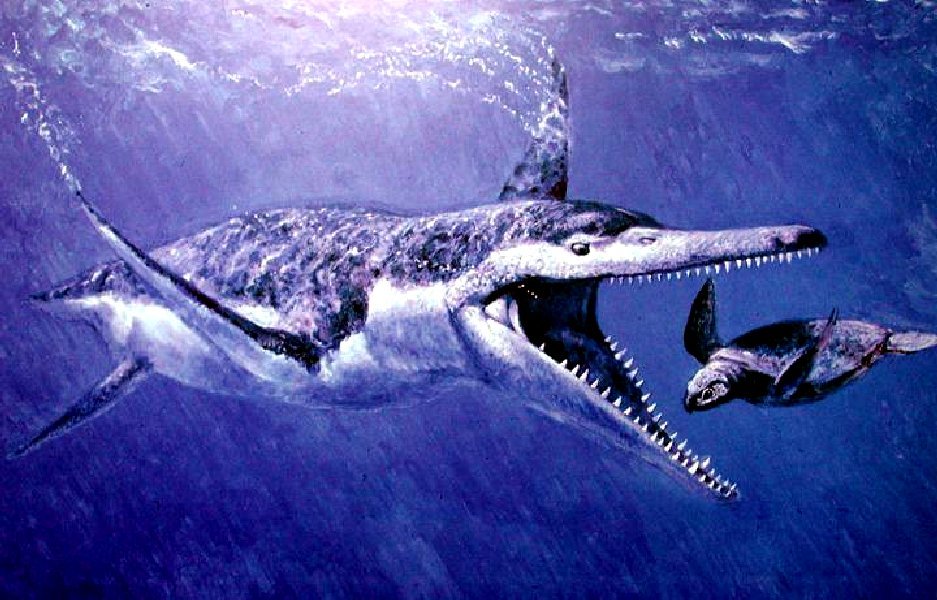
The captain and crew of Walker cannot account for their miraculous deliverance, and within minutes realize that they’re no longer where they were.  The Ocean’s are filled with fish akin to Piranha, and in short order they discover a group of Japanese sailors harried by what appears to be a Pliosaur!  Slowly they realize that much like Dorothy, they’re not in Kansas anymore, and this new world is a wondrous yet dangerous place.

Soon they must not only contend with their surroundings, but an age old war fought between the dominant species of this brave new world…neither of which is human…

“Into the Storm” is a well paced and intellectually satisfying tale of exploration and war which never leaves the reader bored.  To read an interview with Taylor Anderson by Peter Hodges, you can always look here, and here.  And of course, there are two sequels, “Crusade“, and “Maelstrom”, both out in hardcover.