Vonda N McIntyre
Jim Kirk knew that he was going to die, and that Spock would follow him down the accelerating spiral until he had fallen too deep to return. He would willingly choose death to try to save Kirk’s life.
James Kirk, too, had one choice left.
‘Spock…’ he whispered, ‘take good care…of my ship.’
He feared he had waited too long, but that terror gave him the strength he needed. He wrenched away from Spock, breaking their contact, forsaking Spock’s strength and will, and giving himself up alone to agony, despair, and death.”
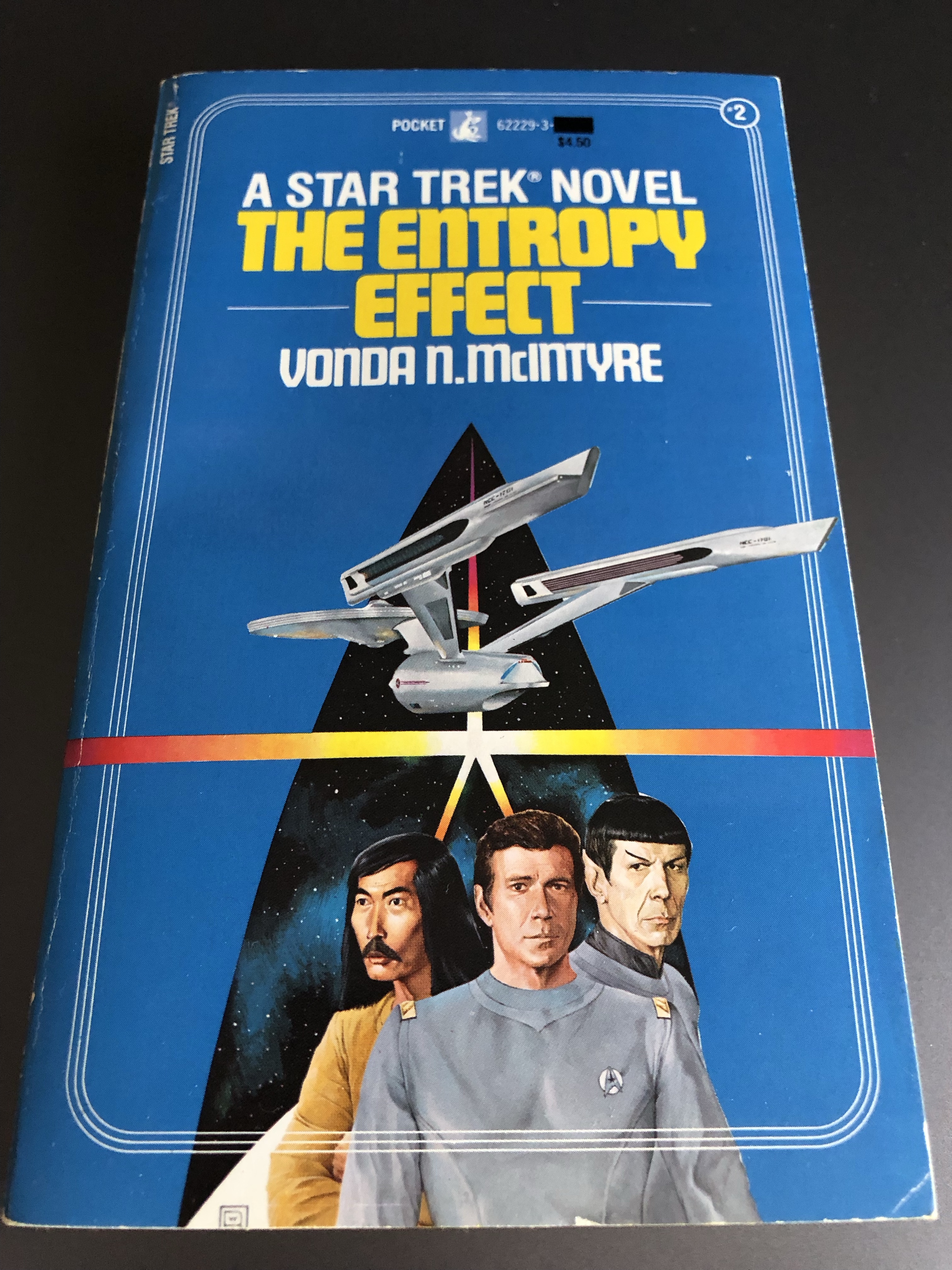
-The Entropy Effect, Vonda N McIntyre (pp. 83)Source: Physical copy.
Publisher: Pocket Books
Date of Publication: June 1981.
When a mysterious naked singularity appears and then spreads across a major warp-space lane, the crew of the Enterprise is tasked with maintaining a position perilously close to the anomaly while science officer Spock investigates its origin. Just as he’s coming to a startling conclusion on the nature of the phenomenon and what it means for the future of the Universe, Enterprise receives orders to divert to mining colony Aleph Prime. Upon arrival, captain Kirk discovers that they’ve been diverted to escort a prisoner to a rehabilitation colony—hardly a good use of Enterprise’s resources. But this is no ordinary prisoner, rather Spock’s former mentor, Dr. Georges Mordreaux, a brilliant temporal physicist now accused of multiple murder while experimenting with his theorems. Spock, whose remembrance of Mordreaux is that of a thoroughly ethical and solely theoretical scientist, requests that Enterprise accept the mission, hoping to discover how he came to be accused of murder, and why he’s being transported in such secrecy. Furthermore, Spock believes Mordreaux might have some insight into the anomaly the Enterprise’ crew has been studying and its significance to their future.
Barely has the Enterprise embarked upon this milk run of a mission when Mordreaux escapes captivity, arriving on the bridge and murdering James T. Kirk in a particularly grisly fashion. Yet when security personnel search the ship, Mordreaux is found to be right where he’s expected, locked up and seemingly unaware of what has transpired or his role in it. Spock must then convince both Mordreaux and McCoy to become accomplices in a plan to alter the very fabric of time, in hopes of stopping the murder of James T. Kirk and saving the Universe from the consequences of The Entropy Effect.
***
Nostalgia tends to polish our recollections, especially when those memories are from childhood. Things you once considered amazing, from a juvenile point of view, tend to lose their lustre in retrospect. That movie you remembered so fondly is not nearly as good; the novel you thought of as incredibly deep proves to be shallow. Memory may be faulty, and it can be unwise to revisit it, lest our expectations be dashed. Not so the case with Vonda N. McIntyre’s The Entropy Effect.
While there was an established canon in 1981, Star Trek had yet to bloom into a publishing phenomenon, The Entropy Effect being second in the line of Pocket Star Trek novels. There were the James Blish tie-ins, various one-offs and logs, but it wasn’t until the Pocket line that I remember the bookshelves being inundated with Trek. Of course, memory is subjective, and since The Entropy Effect is the first book I remember picking up (at the tender age of 9), it’s where my Star Trek novel reading journey began.
McIntyre’s novel was challenging for a youth due to its adult themes, whether it be mild depictions of sexuality or a surprisingly graphic depiction of the murder of James T. Kirk with a terrifyingly insidious weapon. Whether death, and more specifically people’s reaction to it, or human sexuality and romance—many of the themes depicted were beyond the understanding of my nine-year-old self. I wanted space battles and Klingons, not explorations of personal grief, or Sulu’s amorous adventures. Yet as an adult, I appreciate that she was writing to an audience more mature than one might think of being attracted to Star Trek.
Furthermore, it’s refreshing to see the freedom authors had to develop each character before there was an established canon or wealth of secondary source material. Without a writer’s “bible”, McIntyre was free to play with the backstories of characters, especially contributing to what later became the canon of Hikaru Sulu, providing fans with namely—well—his name. An abundance of interesting secondary characters (and a healthy description of each) also contributed to the storyline, and McIntyre’s imagination was indeed healthy.
Besides the main characters (given quantities, well established by the tv series), McIntyre introduced several lower deck characters, whose brief descriptions manage to quickly give these REDSHIRTS their own personalities. There’s Jenniver Aristeides, born of a high gravity planet with the physique to suit, but with the temperament of a botanist. Then there’s Snnanagfashtalli, a sentient panther, and Neon, akin to a miniature Tyrannosaurus Rex, whose language only translates to English as nouns, and whose IQ belies her primitive appearance. Finally, and most pertinent to the story, is Mandala Flynn, whose story is fleshed out through her relationship with Sulu. While not a primary character, Mandala Flynn is given enough agency as Enterprise’ security chief—and paramour of Hikaru Sulu—that when we see her in action, and the results of those actions, it’s not just as a throwaway, but rather a fully formed character whose fate has a profound effect on the reader.
The Entropy Effect isn’t just a thrilling addition to the logs of the Enterprise, it’s also a mystery, specifically a locked room mystery, one that McIntyre manages to pull off with intelligence and imagination. Even as a young man, I was a sucker for a mystery. This mystery will have consequences, not just for the crew of the Enterprise, but for the Universe.
***
Vonda N. McIntyre (1948-2019) was a graduate of the University of Washington, with a Bachelor of Science (Honours) in Biology, and founder of the Clarion West Writer’s Workshop. She was author of the Hugo and Nebula award winning novel Dreamsnake, and numerous novels within the Star Trek Universe, including several of the Star Trek movie novelizations.




 The Strugatsky brothers (Arkady and Boris) collaborated to write this amazing tale of exploration in the aftermath of an alien visitation.

 Gutenberg's Son