
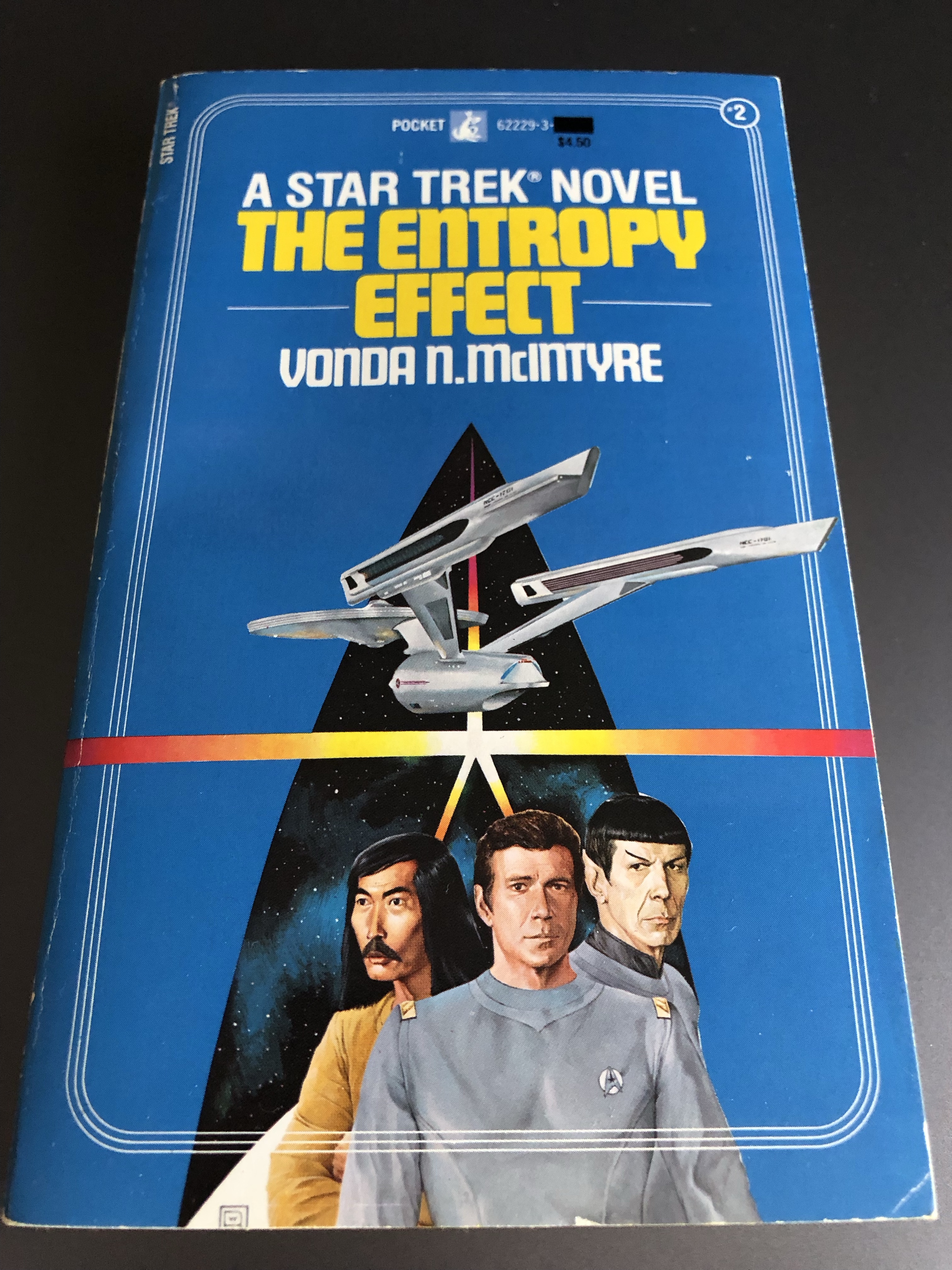
The Entropy Effect

Vonda N McIntyre

Jim Kirk knew that he was going to die, and that Spock would follow him down the accelerating spiral until he had fallen too deep to return. He would willingly choose death to try to save Kirk’s life.
James Kirk, too, had one choice left.
‘Spock…’ he whispered, ‘take good care…of my ship.’
He feared he had waited too long, but that terror gave him the strength he needed. He wrenched away from Spock, breaking their contact, forsaking Spock’s strength and will, and giving himself up alone to agony, despair, and death.”
-The Entropy Effect, Vonda N McIntyre (pp. 83)

Source: Physical copy.

Publisher: Pocket Books

Date of Publication: June 1981.

When a mysterious naked singularity appears and then spreads across a major warp-space lane, the crew of the Enterprise is tasked with maintaining a position perilously close to the anomaly while science officer Spock investigates its origin.  Just as he’s coming to a startling conclusion on the nature of the phenomenon and what it means for the future of the Universe, Enterprise receives orders to divert to mining colony Aleph Prime. Upon arrival, captain Kirk discovers that they’ve been diverted to escort a prisoner to a rehabilitation colony—hardly a good use of Enterprise’s resources.  But this is no ordinary prisoner, rather Spock’s former mentor, Dr. Georges Mordreaux, a brilliant temporal physicist now accused of multiple murder while experimenting with his theorems.  Spock, whose remembrance of Mordreaux is that of a thoroughly ethical and solely theoretical scientist, requests that Enterprise accept the mission, hoping to discover how he came to be accused of murder, and why he’s being transported in such secrecy.  Furthermore, Spock believes Mordreaux might have some insight into the anomaly the Enterprise’ crew has been studying and its significance to their future.

Barely has the Enterprise embarked upon this milk run of a mission when Mordreaux escapes captivity, arriving on the bridge and murdering James T. Kirk in a particularly grisly fashion.  Yet when security personnel search the ship, Mordreaux is found to be right where he’s expected, locked up and seemingly unaware of what has transpired or his role in it.  Spock must then convince both Mordreaux and McCoy to become accomplices in a plan to alter the very fabric of time, in hopes of stopping the murder of James T. Kirk and saving the Universe from the consequences of The Entropy Effect.

***

Nostalgia tends to polish our recollections, especially when those memories are from childhood.  Things you once considered amazing, from a juvenile point of view, tend to lose their lustre in retrospect.  That movie you remembered so fondly is not nearly as good; the novel you thought of as incredibly deep proves to be shallow.  Memory may be faulty, and it can be unwise to revisit it, lest our expectations be dashed. Not so the case with Vonda N. McIntyre’s The Entropy Effect.

While there was an established canon in 1981, Star Trek had yet to bloom into a publishing phenomenon, The Entropy Effect being second in the line of Pocket Star Trek novels.  There were the James Blish tie-ins, various one-offs and logs, but it wasn’t until the Pocket line that I remember the bookshelves being inundated with Trek. Of course, memory is subjective, and since The Entropy Effect is the first book I remember picking up (at the tender age of 9), it’s where my Star Trek novel reading journey began.

McIntyre’s novel was challenging for a youth due to its adult themes, whether it be mild depictions of sexuality or a surprisingly graphic depiction of the murder of James T. Kirk with a terrifyingly insidious weapon.  Whether death, and more specifically people’s reaction to it, or human sexuality and romance—many of the themes depicted were beyond the understanding of my nine-year-old self.  I wanted space battles and Klingons, not explorations of personal grief, or Sulu’s amorous adventures.  Yet as an adult, I appreciate that she was writing to an audience more mature than one might think of being attracted to Star Trek.

Furthermore, it’s refreshing to see the freedom authors had to develop each character before there was an established canon or wealth of secondary source material.  Without a writer’s “bible”, McIntyre was free to play with the backstories of characters, especially contributing to what later became the canon of Hikaru Sulu, providing fans with namely—well—his name.  An abundance of interesting secondary characters (and a healthy description of each) also contributed to the storyline, and McIntyre’s imagination was indeed healthy.

Besides the main characters (given quantities, well established by the tv series), McIntyre introduced several lower deck characters, whose brief descriptions manage to quickly give these REDSHIRTS their own personalities.  There’s Jenniver Aristeides, born of a high gravity planet with the physique to suit, but with the temperament of a botanist. Then there’s Snnanagfashtalli, a sentient panther, and Neon, akin to a miniature Tyrannosaurus Rex, whose language only translates to English as nouns, and whose IQ belies her primitive appearance.  Finally, and most pertinent to the story, is Mandala Flynn, whose story is fleshed out through her relationship with Sulu.  While not a primary character, Mandala Flynn is given enough agency as Enterprise’ security chief—and paramour of Hikaru Sulu—that when we see her in action, and the results of those actions, it’s not just as a throwaway, but rather a fully formed character whose fate has a profound effect on the reader.

The Entropy Effect isn’t just a thrilling addition to the logs of the Enterprise, it’s also a mystery, specifically a locked room mystery, one that McIntyre manages to pull off with intelligence and imagination. Even as a young man, I was a sucker for a mystery.  This mystery will have consequences, not just for the crew of the Enterprise, but for the Universe.

***

Vonda N. McIntyre (1948-2019) was a graduate of the University of Washington, with a Bachelor of Science (Honours) in Biology, and founder of the Clarion West Writer’s Workshop.  She was author of the Hugo and Nebula award winning novel Dreamsnake, and numerous novels within the Star Trek Universe, including several of the Star Trek movie novelizations.
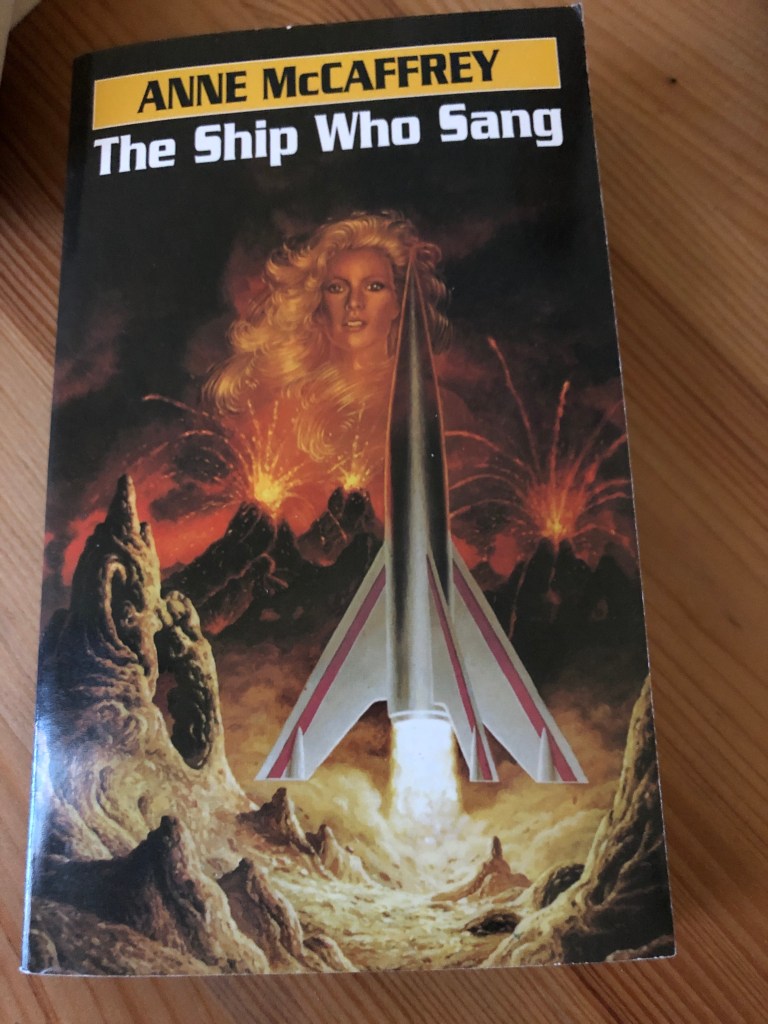
The Ship Who Sang (Review)

The Ship Who Sang: Anne McCaffrey (1969; 248 pages)

2020 was a year even Daniel Defoe would consider rough, so it’s almost a forgone conclusion that 2021 has to be better.  A good start to the year is January’s #VintageScifi Month, as sci-fi bloggers review books that came out prior to their birth year, in my case, 1972. This would also the year to explore the obvious topics—pandemics and viral outbreaks—whether it be on a macro scale, such as in Earth Abides (George R. Stewart: 1949) or a micro scale along the lines of The Andromeda Strain (Michael Chrichton: 1969). If you’re into pop culture and perhaps a bit younger, The Stand (Stephen King: 1978) would be a good pick, or the mostly forgotten but personal favourite of mine, The Last Canadian (William C. Heine:1974). But is this really in the spirit of celebrating a new year and the hope that comes with it? Maybe doom and gloom “pandemic style” is not the way to go, so let’s talk about singing starships instead.

As a corduroy wearing minor, “juveniles” I believe we were called, roaming the school library of a small town in southern Alberta, my sci-fi reading options were limited to various Dr. Who novels, Robert E. Heinlein’s Rocket Ship Galileo and Space Cadet, Carey Rockwell’s Tom Corbett books, and one novel by Anne McCaffrey, The Ship Who Sang.  Pre-teen me walked by the last one many times without pause.  The title just turned me off.  After all, a ship that sang?  Not exactly in line with the exciting exploits of Matt Dodson in the Space Academy or Tom Corbett fighting space pirates. And so it lay, unopened on the shelf.  Many years later, while rectifying deficiencies in my classic science fiction lexicon and seeing McCaffrey’s book still in print, it felt time to overcome my juvenile aversion.

Anne McCaffrey (1926-2011) started her “Brainship” series with a number of short novelettes, eventually collected as The Ship Who Sang (1969), beginning in 1961 with the eponymously titled work.  These novelettes feature Helva, a child born with severe physical deformities yet a remarkable mind, and a society that would euthanize the former unless the child exhibited the latter.  Having been given the choice between the death of their child or a life in service to the Central Worlds, Helva’s parents enrol her in a training program that results in her exceptional brain being encased in a mechanical shell, itself installed in a starship.  Once in place, Helva would act as a central computer, controlling all aspects of the vessel, acting as an emissary of the Central Worlds.  Much like an indentured servant, Helva would labour until she paid off her contract, after which she would be free to become a private contractor.  She would be partnered with a “Brawn”, a scout pilot who would deal with all the mobility aspects of service that she could not. Helva would—in theory—experience near-immortality, able to live far longer than an unaugmented mortal.

During her training, a visitor to the facility once remarked on the beauty of her voice, and later Helva became known as “the ship who sang” when she entertained possible partners, unbonded scouts waiting for a chance to find a ship which will have them.  She finally chooses Jennan, a talented and empathetic scout who appreciates her as an individual, not just a mechanism by which to further his career.  Helva soon finds herself in love, and she and Jennan become a successful pairing, their first mission— the delivery of a vaccine to a plague ravaged planet—a huge success.  Unfortunately, disaster strikes early on in their partnership, and Jennan is killed while attempting to evacuate a colony of reluctant religious zealots from a doomed colony.  With his funeral, she unofficially becomes “the ship who mourned,” and her designation reverts from JH-834 to XH-834.

The Ship Who Mourned (1966) chronicles Helva’s depression after the death of Jennan, and her unwilling partnership with Theoda, a physiotherapist tasked with combating another plague that has ravaged the planet Annigoni IV.  The plague paralyzes its victims, locking them inside their bodies without any ability to communicate.  Theoda is a survivor of the same plague that ravaged her home planet many years earlier, and during the course of investigating ways to help the victims, Helva learns that people can work through their sorrow and carry on in the face of adversity, relying on nothing more than hope.

In The Ship Who Killed (1966) Helva is paired with another female “Brawn”, Kira of Canopus, as they embark upon a mission to “re-seed” a planet whose population was sterilized by a radiation flare.  Her hold filled with embryos stored in miles of tubing and tanks of fluid, their mission is to pick up many more from donated embryo banks and safely transport them to the afflicted populace.  During the course of the mission, Helva and Kira become confidants, and she discovers in Kira’s own story of loss one that rivals her own. Coincidently, Kira also has a love of music, and they spend much of the voyage exploring their shared interest.  The mission takes an odd turn when they receive an unexpected offer of embryos from a remote colony.  Upon arrival, it rapidly becomes clear that things are not as they seem, and Helva finds herself fighting for the life of her friend and her cargo against a death cult with a familiar origin.

Dramatic Mission (1969) takes up the majority of the novel, detailing Helva’s time as part of a troupe of actors, (yep, that’s right) tasked with relating the concept of drama—in the form of enacting plays—in exchange for revolutionary technology from a newly contacted race of sentient beings on Beta Corvi VI. During the mission, Helva and company utilize a “psyche transfer” device to interact with the Corviki—themselves a race of sentient gas clouds.  However, the transfer device has a limitation; the longer one uses it, the more tenuous their connection to their physical body.  Helva is able to use the device too, experiencing a freedom of mobility and sensation for the first time, and also the temptation to stay, to be free of the confines of her starship.  The secondary plot line involves the various personalities of the troupe and how they clash, culminating in a murderous incident.

In The Ship Who Dissembled (1969), Helva finds herself partnered with Teron, a Brawn who on paper seems perfect, but whose didactic nature and lack of intuition aggravates her to no end.  She’s especially irritated because she was warned by Niall Parollan (the obnoxious section supervisor) that Teron would be a terrible fit.  She’s just about ready to call it quits and take the monetary penalty required to have him reassigned when they’re tasked with delivering a precious cargo of rare drugs in an area where four brainships have recently gone missing.  Soon, she and her officious Brawn solve the mystery of the missing brainships, albeit unintentionally, when they themselves are hijacked.  Helva now finds herself disconnected from her ship with no external mobility whatsoever and must outwit these space pirates using only her extraordinary mind and her voice.

Finally, in The Partnered Ship (1969), Helva has paid off her debt to the Central Worlds Brain-Brawn Ship Service and is contemplating her future as a free agent.  No longer limited to the pool of scouts provided by the service, she’s free to chart her own course, and free to choose whomever she wants to partner with.  When she finally decides on a companion, it comes as a surprise to both her and her choice.

***

So, what to say about The Ship Who Sang?  It certainly ranks alongside Heinlein’s juveniles in both quality and imagination, although McCaffrey manages to tell much more than just an adventure novel.  Her inclusion of a disabled character as the lead and the examination of how she interacts with her environs is certainly ambitious, especially for the time.  McCaffrey writes a future that’s structured in a very Golden Age of Sci-Fi way, with its rocket ships and space opera, but she chooses to explore it from the point of view of a character excluded from the traditional tropes of supermen and women conquering the galaxy.  Helva has no advanced abilities beyond her mind, and anything else is the result of the equipment used to assist her in her duties.  Content with her circumstances, given the choice of staying in her shell or transferring her mind to a fully functioning body, she chooses the former, rejecting the idea that she is in any way impeded by her disability.  When asked by Niall Parollan why she gave up the chance to experience physical freedom permanently, she enlightens him:

“Define ‘physical.’  As this ship I have more physical power, more physical freedom, than you will ever know.  I think, I feel, I breathe.  My heart beats, blood does flow through my veins, my lungs do work: not as yours, but they are functioning.”

Rather than feel encumbered by her circumstances, Helva recognizes the vast opportunities that would no longer be available were she to “escape” her disability.

McCaffrey’s world-building is relatively mundane, very pulpy sci-fi, until the reader gets to Dramatic Mission.  It’s the standout story of the novel, describing a society entirely divorced from the human experience.  She crafts a civilization whose inhabitants are essentially big clouds of gas, communicating and emoting through the mediums of size, density, and changes in colour and smell.  The story isn’t nearly as interesting as the way in which it’s conveyed, and the reactions of Helva and her occupants to experiencing life in a way totally alien to the human experience.  The fact that McCaffrey is able to convey it is a tribute to her skill as an author and managed to garner her a Hugo nomination in 1970.

Anne McCaffrey posits a truly scary future where the infirm are euthanized unless they are deemed useful to society, and a society comfortable with indentured servitude.  She makes passing mention of the ethics of such a society, brushing past it very quickly in the first story, and a deeper discussion of the morality of the Central Worlds would have been valuable to the reader.  She does explore Helva’s views of her “disability” and the benefits accrued from her status as a shell person.  The ship acts as a compensatory device not unlike a wheelchair, or hearing aids, etc., a device to be used rather than a prison to be endured.  Throughout the stories Helva acts as an advocate for the disabled, never perceiving her situation as negative and utilizing her attributes to best effect.

Even Niall Corollan is portrayed as someone who has worked hard to overcome their deficiencies.  During the course of her time with the Central Worlds Space Corps, Helva clashes continually with Niall, a man who failed the Brawn program due to his diminutive size but is nevertheless a competent and talented supervisor.  She eventually comes to realize that he is the perfect partner for her, their tempestuous relationship resulting more from his desire to challenge her rather than any actual animosity.  In fact, he’s surly because he’s prevented from partnering with the woman he’s come to love by her contract and his inability to meet some arbitrary physical requirements.  Luckily for both of them, once she’s paid off her contract, she’s free to choose whomever she wants.

The Ship Who Sang definitely is a creature of its time, a time of rocket ships and ray guns, and has aged, not terribly, but like a fond memory of childhood.  The relationship between Helva and Parollan is a bit hokey, as is the musical premise, yet it is also endearing, a worthy representative of vintage science fiction. However, the novel exhibits its greatest value as a starting point in discussions of disability in Science Fiction, and the ethics of any society with regard to its most vulnerable.

Blog note: I’m aware it’s February.