The Court of the Air – Stephen Hunt

CourtOfTheAir“We’re the ghosts in the machine, Oliver, keeping the game straight and hearts pure.  The only thing they know about us is the name Kirkhill gave us – the Court of the Air; the highest bleeding court in the land.”

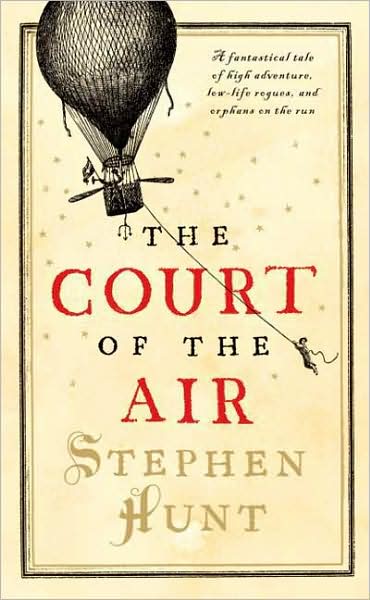
About five years ago, a title leaped out at me from the shelf as I walked through my local bookstore.  The Court of the Air by Stephen Hunt, described on the dust cover as, “A fantastical tale of high adventure, low-life rogues, and orphans on the run.”  Now I’m a sucker for both fantasy and adventure novels, especially those with a historical feel, and a quick read of the synopsis suggested that this novel could be all those things, with the added bonus of being Steampunk.  At the time, I set it back down, thinking to pick it up at a later date–and then promptly forgot it.  Flash forward a year and the same title once again leaped out at me while strolling through another bookshop.  It also leaped out in hardcover for an absolutely reasonable price.  So, I bought it, set it on the shelf with the intent to read, and there it sat until earlier this year.  When I finally got around to reading it, I realized that I’ve been missing out on the Steampunk equivalent of J. R. R. Tolkien or George R.R. Martin.  I also realize that if I missed out on this for six years, you might too, and we can’t have that.

So, synopsis please, and we’ll go from there. 

The Court of the Air is nominally the story of two orphans, one being the foundling Molly Templar, a street urchin left to the care of the Sungate workhouse in Middlesteel, capital of the nation-state of Jackals.  The other, one Oliver Brooks, is also an orphan after an Aerostat crash into the feymist (magical faerie mist is the only way I can describe it) that blankets parts of Jackals killed his parents and left him alone in the world except for his uncle Titus.  Life is hard for both Molly and Oliver.  She goes from job to job, the proceeds confiscated to pay for her care at the workhouse until she comes of age and finds a career, while he is ostracized by the community and forced to register with the worldsingers (a type of magician) every week to prove the latent mystical powers they suspect he has as a result of his time in the feymist have not manifested.  When everyone in Molly’s workhouse is slaughtered by a mysterious assassin, and Oliver’s uncle is murdered in his house and he subsequently framed for the crime, both go on the run and into a series of adventures that will eventually bring them and their stories together—and may possibly rip both the state of Jackals and literally their entire universe apart.  That is, unless they can find a way to stop it.

The Court of the Air is a novel of intrigue within intrigue, with many factions on the trail of the two orphans, some to protect them, others to stop them from fulfilling a destiny they aren’t even aware of.  It’s also a masterful blend of both Steampunk and something somewhat unique to the genre.  Sure, it was quite obvious in the opening pages that there would be the traditional Steampunk fare: Autonomous Steam Men, Aerostats (also known as Zeppelins), Pneumatic Buildings and Subterranean Cities, but what piqued my interest was the addition of magic.  Elements such as the Feymist (faerie) creatures, the Special Guard (those augmented by their exposure to the world beyond), Worldsingers (magicians who utilize the power of the earth in their arts), even the militia’s muskets relying on crystals grown for use as a sort of magical gunpowder, all add a mystical element to a genre that (I think) is not generally known for it.

I would be remiss at this point not to mention the Court of the Air itself, an organization whose existence is whispered amongst the people but rarely seen.  A shadowy league, influencing significant events from behind the scenes for their own altruistic–or nefarious–purposes.  A cabal to whose attention Oliver and Molly have unwittingly come.  

There are times in which The Court of the Air can be a tricky read.  Stephen Hunt has managed to create a universe with its own particular accent, especially with regards to the language.  The novel is chock full of Jackelian slang.  As an example, Crushers are police, Wordsingers are magicians, even the honorifics mister and missus become Samson and Damson.  Many times while reading The Court of the Air, I wished for a dictionary of Jackelian vernacular, but much like a Dickens novel, you get used to it, and it gives the novel a particularly strong air of authenticity.  Speaking of Charles Dickens, Hunt’s work has much the same feel, writing of orphans and workhouses, characters with a hidden destiny, a gentrified society of haves and have-nots, and all wrapped in wonderful prose of a decidedly Victorian flavor.

Hunt’s Universe is also very obviously a blending of English history and Steampunk fantasy, what with the Kingdom of Jackals being nominally a constitutional monarchy that has neutered the power of the King after a conflict reminiscent of the English Civil War.  Even the troops carry weapons that nod to their historical counterparts.  The New Pattern Army of Jackals recycles a variation of Oliver Cromwell’s New Model Army, and its soldiers are loaded out with a musket called the Brown Jane, recalling the real life Brown Bess.  Calling the militia Redcoats simply completes the picture.  However, the automaton Kingdom of Mechancia and the evil shadows of the Wildcaotyl bring both a Steampunk and fantastical element to Jackals history.

Even the political ideologies of the major factions are patterned on historical examples.  Jackals is a social democracy where parliament rules with a king as figurehead only, while their enemy, the Commonshare of Quartershift is an obvious allusion to both the former Soviet Union and the ideology of Communism.  Within Jackals itself, there is a debate between the accepted state of society and the criminalized works of Benjamin Carl, a Marx-like figure whose treatise, “Community and the Commons,” sparked a failed revolution years earlier. 

This spectacular novel does take a while to become fully immersed in, what with the learning curve of both the colloquial slang and the sheer size of Hunt’s universe. In the final analysis, The Court of the Air is a novel that you don’t so much read as you do explore.  And that makes for a wonderful novel that deserves to be the standard to which other Steampunk novels be compared. 


A++

The Buntline Special–Mike Resnick

The Good, the Bad, and the Undead

“A lot of people think Ringo’s the best,” said Holliday.  “And if you’re going to be the best, you have to beat the best.”

“Think of the damage you two could do to the Cowboys if you were on the same side.”

“We would never be on the same side.  Sooner or later we’d have to meet out in the street.”

“Even though he’s a zombie?”

Mike Resnick’s The Buntline Special introduces us to a world in which the U.S. government (circa 1881) has contracted Thomas Edison to utilize his talent for invention in what would today be called a “Cold War” with the Indian nations over the future of the United States.  In pursuit of this goal, Thomas and his good friend Ned Buntline (who, in this universe is an engineer rather than a dime novelist) are tasked to discover a remedy to the magic of medicine men such as Geronimo that has thus far stymied government efforts to realize their manifest destiny of creating a nation that stretches from sea to sea.

However, the native medicine men are fully aware of their efforts, employing a number of assassins to take Edison (Buntline may be a wonderful engineer, but lacks Edison’s talent for invention) out of the picture.  To protect their interest, the government has employed the Earp Brothers (Wyatt, Virgil and Morgan), and they in turn have called upon the special talents of both Bat Masterson and a consumptive, yet lethally effective, Doc Holliday.

Based in the town of Tombstone, itself on the edge of “Indian Territory”, Buntline and Edison have brought electric light to the city and the horseless stagecoach to the region.  Armored against Indian attacks by Buntline’s signature invention (bullet proof brass of all things), the Buntline Express has severely dented the local horse trade (both honest and illegal) and gained him the wrath of the Clanton-McLaury gang.  Since Edison and Buntline have a synergistic relationship, the Earps find themselves tasked with protecting these two amazing minds from the magical forces of Geronimo and the more pedestrian efforts of the Clanton gang.

During the course of their investigation as to which medicine man is targeting Edison (the original consensus is Geronimo), Bat Masterson runs afoul of the native warrior and finds himself on the receiving end of a particularly nasty curse.  By day, he is a man; by night—a man sized bat.  Meanwhile, Holliday finds himself stalked by Johnny Ringo, the gunslinger hired to kill Edison—and possibly Doc’s equal with a pistol.  Ringo’s also been dead for awhile, so good luck killing him.

Told from the viewpoint of Doc Holliday, The Buntline Special finds its strength in the dialogue, specifically in Doc’s quick wit and devil may care attitude.  It’s quite easy to become immersed in the Steampunk Universe Resnick has created, mainly due to the affinity one feels for Doc.  Here’s a man who lives every day as if it were his last, in a world where magic and science duel for supremacy, yet unable to avail himself of either.  He’s just as dead as Johnny Ringo, it being a matter of time before consumption gets the better of him, and that leads to a fatalistic honesty in his everyday dealings.  Of course, he’s not quite DEAD dead, and still has to deal with the aforementioned revenant.  How does one kill a man who’s already dead?  The answer lies with the Buntline Special.Buntline special

Now this isn’t the foot long version of the Colt Peacemaker made famous by the real Ned Buntline.  Remember, this is a Steampunk novel.  Therein lies the magic—or fantastical science—which makes this first of the Weird West Tales such a delight to read.  If anything detracts from the story, it’s the fact that while Resnick does take liberties, The Buntline Special still plays along the same lines as the real history of Wyatt Earp.  Morgan still gets killed. There’s still the shootout at the O.K. Corral.  Pretty much everything that took place in real life is covered, leading the reader who knows their history to be able to predict what’s going to happen.  However, while those things are necessary to maintain some semblance of continuity, it’s the masterful blending of history and fantasy that keeps you reading to the end.  For the hardcore Steampunk fan, this novel is a straight shooter.

B+

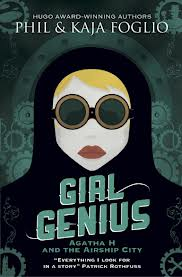
Girl Genius: Agatha H and the Clockwork Princess–Phil and Kaja Foglio

GirlGenius2“It’s ‘over.'” She snorted. “You speak like a child.  The Baron’s people will be back, or if not, there will be others like them.  You must be ready!”

Agatha looked at her angrily. “What makes you say that?  It’s a perfect plan.  They think I’m dead!”

“There is a serious flaw in this ‘perfect’ plan of yours…you’re not really dead now, are you?”

Beginning shortly after the events of Girl Genius: Agatha H and the Airship City, Girl Genius: Agatha H and the Clockwork Princess chronicles the story of our titular heroine, Agatha Heterodyne, and her feline familiar Krosp 1, (Emperor of Cats) Krosp1as they flee the forces of Baron Klaus Wulfenbach across the Wastelands of Europa. The Baron, essentially Emperor of Europa, has quite the history with the Heterodyne brothers and wants to keep any offspring of his former rivals under his thumb.  Agatha is also fleeing the attentions of the Baron’s heir apparent, Gilgamesh, who is not only the son of her nemesis, but a possible suitor.  Having recently learned she is heir to the Heterodyne dynasty, Agatha is headed for Mechanicsburg, the ancestral home of the Heterodynes, in hopes of finding answers regarding the disappearance of her parents and uncle.

The land across which she is fleeing is called the Wastelands for a reason.  A hazardous place, it’s full of nasty surprises, the result of various experiments and previous wars by some of Europa’s most gifted—and craziest—Sparks.  Abandoned—but otherwise functional and deadly—war machines roam the forests, as do various unnatural creatures, hiding in wait to scoop up the wayward traveller as a snack.  Anyone traversing the Wastelands spends most of their time fighting off the various dangers along the way.  Owing to a bit of luck, Agatha and Krosp come across Master Payne’s Circus of Adventure, a travelling road show of various performers and artisans, plying their trade from city to city and banding together for safety while on the road.  Realizing that a Circus would be a good way to keep both her anonymity and security, Krosp and Agatha join the circus after proving their worth, Agatha, by virtue of her natural affinity for all things mechanical—she is a Spark, after all—and Krosp by merely being a talking cat.

Within the travelling circus, they soon meet a series of interesting characters, such as the vain and talented actress Pym; Abner, Pym’s paramour and right hand man to Master Payne; and Lars, circus hand, reluctant hero, and possible love interest.  Agatha also meets the dour and decidedly dangerous Zeetha, a warrior princess of the lost city of Skifander, and soon is taken under her wing to learn the warrior skills she never needed while working in a lab, but definitely does in the real world.

There’s still the problem of Gilgamesh’s pursuit, but the members of Master Payne’s Circus of Adventure are nothing if not inventive, and masters of misdirection.  One faked death later, and Agatha is out from under the scrutiny of the Wulfenbachs.  During the course of their journey, Agatha manages to gather a following in the form of three Jagermonsters, sworn protectors of the family Heterodyne.  Jagermonsters are Hyde like creatures—formerly human—who use their superior strength and martial prowess to keep their lady from harm.  They’ve also been looking for the Heterodyne heir for the past ten years, and when they find Agatha, become her self-proclaimed heroes.

Agatha also proves herself to be a natural actress, playing the role of Lucrexia Mongfish (Bill Heterodyne’s wife) in many of the Heterodyne Brothers plays put on by the roadshow to entertain locals in the various cities they travel through. Luckily, a lot, if not all, of their plays revolve around the Heterodyne brothers and their various quests to save the townsfolk of the realm from unhinged Sparks and their nefarious creations. Unbeknownst to the other players, Agatha is the long lost daughter of Lucrexia, making her acting all the more believable.

The story comes to a head with the arrival of the circus at the stronghold of Sturmhalten, the ancestral home of the Sturmvaraus family.  The present rulers of Sturmhalten, Tarvek and Anevka—the titular Clockwork Princess–recognize the potential in Agatha to further their own dark designs, and take Agatha captive at the first opportunity.  From there, it’s up to Krosp and the members of Master Payne’s Circus of Adventure to rescue Agatha—before the forces of Baron Wulfenbach descend upon Sturmhalten and take her back into custody—and before Agatha succumbs to the will of the most malevolent being to have ever threatened the people of Europa—a.k.a. THE OTHER.

ggGirl Genius: Agatha H and the Clockwork Princess reads much like an old-time serial, those weekly installments of great classics like Flash Gordon one might see at the theatre week by week.  Understandably so, since Girl Genius is based on the serialized web comic by Phil and Kaja Foglio.  It’s extremely entertaining to be able to flip back and forth between comic and book to compare one’s inner conception of the various characters with the author’s own visuals.  This sequel also helps to flesh out a bit of the back story behind the events of the first novel.  However, it is useful to have the Girl Genius Wiki on hand, as the sheer number of characters can make for confusion.

With this second volume, we also discover some interesting aspects of the Heterodyne family—namely that until Bill and Barry changed their image, the Heterodynes were feared throughout the realm and generally regarded as the worst of a bad bunch.  Hence the instinctual fear everyone seems to have when confronted with the terrifying visage that is your average Jagermonster.  (Note to readers: Jagermonsters are my favourite!)

One notable aspect of both Girl Genius novels is the demonstration of a number of strong female characters, ranging from Agatha herself, a young lady plunged into a situation in which she has to rely on her natural talents, to Zeetha, the lonely, yet dangerous warrior woman, and extending to some of the more villainous characters.  Even the OTHER, the epitome of villainy in this Steampunk world–is a female.

There’s also a strong comedic element to the story, usually embodied in Agatha and her reactions to new experiences, or the comedic relief of her feline familiar.  Sometimes bawdy, sometimes slapstick, there is generally a lot of humour to counterbalance the darker aspects of the characters experiences as they move through a world that hides danger around every corner.

The biggest drawback to this novel is that it’s so very, very, looooooooonnnngggg!  Granted, Girl Genius is translated to print from the web comic and comic story arcs can last for years, but at 590 pages, the novel could be a strain on the attention spans of younger readers.  Honestly, this novel wouldn’t suffer a bit if they had cut out a hundred pages (at least), and I wonder if their intended target audience–bear with me, I’m assuming young teens–would be willing to invest so much of their time. The Foglio’s previous novel topped out at a more manageable 300 or so pages.

Agatha H and the Clockwork Princess is a lot of fun, although it seemed to take forever to get through.  The payoff is well worth it though, and I do hope to see further print installments of the series.  That, I imagine, will depend on how well the first two books of the series sell.  Agatha’s story has barely begun—and I know I’d like to read the rest of it.

Cadaver In Chief–Steve Hockensmith

Cadaver In Chief

“Hello,” Woods said as she walked to her car.  “Hello.  Hello.  Hello.  Hello.  Hello.”  She said, “Hello” to everyone she passed, and they all said “Hello” to her.  Anyone who didn’t say “Hello” would get looked at pretty hard.  Maybe even shot. 

The end times were hell on shy people.

The end times were also pretty much hell on the newspaper industry.  Already under siege by the rise of on-line media, the zombie apocalypse put the last coffin nail in a dying industry.  After all, if people were taking their lives in their hands every time they left the house for work, they certainly wouldn’t want to venture out in search of a People magazine or their favourite daily.  Besides—all the paperboys were dead.

Jan Woods, reporter for the Washington Tribute, is winding down her last couple of days before retirement, reporting puff pieces on dog grooming that no one is likely to read.  She’s going through the motions: research story…shoot a zombie…write the story…run down a zombie with her car…etc. etc. Just another day in the big city.  However, when that city is Washington, from time to time one must forget about the mindless undead and write about the brainless living.  Send in the politicians!

As it so happens, Jan’s editor has an interesting story for her to pursue. A nasty rumour has surfaced online, “Nasty” being the term used these days to describe the walking dead.  Nasty, as in the President’s been dead for a while, but he’s still walking around, glad-handing and kissing babies (nasty!) and all the assorted duties of the commander in chief.  Or, Cadaver in Chief, if the rumours are true.

Not since Watergate had such a juicy tip fallen into the hands of a Washington reporter, crazy though it sounds.  If the president is really a former president, a “ManChompian” candidate of sorts, then it’s a conspiracy that reaches to the highest level of government, and Jan’s got herself a scoop that could end her career on a high note.  However, if the plot goes as deep as that, Jan’s got a scoop that could end her—permanently.

There is a bit of a snag—the juicy tip comes from one Rick Klinger, on-line conspiracy freak and blogger for Truthbuffet.org, a left wing “political” site akin to the Huffington Post.  Known as a bit of a loon, Klinger (who bears a striking resemblance to the odious Alex Jones—minus the obvious psychopathy) has a source within the Republican administration that claims President Brick Bradley died months earlier during a political fundraiser and the man making the rounds is actually an imposter.  However, Klinger is also a paranoid loon (again, Alex Jones) and won’t divulge his source for Jan to check out. As for her queries to the White House:

“Quote: The President is alive and well and you’re an idiot and don’t call here again. Unquote.”

Jan is nothing if not persistent, and during the course of the next several days investigates the hotel (and morgue) where the president was rumoured to have died. Next thing you know, there’s a parcel in her apartment, containing a dwarf zombie with a huge appetite.  He’s also got an explosive personality.  Maybe there is something to the rumours after all?

From there it’s an action packed adventure through Washington and its surroundings as Jan searches for answers while avoiding the attentions of mysterious government operatives and having conversations in dark parking lots with the likes of, “Debbie Does Dallas”, the “Deep Throat” of this decidedly anti-first amendment administration and their zombie minions.  Luckily, Jan is very pro-second amendment (who wouldn’t be in a world where take out dinner describes what might happen to you?) and has gotten pretty good with that hot pink Uzi she got at 7-11.  The story climaxes with a literal assault on the first amendment as Jan and her coworkers fight for their lives in the offices of the Washington Tribune, and shortly thereafter, a reelection rally that no one would forget—if they survive it.

Cadaver in Chief is a tongue in cheek political mystery that pays homage to movies like The Manchurian Candidate and All the Presidents Men—with zombies.  It’s also a nice little novella.  However, if there’s any problem with this mini-novel, it’s that it could use a little fleshing out.  Steve Hockensmith creates an interesting mystery full of government operatives and smarmy politicians, political apathy and conspiracy nuts (who may not be so nutty) and the type of experiments that might get a scientist branded “mad”,  but ten chapters is barely enough space to scratch the surface.  By the end of the novella, I felt a bit—unsatisfied.  Don’t get me wrong, it’s not because the story was lacking, rather that it lacked a bit of story.  Or, to put it another way—this novella screams for a sequel.

As for the main character, Jan Woods may be the stereotypically “plucky” reporter, but she’s also days away from retirement, much like “that cop” in any police procedural, and it’s refreshing to see a character who’s not a young, perky blonde with crazy computer skills and a body to die for.  Nor is she the grizzled Ed Asner type, simply a good reporter who’s become slightly apathetic in an age where no one respects her medium (newsprint) yet still wants to get the truth out there.

Of course, good dialogue is something I’ve always appreciated in a novel, and it’s something Steve Hockensmith excels at.  Granted, in real life not everyone is witty or wittily sarcastic (although they might like to think so), but, as I’ve said before–smart, funny dialogue is a defining feature of his previous novels.

I was a little worried at times that this was simply going to be a put-down of conservative (read that as Republican) politicians, but as time went on, the satiric vitriol came down pretty much equally on both sides of the aisle.  If there’s one thing that crosses party lines, it’s the capacity of politicians to set themselves up for ridicule.

Overall, Cadaver in Chief is a bit of zombie fun that partisans of both liberal and conservative bent can sink their teeth into.

B

(A word of apology to Steve Hockensmith: He was gracious enough to send me a preview copy of Cadaver in Chief back in November and grant me an interview, yet it’s taken until now for me to get a review together.  I’ve no readily available excuse except to claim a bit of “zombie fatigue” which has resulted in the delay.  Steve Hockensmith is a great writer and a good guy, and if you’d like to learn more about his works and process, he maintains a blog at http://www.stevehockensmith.com)

John Dies at the End apparently doesn’t translate well.

Johndiesattheend2

A while back I wrote a review of John Dies at the End, a book which I absolutely loved.  Shortly thereafter, it was optioned for film and Don Coscarelli (of Phantasm fame) attached as director.  I’ve always thought Phantasm was a pretty mixed up film, and John Dies at the End is a pretty mixed up book, so with fingers crossed I eagerly awaited a decent translation from book to screen.

Well, according to my buddy over at The Switz, it looks like I’ll have to keep waiting. 

Mogworld-Yahtzee Croshaw

mogworld

“Me, I’m just here for a nice clean death, and Dub said he can give me one.  I don’t care who ends up running the world.  I just want it to stop being my problem.” ~Jim Bottomroach.

Life was so much simpler for Jim Bottomroach when he was dead.  Being undead, now that was a trick.  Killed during a skirmish between St. Gordon’s Magical College and the warrior schools of Stragonoff over a mystical stone that doesn’t exist, Jim was quite satisfied to join the stone in its nonexistence.  His two years of magical college hadn’t amounted to much.  Learning just three spells, the most useful—and by extension most entertaining—being one that would turn a rival into a rabbit (momentarily).  Just that would be enough to turn anyone off the magic business.  Jim had begun to seriously regret his career choice in the moments before a training war hammer knocked his soul right out of his body.

And that’s where it should have ended, all bright light and life reflection and then nothing.

However, things never turn out how they should, as Jim quickly learns (well, okay, 60 years later is not all that quick) when he’s resurrected by the necromancer Dreadgrave, who seeks to create an undead army to pillage the land around his impenetrable “Doom Fortress”.  Jim is quickly impressed into this undead army of the unwilling and put in charge of the rat pit, a rather unsavory fate–or savory, from the rat’s point of view–for any adventurers caught raiding Dreadgrave’s (impenetrable?) compound.  Distraught at his fate, Jim promptly jumps from the first tower he can climb.

Imagine his surprise to find that yes, he can die again, but no, it just won’t take.  Sure, his body is in worse shape, an eyeball here, a lung over there, but his consciousness is as intact as his body isn’t.  From then on, Jim’s goal is to search for a permanent means of death.  In the meantime, unlife goes on, until that fateful day a horde of angels descend from the sky and delete the Doom Fortress, Dreadgrave and all, yet somehow missing Jim and two others.  Meryl is an overly earnest young woman (she’s been dead as long as Jim, but she died young) and Thaddeus is a religious zealot who considers himself and the others to be a blasphemy against God.

It’s no small irony that only when they’ve stopped running and have a moment to think, Jim realizes his missed opportunity to end it all.  During the course of their flight, Jim discovers that while he returns to his body in a slightly more damaged state, for the past fifteen years, anyone else who dies is resurrected in a new body, a phenomenon people have come to call “The Infusion.”  Nobody dies permanently, not people, not cows, not blades of grass.  However, no births occur either.  So life goes on, perpetually and death doesn’t have the cache it used to.  Especially when you’re not granted a new body, and technically aren’t alive.

But fate isn’t done kicking Jim and his cohorts around just yet.  There’s a new Vicar in town, name of Barry, and he’s been endowed with almost God-like powers by the great God Si-Mon.  He’s also got it in his mind that Jim and his fellow undead are an aberration that Si-Mon requires be deleted to make the world right again.  At this point, Jim realizes that he’s not just fleeing aimlessly; he’s on a quest.  Defeat Barry and the great God Si-Mon by restoring the laws of nature, and by extension, find a way to die permanently.

Jim is helped along the way by a rogue adventurer/dolt by the name of Slippery John, who suggests his best bet to correct the natural order lies with the Magic Resistance, a group of sorcerers whose motivations parallel his own.  Especially the necromancers, who are finding it hard to get good help when no one stays dead.  Slippery John has his own motivation for tagging along, namely to find a cure for his beloved Drylda, who’s suffering from a malady known as the “Syndrome.”  The Syndrome only seems to attack adventurers, causing them to strike heroic poses and become obsessed with completing quests, right up until they become catatonic.  However, some might say Drylda’s catatonic state explains Slippery John’s “date rapey” interest in her.  So, add finding a cure for the Syndrome to Jim’s to-do list.

As a final obstacle to their quest, the adventurer’s guild has sicced a pair of stone cold murderers on their trail to find the Magic Resistance and stop their efforts.  Questing is good business, after all. Summing it up, Jim simply has to find the Magical Resistance, enlist them to help him change the laws of nature while dodging the attentions of the Adventurer’s Guild and simultaneously find a cure for the Syndrome.  If he weren’t already dead, I’m sure Jim would wish he was.

One other thing—every time Jim dies, he sees words in the air, disturbing words that make him question existence, or what he thinks it is.  Once he finally realizes what’s going on, what existence really is, that’s when the book really pays off.  It’s also a spoiler I’m not willing to reveal.  You’ll figure it out, especially if you figure out what MOGWORLD really means.

Reading MOGWORLD, I’m reminded of Tom Holt, Christopher Moore, Robert Asprin or maybe A. Lee Martinez, all authors who’ve put their stamp on the genre of comedic fantasyMogworld has the same quirky sense of humour and horror I found while reading any of the above authors, but especially Tom Holt, an author for whom reality is usually just a mask disguising what’s really going on.  Both hilarious and touching, Jim’s exploits to become “just” dead reveal a character that’s not nearly as nihilistic as he’d like you to think.

Just look at how he interacts with his fellow travellers.  Jim’s outward disdain for Meryl cannot mask his concern for her well-being.  Given several chances to leave her to her fate, he never actually does.  Time and again he suggests Thaddeus lay off all the “smite this” and “aberration that” but never kicks the former minister out of the party. Drylda and Slippery John really aren’t his problem, nor is finding a solution to the Infusion when he can simply let Barry delete him, but his desire to die permanently is always put behind the welfare of the world.  Jim chooses time and again to dodge the death he claims to welcome in his quest to fix the world.

Yahtzee Croshaw’s debut novel is hilariously entertaining.  I went into it thinking it was just going to be an interesting take on the sword and sorcery genre, focusing on a character that generally doesn’t get the limelight, just like Star Trek’s redshirts, or any super villain’s henchmen. You won’t be disappointed, especially if you’re a fan of the underdog, or find yourself rooting for the zombies at the movies.  If you’ve ever spent hours down at the arcade playing Gauntlet or long nights of misspent youth at D & D sleepovers, then this novel is for you.  If not, well, it’s still for you, because it’s a delightful look at the henchmen whose job it is to make the heroes look good.

As Jim put it himself, he doesn’t want to be a hero, just a protagonist.

A++

Alex Grecian’s The Yard has my attention

The Yard

Anyone who knows me and my book habits will know that I’m a sucker for anything “Holmesian,” and frankly, anything to do with Scotland Yard has the same effect. I’ve always had a soft spot for the beleaguered Inspector Lestrade and his fellow colleagues, especially those of the Murder Squad.  Imagine my excitement then while browsing at my favourite discount book store and coming across a hardback copy of Alex Grecian’s  The Yard

The Yard chronicles the life of inspector Walter Day, newly inducted into Scotland Yard’s Murder Squad just a year after their failure to apprehend “Saucy Jack”–a.k.a. “Jack the Ripper.”  At a time when morale is down, he has the unfortunate luck to be assigned to solve the case of a body dumped at a local railway station.  The body of a fellow Murder Squad detective.

A Victorian murder mystery involving Scotland Yard solving the murder of one of their own?  Sign me up!

A brief look at Alex Grecian’s website elicited a fair bit of excitement on my part. Firstly, The Yard is intended to be the debut of a larger series.  Secondly, the sequel, The Black Country, is scheduled to be released in hardback on May 21st.  And thirdly–The Yard has its own book trailer:

Review to follow…

Girl Genius: Agatha H and the Airship City–Phil and Kaja Foglio

Girl Genius

“But I don’t have the Spark. I seem to have the opposite.  Nothing I build even works.”

Krosp sighed in exasperation. “What do you think you DO at night?”

Agatha looked wary. “I don’t know. I’m asleep.  What do I do at night?”

‘You build things.”

“But there’s never anything there when I wake up.”

Krosp folded his arms.  “”They always run away.”

Agatha Clay (or is it “H”?) is a frustrated teenager. Essentially an orphan, she lives in the care of Adam and Lilith, friends of the family who promised her uncle years before that they would care for her while he was away. It’s been eleven years and counting.  They’re also “constructs”, the result of some mad scientist (and there are many in Europa) finding a needle and thread and some body parts to stitch together.  A student at the Transylvania Polygnostic University, Agatha works as a lab assistant to the Tyrant of Beetleburg, the aptly named Dr. Beetle.  Yet try as she might, none of her experiments ever work out.  Create a clank (mechanical construct) and it falls to pieces within a few steps.  Try to apply her mind to a problem; the result is splitting headaches.  In a world lit by Sparks–I’ll get to that in a minute–Agatha’s light is much diminished.

It’s especially hard to shine in a time when those that have an almost magical ability to wield science–the aforementioned “Sparks,” create a multitude of wonderful, and sometimes dangerous, constructs.  When the construct is flesh and blood, you end up with her ersatz parents, or the monster soldiers (Jagermonsters) that patrol the streets of Europa.   When it’s mechanical, you end up with Mr. Tock, the giant clank that guards the front gate of the University.  Agatha yearns to fulfill her potential, but fails miserably every time.

A brief word about Sparks: generally, their talent for all things scientific manifests itself at puberty and can be quite disconcerting.  Some go crazy.  Others are just a bit odd, hence the moniker “Madboys” that gets tossed around in any discussion of a Spark.  Being a Spark is a dual edged sword.  They are generally capable of great accomplishments; however, those accomplishments more often than not wind up killing them.

On her way to school one morning, Agatha is waylaid by a couple of destitute soldiers, one of which steals her necklace.  The locket attached is irreplaceable, containing the only picture of her parents she has.  Late to the lab and rightly upset, she discovers that the Tyrant’s Tyrant, Baron Klaus Wulfenbach, has made a surprise visit to the university, bringing with him a cadre of soldiers and a righteous anger.  Years before, a villain known as “The Other” terrorized Europa, wiping out various members of the Spark gentry and enslaving their subjects before disappearing around the same time as the legendary Heterodyne Brothers, two Sparks famed for their ability to take care of just that sort of problem.  The means by which the Other subjugated the people were known as Slaver Wasps, mechanical insects that sprang from Hive Engines to either kill or enslave the populace.  Dr. Beetle has managed to find a dormant hive and in a moment of incredibly bad judgment, tried to keep knowledge of it from Wulfenbach.  Next you know, Dr. Beetle is dead, the town is occupied by the Baron’s troops, and Agatha has been dismissed from the university.

Distraught after this series of unfortunate events, Agatha retreats back to her foster parents and retires for the night. She’s always been a restless sleeper, dreaming of all the things she wants to build.  The next morning Agatha wakes to find that a clank the size of a steam tractor—perhaps formerly the steam tractor Adam was overhauling–has rampaged through town and brought both the Baron and his son Gil–accompanied by a mob of Jagermonsters–to her doorstep.  Even worse, one of the thieving soldiers has dropped by, wanting to know why his brother died after handling her locket for less than a day.  As for the Baron, he’s excited at the prospect of harnessing the power of a new Spark, and before anything can be sorted out, both Agatha and the soldier have been gassed and whisked away to the Baron’s stronghold.

When Agatha awakes, she’s informed by Moloch (the soldier) that they’re hostages on the Baron’s Airship City, and that Wulfenbach has mistaken Moloch for a nascent Spark.  Moloch knows the truth of Agatha’s abilities and needs her to play the role of his assistant while they find a way to escape.  As for Agatha, she’s beginning to realize she can create things that actually work, that the headaches accompanying her attempts at concentration have disappeared, and that she’s in a lot of trouble.

Gilgamesh Wulfenbach, heir apparent to his father’s tyranny, has taken notice of her.

From there it’s one adventure after another as Agatha explores the floating city, meeting its many denizens, malevolent and benevolent alike, trying to keep her secret from the Baron while looking for a way to escape his clutches.  Luckily, Gil seems a bit smitten with her and wants to encourage her development, even if it’s just to spite his father.

***

I’ll grant this description doesn’t live up to the contents of Girl Genius: Agatha H and the Airship City, but it’s a daunting book to describe.  I’ve omitted a lot in my brief synopsis because there’s simply so much going on that it’s impossible to encapsulate everything in a few paragraphs.  Luckily, there’s a Girl Genius Wiki online to keep everything straight.

Clearly a Steampunk novel with great aspirations, Girl Genius is based on the Web comic of the same name by Phil and Kaja Foglio.  When first sitting down to read it, I worried that Girl Genius was going to be a  Harry Potter knock off, what with the main character being a student at a school for gifted children in a land divided into those who are normal and those who possess a special talent, this time an innate talent for science rather than magic.  However, aside from the fact that she’s a university student and that magic has been replaced by science, there are very few similarities between the two novels.

Actually, that’s both true and untrue.  The more I think of the Other who disappeared years ago after wreaking havoc on the realm, the more I see the comparison to Voldemort of the Potter series.  However, the story of a girl taken from her home and plunged into a strange and wondrous world begs comparison to Baum’s Dorothy and the Wizard of Oz, although in this case, the world seems filled with tin men.  Once I got beyond the inevitable comparisons, I was able to sit back and enjoy a thoroughly entertaining tale.  The Foglio’s have done a bang up job of creating their own Steampunk universe and inhabiting it with various interesting and unique characters.  My personal favourites were the Jagermonsters, an army of Hydes (of the Dr. Jekyll variety).  Ferocious and intimidating, they are also endowed with a certain childlike charm.  They also add a nice bit of comic relief, even in situations that wouldn’t normally seem to warrant humour.

Is this a young adult novel?  That’s a hard question to answer, as some of the scenes are (from the perspective of this forty year old) somewhat racy, although there’s really no more hanky-panky than a stolen kiss.  It’s definitely not limited to teens, being a fun filled romp for anyone with a predilection towards the Steampunk genre.

Fair warning: Agatha H and the Airship City is certainly not meant to be a self-contained novel.  Rather, it’s more of a prologue to a larger story, introducing the main characters and the world they inhabit without resolving the greater issues introduced.  Where are Agatha’s parents?  What of the legendary Heterodyne brothers and the mysterious Other that once terrorized the realm?  Why are the Jagermonsters so obviously smitten with Agatha?  Why does Agatha seem to be so important to everyone around her?  These are a few of the questions that will hopefully be addressed in the sequel: Agatha H and the Clockwork Princess.  This teaser novel has definitely got me hooked.

B+

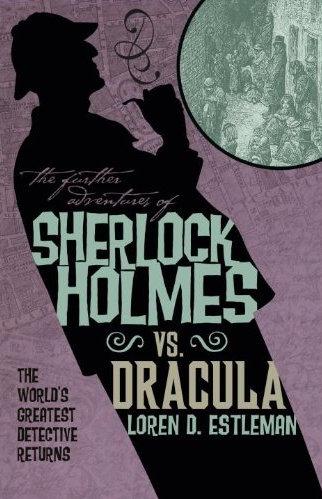
Sherlock Holmes vs. Dracula–Loren D. Estleman

sherlockdracula

“Who is Count Dracula,” he intoned, frowning.  “As well may you ask me who is Lucifer, for the two have much in common.  Perhaps I should begin by telling you who was Count Dracula, and by this means prepare you for the odds we face in dealing with who he is.”~Abraham Van Helsing.

Over the past few years, Titan Books has published a series of Sherlock Holmes pastiches by various authors placing Sherlock Holmes and his stalwart companion Watson in a series of unique situations.  Many involve the good detective interacting with other famous characters of literary and historical fame such as the fictional Dr. Jekyll or the real life serial killer, Jack the Ripper.  Loren D. Estlemen decided to pit Holmes and Watson against one of the literary greats of the 19th century, a character whose influence on the genre of horror may even eclipse Holmes’ influence on the modern mystery.  Who could provide Holmes an opponent of the same intellectual caliber as Moriarty, and yet add a taste of gothic horror to the milieu?

Dracula—Count Dracula.

Sherlock Holmes vs. Dracula may seem an odd addition to the mythos, yet Watson admitted on several occasions that the Sherlock Holmes case files were far from complete–some redacted due to their less than interesting nature, but others—perhaps because they would be unbelievable or distressing to the general public?

Sherlock Holmes vs. Dracula (a. k. a. the Adventure of the Sanguinary Count) begins with Dr. John Watson’s admission that he wrote the tale to “set the reader straight” about the events described in Bram Stoker’s Dracula.  Watson is somewhat miffed by the exclusion of his and Sherlock’s involvement in the investigation of the wreck of the Demeter and subsequent events leading to the Count’s demise.  Why he stored it away instead of publishing is left to the reader’s imagination.

The novel begins with the arrival of a reporter on Holmes’ doorstep, entreating him to come down to Whitby and investigate the wreck of the Russian clipper Demeter, which sailed into harbor the night before and mysteriously ran aground.  Onboard, coast guard officials discovered the crew missing, save the corpse of the captain, tied to the wheel with a crucifix in his hand.  Upon further examination, the corpse was found to be exsanguinated, bearing two fang marks upon the neck and a look of absolute horror on his face.  Sherlock (and Watson) quickly make their way to Whitby and are allowed to board the wreck.  Once he makes his rounds of the deck and hold, Sherlock discovers clues that suggest to him that each member of the crew was killed in a similar manner and then thrown overboard by a being of extraordinary strength.

At this point the investigation is suddenly halted when officials discover the ship’s log and judge it “obvious” that the first mate was deranged and responsible for the murder of the entire crew.  On the basis of his initial observations–and his own examination of the log–Holmes finds this explanation ludicrous.  Clearly there has been a cover up, but without the chance to further inspect the ship or her cargo, he realizes the adventure of the foreign schooner will most likely be unsolvable.

Flash forward a few weeks and Watson receives an unexpected guest, carrying a copy of the Westminster Gazette and a synopsis of what the paper describes as, “The Hampstead Horror.”  Apparently children have been disappearing only to reappear on the heath, shaken and confused but otherwise unharmed, except for slight injuries to the throat and tales of “The Bloofer Lady, an apparition that lures them into the shadows and steals their memories.  Holmes immediately makes the connection between the adventure of the Whitby Horror (a more apt description of the events of the Demeter) and that of the Bloofer lady and has come to ask Watson for his help resolving both cases.

Once on the heath, it is only a matter of time before they find the Bloofer lady and thwart her from claiming another victim.  After tracking her to her lair–even then Holmes has his suspicions as to what she might be–they come across another group of adventurers. This group is not set upon solving the case, but rather embarking upon what Watson might describe as, “murder most foul!”

And thus it is that the dauntless Sherlock Holmes meets the indomitable Abraham Van Helsing and his band of vampire hunters at the moment they release Lucy Westerna from the pernicious clutches of one Count Dracula, a being as near the devil as can be without taking his crown.  Watson, a man of medical science, takes their explanation ( staking her heart and cutting her head off will break the curse!) with such a grain of salt he almost chokes, and even questions Holmes’ sanity when Sherlock explains that what Van Helsing is saying is the truth.  There is a vampire loose on British soil.

Holmes is in turn surprised when his offer to help hunt down the vampire is rebuffed by Van Helsing and company.  Due to Watson’s writings, apparently Holmes has a certain ‘notoriety’ that the hunters would rather not embrace for fear of panicking the general public.  At this point Holmes decides that if he cannot help Van Helsing, perhaps Mina Harker might feel differently…

…and next thing you know, they’re chasing down locomotives, exploring Dracula’s various crypts and generally thwarting the Count’s  efforts to assimilate into British society.  So much so that Dracula finally decides to flee the country, taking Mrs. Watson along as insurance that the intrepid duo will leave him to his business.  Dracula’s choice of hostage proves ill thought out, galvanizing the detective and his biographer to become a threat rather than a nuisance, culminating in a confrontation on the deck of another clipper some time later.

Having read Fred Saberhagen’s The Holmes-Dracula File a few years ago, I was relieved to find Loren D. Estleman’s take on the odd match up of Sherlock Holmes and Dracula greatly more satisfying.  Lately I’ve been reading the original Sherlock Holmes stories (I know, I know, what was I waiting for?) and was pleasantly surprised to find that during the course of reading Sherlock Holmes vs. Dracula, the author managed to capture both the voice and character of Sir Arthur Conan Doyle’s signature creation.  Estleman’s Watson is very much one Doyle would recognize, and Sherlock is very much true to form, something I would imagine hard to achieve when attempting to emulate the writing style of a master of his genre. After all, Saberhagen was a master in his own right, and his attempt met with much less success.

Sherlock Holmes vs. Dracula is also very much Watson’s story, with Sherlock as his main character and Dracula as the man (demon?) behind the curtain, much discussed but rarely seen.  However, on those few occasions, Holmes and Watson only manage to escape with their lives because the Count underestimates their tenacity–and Holmes’ intellect–or is occupied by something else.  Along the way we get a look at Holmes and his process of deductive reasoning, and a fair bit of action, whether hopping a moving train or chasing down a vampire by bloodhound, by carriage, and even steam cutter.

The one complaint I have with this novel is the one that can’t be avoided.  Sherlock’s portion of the story of Count Dracula of necessity has to end before the threat that is Dracula can be resolved, keeping the chronology of Stoker’s novel intact.  Knowing that the villain will not be vanquished by the end of the novel is somewhat unsatisfying, but necessary to the continuity of Stoker’s tale.  However, it leads to a novel which “stops short,” leaving you wanting more.  Luckily, Estleman also wrote Dr. Jekyll and Mr. Holmes, another adventure I plan to pursue in the near future.

Rating: A

Casino Royale–Ian Fleming

‘First of all, and he inhaled a thick lungful of Caporal,’you will be pleased with your Number Two.   She is very beautiful’-Bond frowned-‘very beautiful indeed.’  Satisfied with Bond’s reaction, Malthis continued: ‘ She has black hair, blue eyes, and splendid…er…protuberances.  Back and front,’ he added.~Rene Malthis.

Ian Fleming may not have written the first spy novel, but the genre has been dominated by his presence ever since the publication of Casino Royale in 1953.  James Bond has outlived his creator by 49 years so far, continuing to fight the enemies of Britain in the works of several “official” 007 authors such as John Gardner, Raymond Bensen, Sebastian Faulks and most recently, Jeffrey DeaverWith the advent of last year’s blockbuster Bond flick, Skyfall, it occurred to me that it was time to get back to basics, and with that in mind, re-read Casino Royale.

Reviewing a 60 year old novel about one of the world’s most recognizable pop culture icons might seem a bit redundant, but perhaps it’s time to take a look and remind everyone what originally drew people to the charming yet lethal “Mr. Bond,” and point out that the caricature he’s become (until the advent of Daniel Craig’s films) is not the man who originally endeared Fleming’s readers.

Casino Royale takes place in Royale-les-Eaux, a fictional resort town in France, home to the aforementioned casino.  LeChiffre, an agent of the Soviet Union (in the 2006 movie, his affiliation is updated to the Quantum network to account for the end of the Cold War) responsible for infiltrating the French labour unions to create a fifth column, has gotten himself in a bit of a mess.  As Union paymaster, he’s embezzled funds to buy a series of brothels, but after French authorities crack down on the prostitution industry, his venture falls apart.  His only hope to escape the clutches of SMERSH (essentially a Soviet assassination squad) is to replace the money, and quickly.  In a desperate bid to do just that, LeChiffre uses the last of his embezzled funds to enroll in a high stakes game of Baccarat at the Casino Royale.  If he wins, he can replace the funds.  If he loses, his life is forfeit, and the Soviet Union will have to eliminate an extremely influential (but thoroughly crooked) agent.

This is where a “00” agent by the name of James Bond factors into the equation.  Funded by the British Secret Service and utilizing both his talents and those of a local French agent by the name of Malthis, Bond is to pose as a playboy with too much money and not enough common sense, play against LeChiffre, and bankrupt him.  Assassination would be simpler and more appropriate (after all, 007 is licensed to kill), but the Brits want LeChiffre’s organization embarrassed, and thereby the Soviets.  Bond is also allotted an MI6 contact in the form of Vesper Lynd, a beautiful yet cold agent to assist in his venture.

Of course, no plan survives contact with the enemy, and Bond finds LeChiffre to be a more formidable opponent than he first believed.  Between a failed bombing, being bankrupted at the tables (and thus enlisting the help of American CIA agent Felix Leiter to fund a second attempt), and later the kidnapping of Vesper and his own torture at the hands of LeChiffre, Bond proves himself to be a steely and resourceful character.

But–let’s not ruin the story for you.

Several things impressed themselves upon me during the course of reading Casino Royale, the first being a notable lack of traditionally Bond gadgets.  Bond is a more realistic character (at least in this first novel) than in the movies.  His tool bag consists mainly of his wits and a slim and easily concealed pistol.  No laser watches or jetpacks.  However, LeChiffre has several knives hidden on his person, and his car has a compartment that drops caltrops on the road at the push of a button.  His henchmen also employ hidden weapons in the form of camera bombs and a pistol cane, so the gadget precedent is set.

Nor is Bond the shallow character portrayed in the films.  Beneath a shallow exterior, Bond is revealed to be an introspective character, as evidenced in a conversation with Malthis during his convalescence.  Discussing his torture at the hands of LeChiffre, Bond confides that he sometimes wonders about the difference between himself and those he hunts.  Putting himself in LeChiffre’s shoes, he wonders if those he sees as evil see him in much the same manner.  Not quite moral relativism (Bond is notoriously patriotic and believes he is in the right), but a deep contemplation of whether the evil of the world know they are evil, and how his actions could be perceived much the same by the opposing side.

The same holds true of his attitudes and behavior towards women.  In film, Bond is reduced to a caricature of what Fleming created in Casino Royale, merely a male slut, bound and determined to bed any and every female that crosses his path.  However, Fleming sketches a much deeper character, explaining what appears to be misogynistic behavior in a more nuanced manner than you can get on the big screen:

With most women his manner was a mixture of taciturnity and passion.  The lengthy approaches to a seduction bored him almost as much as the subsequent mess of disentanglement.  He found something grisly in the inevitability of the pattern of each affair.  The conventional parabola – sentiment, the couch of the hand, the kiss, the passionate kiss, the feel of the body, the climax in the bed, then more bed, then less bed, then the boredom, the tears and the final bitterness was to him shameful and hypocritical.  Even more he shunned the mise en scène for each of these acts in the play – the meeting at a party, the restaurant, the taxi, his flat, her flat, then the week-end by the sea, then the flats gain, then the furtive alibi’s and the final angry farewell on some doorstep in the rain.

Basically, Bond finds women a distraction in a game where distraction cannot be allowed.

Bond is an exercise in extremes, from his cool demeanor to the passion with which he greets life.  After all, it’s a business for hard men, the type that can compartmentalize their feelings and get on with the mission.  After Vesper’s suicide and his subsequent discovery that she was a double agent, how else could he say this of the woman he loved?

“This is 007 speaking.  It’s an emergency…3030 was a double agent…Yes, dammit, I said ‘was.’  The Bitch is dead now.”

Casino Royale is a splendid example of the genre and gives real insight to a character we’ve all been exposed to over the years—but never really known.