Quirk Books is looking for Bloggers!

Quirk Books wants You!

Quirk Books wants You!

Over the past few years, I’ve managed to enjoy and review several titles by Quirk Books.  From Night of the Living Trekkies (a delightfully morbid look at sci-fi conventions) to the adventures of Elizabeth Bennett in Pride and Prejudice and Zombies, Quirk Books has always had, well–I guess the right word would be, “quirky”, take on whatever genre they tackle.  I have yet to be disappointed by a Quirk title.

They also maintain a blog on their site, and a couple of weeks ago it came to my attention that they’re looking for a few good bloggers.

Now there are a few conditions.  You must:

* Be passionate about books.

* Have a decent presence on major social media networks. Twitter, Facebook, etc.

* Be willing to promote your posts on those networks.

Doesn’t sound like an onerous list of requirements.  And–it’s a paying gig!

So, if you’ve got similar tastes in reading and a desire to both write and be read, why not drop them an email (see the above link) and see if you’re a good fit?

Sherlock Holmes: The Army of Dr. Moreau–Guy Adams

“Science is a fluid thing, Doctor. Like mercury spilled on the laboratory table, it chases away with itself.  Often, it is quite beyond us to restrain or capture it.”~Sherlock Holmes

Within the first several pages, it becomes obvious that Guy Adams in going to have a little irreverent fun with the legend that is Sherlock Holmes. Whether it’s John Watson describing himself as “The Crime Doctor” (a wink to the 1988 movie, Without a Clue), his blending of H.G. Wells’ tale of Edward Pendrick’s visit to The Island of Doctor Moreau, or a nod to his own World House novels in the form of explorer and big game hunter Roger Carruthers, Adams has mashed together works by two literary greats of the 19th century and come out with a winner.

When citizens of London start turning up mauled by a variety of creatures that simply do not exist on her majesty’s island nation, Mycroft Holmes (he who is the government) turns to his brother Sherlock and offers him a chance  to serve Queen and country and solve a seemingly impossible crime. Mycroft knows the story of Edward Pendrick and Dr. Moreau (once in his employ) and fears that Moreau is either not as dead as was formerly believed, or that someone has resurrected his work as a vivisectionist, hoping to create a race of super beasts for their own nefarious purposes.  Sherlock finds himself intrigued, and before you know it, the game is afoot!

The Army of Dr. Moreau is a rollicking good ride, as Holmes and Watson take to the cities sewers, tracing the path of a local gang leader whose description sounds suspiciously canine.  They also meet with a group of Mycroft’s extraordinary gentlemen, from Professor George Edward Challenger (recently of Doyle’s The Lost World) to Professor Lindenbrook (of Verne’s A Journey to the Centre of the Earth) who have been tasked to assist in ways scientific and medical, and of course, Adams own creation, who will later become pivotal to the events of The World House and The World House: Restoration (two must read books if you decide you like Guy Adams). 

The novel does falter somewhat in the latter third, as Adams strays from the traditional Holmesian mystery to a straight up action novel, yet there is enough of Holmes’ and Watson essential nature to carry it to the finish.  What starts out as a charming change of viewpoint (Holmes takes the reins as narrator when Watson becomes unavailable) becomes somewhat frenetic late in the novel, as every chapter is told from a different point of view.  It does feel a bit rushed, and I wonder if his story could have benefitted from another fifty or so pages, perhaps expanding the role of Mycroft and his extraordinary gentlemen in the hunt for whomever has recreated Moreau’s madness in the slums of Victorian London.  However, it doesn’t distract significantly from what is a thoroughly fun, although pulpy, pastiche.

This Book is Full of Spiders: Seriously Dude, don’t Touch It–The Book Trailer

It may have been published in 2009, but John Dies at the End was probably my favourite book of 2011.  I suspect that This Book is Full of Spiders: Seriously Dude, Don’t Touch It! may prove to be my favourite book of 2012. Out October 2nd, 2012.

Thanks to IO9 for the nifty preview!

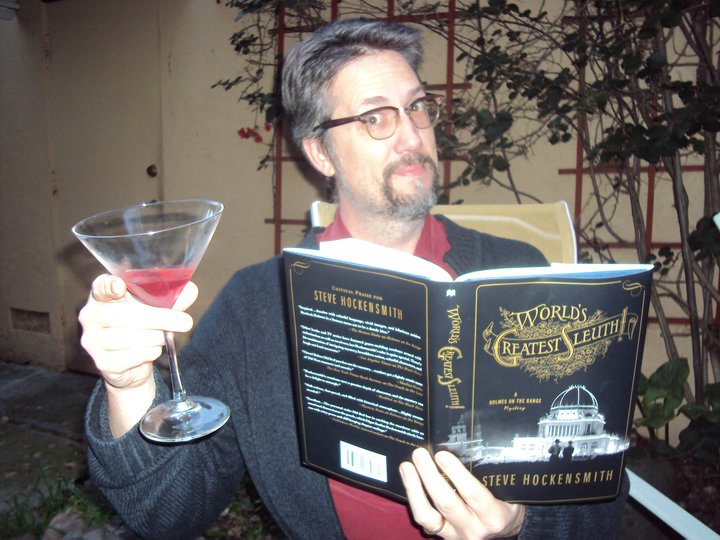
Home from the Range–An interview with Steve Hockensmith

A few weeks ago I learned that Steve Hockensmith, one of my favourite writers of both mysteries and zombie fiction (yes, odd combo, I know) had released his latest novel, Cadaver In Chief.  However, it hadn’t popped up on Amazon.ca yet, (one of the curses of being America’s neglected big sister), so he was kind enough to provide a copy for me to review.  During the course of our chat, I passive aggressively (yes, that is the Canadian way) suggested maybe–you know–if I was brave enough–I’d ask him for an interview.

Unlike that redhead at work I keep mentioning to co-workers in the hopes that she might notice, Steve took the hint and ran with it.  So, free book AND an interview!    No redhead of course, unless you count the Amlingmeyer brothers…

Okay, awkward introduction aside, I give you…an interview with Steve Hockensmith, writer of the Holmes on the Range series, numerous mystery anthologies and both the prequel and sequel to Pride and Prejudice and Zombies:

Every hero or villain has an origin story, whether it’s Peter Parker and his radioactive spider or James Moriarty and his superior mind. Or, perhaps the Amlingmeyer brothers and their unfortunate experience with a flash flood. What’s you’re origin story? How did you come to decide to be a writer?

I’d like to say I developed superhuman storytelling abilities after being bitten by a radioactive writer, but my origin’s not nearly so exciting. I’ve just always been into stories and escapism. As a kid, I loved DC Comics, Doctor Who, Star Trek, Star Wars, Kolchak: The Night Stalker, The Avengers (the TV show), old movies, new movies, good movies, bad movies and books books books. I was geeky when geeky wasn’t cool, to misquote Barbara Mandrell. (Geeks love obscure pop culture references, y’know.) After college, I thought briefly about moving to L.A. to try to break into TV as a writer, but everything I’d heard about “the industry” made me think I’d hate it. Plus, I was chickenshit. So I decided to tell stories in the way that seemed right for me — in a quiet room, alone, following my instincts instead of notes from suits — and after a decade of that I managed to get a novel published. As origin stories go it’s no “Rocketed to Earth from the doomed planet Krypton…,” but what can I say? That’s how it happened.

Why mysteries?

Because I suck at science fiction. When I first got serious about writing, I wasn’t sure what I wanted to write. My favorite novelist was (and is) Kurt Vonnegut, but I don’t think you can just say, “I love that guy. I’ll do what he did.” Ain’t gonna work. So I figured it’d be best to start small, with short stories, and slowly feel my way to whatever it is I wanted to say. I focused on science fiction because I’d read a lot of it as a kid and there were several paying markets — Asimov’s, Analog and The Magazine of Fantasy and Science Fiction, in particular. After three or four years of effort, I managed to sell one story to Analog and bupkis to the others. And I couldn’t even get mad at anybody for overlooking my genius because I clearly didn’t have any genius…for science fiction. The stories simply weren’t that good, and I knew it. Then, just as I was about to give up, I was bitten by a radioactive writer, and everything changed. Really! I finally got around to reading The Big Sleep, and that opened up a whole new world for me. My strengths as a writer, I think, are voice and humor and attention to the seemingly mundane details of everyday life. And that’s not what SF’s all about, so it simply wasn’t a good fit for me. Mysteries, on the other hand….

Which brings us to the Holmes on the Range series. How does one come up with the idea of a couple of cowpokes travelling around the west emulating the deducifying style of a certain Sherlock Holmes?

Ten years ago, I decided to write a Sherlock Holmes story for Ellery Queen Mystery Magazine. (They have an annual Holmes tribute issue.) But I didn’t want to do a pastiche. (A) My ego’s too big for that, and (B) I know in my heart of hearts that I probably couldn’t pull one off anyway. So I had to come up with a way to tell a Holmes story that wasn’t about Holmes. Well, how do you do that? My solution: tell a story about someone who reads about Holmes and how that changes his or her life. And when I thought about the original Holmes tales and when they first appeared, I realized that America was still a pretty wild place at the time. The frontier days and Indian wars were barely behind us, and there were still cow towns and outlaws and bounty hunters and hanging judges and all that. And cowboys, of course. Say…what would they make of a guy like Holmes? Once I asked myself that, it all fell into place quickly, and I wrote the first Holmes on the Range story. Thank god Ellery Queen bought it, or who knows where I would’ve ended up?

Speaking of the Amlingmeyer brothers, I love the dynamic between Gustav and Otto.  Every great detective seems to need a sidekick, whether it’s Nero Wolfe and Archie Goodwin or Sherlock and Watson.  Yet Otto doesn’t necessarily seem so much a sidekick as a mutual partner.  Is Otto as much a sleuth as his brother?

Thanks for noticing that! I think because Otto’s such a goofball, some readers don’t pick up on the fact that he’s really a pretty smart, resourceful guy. He’s definitely not a sidekick in the way that S.S. Van Dine is Philo Vance’s sidekick or Capt. Hastings is Hercule Poirot’s sidekick. Van Dine and Hastings are utterly passive observers. They exist solely to provide a window onto the story. Otto isn’t just the narrator, he’s one of the heroes. He helps push the plot forward. Watson rarely did that, actually. Otto’s closer to someone else you mention: Archie Goodwin. I don’t think I’d read any Rex Stout before I wrote the first Holmes on the Range story, but Archie and Otto are definitely two of a kind. Nero Wolfe and Old Red might be the geniuses, but they’d never put any puzzles together if their right-hand guys weren’t out there gathering up all the pieces.

World’s Greatest Sleuth! takes place during the World Columbian Exposition of 1893 and features several walk throughs of the event during the course of their murder investigation.  The same novel features a pair of relatively obscure fictional detectives (King Brady and Eugene Valmont) whose heyday of popularity was the early twentieth century.  How much research goes into a Hockensmith novel?

Probably too much. Not that I do research-based info dumps the way some writers do. I think I’m pretty good at smoothly integrating the background material into the narrative. But sometimes with research I don’t know when to stop. I’m a geek, remember. Research is fun! So fun I’m always tempted to blow an extra week or two on it when it’s probably time to start writing. For four of my five Holmes on the Range novels and both my Pride and Prejudice and Zombies novels I spent at least a month on research before I started outlining the plot. I always began with the nugget of an idea — usually just a location and a general situation — then I’d let history guide me where it would. The exception is The Crack in the Lens. I went out of my way to make that one research-light. And it worked. Mostly. I probably spent two weeks on research instead of four or five. That’s one thing I’ll miss if I decide to continue the Holmes on the Range series as an indie thing. When I was getting nice advances, I could afford to spend the time on research. If I’m doing the books for myself, no dough until they start selling, it’s going to be harder to justify so many days at the library.

Personally, I think the Holmes on the Range series would be well suited to television, much as say, the Murdoch Mysteries.  Have you ever talked with anyone about adapting them?

Yeah, there was talk, once upon a time. And I suppose there’s still a remote chance it’ll happen. It’s pretty unlikely, though, which is too bad. I agree with you: It could be a really fun TV show. Maybe if I’d started writing the series in 1964, that would’ve happened. But anything Western-ish is a tough sell these days. The genre’s seen as old-fashioned and it’s expensive and it’s rarely done well anymore. But hey — keep hope alive. Longmire seems to be doing well, Hell on Wheels got picked up for a second season, and Sherlock Holmes and mystery shows have never been more popular. So lightning could strike. Pray for rain.

One thing I’ve noticed over the course of your career is that the hallmark of any Hockensmith novel isn’t so much the storyline (although they are great), but rather the witty dialogue, whether it’s banter between the brothers Amlingmeyer or that of Elizabeth Bennett and Mr. Darcy as they fend off the affections of various undead dandies.  Does the banter come naturally?

Why thank you, sir! I do think dialogue is a strength of mine, and it’s one of the things I enjoy writing the most. Nothing stops me dead faster than trying to capture the look of someone’s house or clothes or face. Descriptive writing is torture for me. Maybe that’s because of all the hours and hours I spent as a kid watching old movies on TV. When I’m writing a book, it’s as though one of those films is playing in my head and I’m just trying to transcribe it. So the dialogue and action is relatively easy. Finding words to describe the heroine’s hairdo — that’s hard. It might also go back to the moment when I really embraced the mystery genre, though I didn’t realize that’s what I was doing at the time. A few years before I read The Big Sleep, when I was still in college, I was lucky enough to stumble across the Thin Man movies in the local library. Man, I watched those things over and over and over. I still pull them out every year or so and watch them again. Not all of them are great movies, yet I always get immense satisfaction from watching Nick and Nora do what they do. Ooo! I just remembered! I had the same reaction to the Peter Ustinov Hercule Poirot movies of the late ‘70s and early ‘80s, too. So if you break down the DNA of the Holmes on the Range books, it’s less Western and Arthur Conan Doyle than you might assume at first glance. Those are in there, but the books wouldn’t be what they are without Shadow of the Thin Man and Death on the Nile and Evil Under the Sun, too. And to return (finally) to your original question: Those are all films with wonderful, witty dialogue. Coincidence? I think not!

Speaking of Dawn of the Dreadfuls and its counterpart, Dreadfully Ever After, how is it that you went from cowboy mysteries of the old West to Elizabethan debutants fighting undead hordes with crazy ninja skills? Did Quirk Books approach you regarding a prequel to Pride and Prejudice and Zombies?  How did that relationship come about?

Long story short (or as short as I can make it): Word got out that Quirk Books needed someone to write another PPZ book and my editor at Minotaur gave my agent a heads up (god bless him) and she threw my hat in the ring and I managed to get the gig. I think what won over Jason Rekulak, my editor at Quirk, was that I’d written funny historicals that mashed unlikely genres together. He also seemed to appreciate that I made no attempt whatsoever to copy Jane Austen’s style. Who could pull that off? If you tried to fake the feel of a mashup book I think you’d end up with something like Shock Treatment — the sequel to The Rocky Horror Picture Show no one watches or remembers anymore. You can’t set out to be a wacky cult favorite. You just have to tell your story in whatever style you think works best. So that’s what I did.

Since the release of Dreadfully Ever After and World’s Greatest Sleuth!, you seem to have gone the route of self-publishing and ebooks.  Is it an easier medium to work in?

Yes and no. The lull in books from traditional publishers wasn’t entirely of my choosing. To be honest, it’s been a crappy couple years. I’ve had several projects blow up on the launch pad. It’s been a combination of bad luck and lack of direction on my part. I’ve done waaaaaaaaay too much ping-ponging around trying to figure out what to do with myself. The ebooks have been gratifying in that they’re finished and they’re available and I think they’re great. Man alive, I love the print editions of Cadaver in Chief and Naughty! The designer I used, Rick Forgus, is a genius. Those books look beautiful. I’m very, very proud of them. On the other hand, marketing an indie book remains a chore and, frankly, a mystery to me. I was saying to my wife the other day, “I know how to write books. I just don’t know how to sell them.” Unfortunately, if you don’t have that second skill, there are going to be times when the first one doesn’t seem to mean much.

Anything you miss about working with a publisher?

Oh, sure. Free booze at conventions. Getting big boxes of beautifully printed books delivered to my door. Help with marketing and promotion. Insightful editorial input. (I’m lucky: I’ve worked with three editors and I liked and respected them all. That’s a track record some writers I know would envy.) I think it’s the free booze I’ll miss the most…and I’m only partially kidding about that. It’s extremely validating when a publisher buys you a gin and tonic. You feel like you’re in, you made it, you’re real. Of course, you’re a real writer without the free G&Ts, but that can be hard to remember sometimes.

I’ve had a book outline sitting in a drawer for what seems like forever due to both laziness and insecurity. Any advice for amateur authors hoping to break into the field?

I’ve got a standard line that always sounds flip, but believe me — it isn’t. Here it is: Keep writing bad stuff until you’re writing good stuff. That’s pretty brief as secrets to success go, but I can make it even briefer: Keep writing. Or in your case, start writing, then don’t stop. The number-one thing every writer needs in order to succeed is perseverance. After that, you need talent and skill (two different things) and luck. But without the perseverance, everything else is meaningless. The other advice I give is to start small, like I did, with short stories. That was how I turned raw talent into honed skills. It was how I established myself as a professional, too. The agent who ended up selling Holmes on the Range to Minotaur found me via a story in Alfred Hitchcock Mystery Magazine. She approached me! Imagine that! You never know what will lead to what. But it always starts at the same place. A keyboard. Write!

Fans of your blog always seem to be mentioning their affection for Hannah Fox, featured in several of your shorter works.  Any chance we’ll see more of this Nancy Drew with attitude?

Hannah actually pops up in my contribution to an upcoming anthology, so fans will get a chance to see what’s become of her. I have a whole book about her in a drawer — she was the star of the still-unpublished novel I wrote before Holmes on the Range. I keep thinking I’ll pull that book out again and rewrite it, since I still like the idea and I’ve gained (I hope) a lot more skill and smarts over the years. Hannah’s definitely alive in my mind. Whether she breaks out into the real world again (or at least the world of stories and books) remains to be seen.

I haven’t yet had a chance to read your latest work, Cadaver in Chief. Tell us how that came about.

I was waiting to hear back from an editor about a potential project and I thought to myself, “God, I hate sitting on my ass. I bet I could write and publish an ebook before I get an answer on this other thing.” So I set out to do it. And because I wanted to do it so fast, so now, I thought that should be reflected in the book. I wanted it to be a ripped-from-the-headlines kind of thing. Super-zeitgeisty. Which is why it ended up being about political manipulation and cultural disruption and the collapse of traditional media. Oh, and zombies! Can’t get more zeitgeisty than that, right? It was a ton of fun to write — it’s as much a mystery and a satire as it is horror — and I think it turned out really well. Plus, I won the race! I did finish before I got an answer, which is another reason to love indie publishing. You can react to trends really, really quickly. Of course, even if you do you’ve still got to figure out the goddamn marketing. Sigh.

I certainly couldn’t end the interview without asking about Gustav and Otto and the chance of further adventures.  When we last left them, they were looking at a bright future and I for one would like a glimpse into that.  After all, nobody fell off a cliff or anything….

I deliberately left the boys in a happy place at the end of World’s Greatest Sleuth! because I wasn’t sure we’d ever see them again. Things were obviously winding down with Minotaur — the series never took off the way they’d hoped — and I was feeling burned out and disappointed. Those books were really, really hard to write, all of them, yet at the end of the day what did I have to show for all that work? (Other than five books I was proud of and some nice cash I was grateful for, of course.) That’s still a question I wrestle with. As much as I’d like to see Big Red and Old Red ride again, I’m not going to write a book about them just for me and 100 other people. That would be too painful, and dammit — I simply can’t afford it. The thing that gives me hope is that the Holmes on the Range short story collection I put out, Dear Mr. Holmes, keeps selling and selling at a very satisfying clip. So we’ll see. At the moment, I’m leaning toward giving it a try. The movie’s already running in my head. I know what happens to the guys next. Maybe I’ll start transcribing soon.

Fingers crossed that the Amlingmeyer brothers ride again!  If you’re not familiar with Steve Hockensmith’s works, I’d suggest you start with Holmes on the Range. It’s a delightful mystery and a great introduction to what you can expect from a Hockensmith novel.  Of course, Cadaver in Chief is on sale now, so if you’re sick of the presidential race yet want some political intrigue (and maybe see a politician or two get their faces eaten off), maybe you should start there.

Steve maintains a blog at the aptly named Steve Hockensmith’s blog, a.k.a. Stevehockensmith.com where he ruminates on all things mystery and, well, whatever meets his fancy.  Check it out!

Memories of Futures Past

“To the Moon, Alice!”

Ever wanted to read some classic Science Fiction yet been unable to find a copy of your favourite author’s work?  I myself have been fruitlessly looking for a copy of E. E. “Doc” Smith’s Lensmen series for a while now.  Or, say you’re a fan of Murray Leinster.  His works are out there, but few and far between.

Well, someone’s decided to make sure that visions of future past don’t disappear into history. The good people over at engadget have a nice little profile of a bookstore in New York (Brooklyn to be specific) whose proprietors have dedicated themselves to bringing lost and out of copyright Science Fiction back into the mainstream.

Singularity&Co have dedicated themselves to:

Save the SCIFI!

Singularity&Co. is a team of time traveling archivists longing for futures past. 

Each month, our subscribers help us choose a vintage, out of print scifi book to rescue (with the rightsholders’ permission).  We’re bringing forgotten 20th century scifi into the 21st.

They’ve dedicated themselves to scanning rare and classic Science Fiction books into a digital format and then releasing them as ebooks.  If you’re an  aficionado of classic SciFi, these are the people to watch!

(Thanks to Mat Smith at engadget)

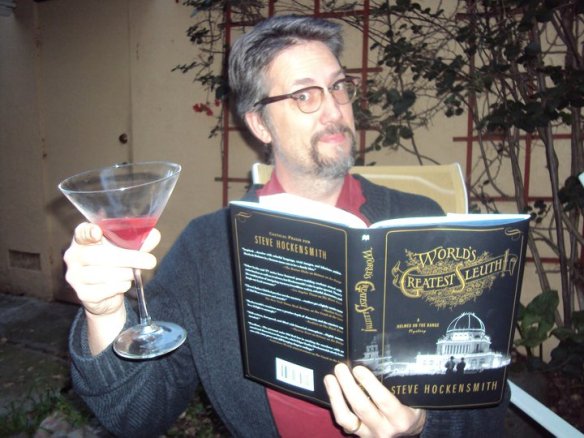
World’s Greatest Sleuth!–Steve Hockensmith

“This, I realized, was what it would look like to go up against a killer who knew more about detectiving than we did–a professional as opposed to talented amateurs like ourselves.  If mystery solving’s truly a game, as Valmont had said at dinner the night before, then there was one conclusion I couldn’t escape.

We were out of our league.”~Otto Amlingmeyer

It’s 1893.  Otto and Gustav Amlingmeyer find themselves convalescing at a Texas Angora ranch (well, Gustav is convalescing; Otto is going stir crazy) after the events of The Crack in the Lens.  Luckily, (for Otto) the downtime has been put to good use–his latest manuscript (being Gustav’s official biographer, Otto acts as a Watson like scribe–minus the doctoring) is finished and ready to be mailed to the New York publisher of their “Holmes on the Range” adventures–one Urias Smythe.

Meanwhile, back in New York, Urias Smythe has been busy, and when Otto heads to the local Western Union to submit his manuscript, he finds a missive from Smythe to hop the next iron horse to Chicago.  Urias has enrolled the brothers Amlingmeyer in a contest at the World’s Columbian Exposition, pitting their talents against other amateur detectives for the title of World’s Greatest Sleuth!

The game’s afoot.  Literally. 

Upon arrival in Chicago, the brothers meet the competition.  There’s King Brady, looking awfully spry, Eugene Valmont, former French policeman (mildly disgraced), Boothby Greene (Sherlock Holmes look-a-like if nothing else), and of course, the team of Diana Corvus (possible paramour?) and Col. C. Kermit Crowe (disgruntled former employer to the Amlingmeyers).  They’ve all been brought together for a publisher funded sleuth, a treasure hunt of sorts for amateur detectives.  Each day, the puzzlemaster, one Armstrong B. Curtis, will supply clues to each of the teams, and the first to bring him and William Pinkerton (son of Allan and judge of the event) a golden egg hidden on the grounds shall be declared that day’s winner.  At the end of the contest, the sleuth with the greatest skills, or at least the ability to solve word  puzzles, would be walk away with $10 000 and the aforementioned title.

Of course, nothing comes easy for the Amlingmeyers.  First of all, Gustav can’t read, so Otto’s along for the ride.  Secondly, Otto finds himself out of sorts seeing Diana Corvus once again.  Diana epitomizes the girl who got away, and she’s working with Crowe, a man who despises the Amlingmeyers.  Thirdly–she’s Crowe’s DAUGHTER!!  One final distraction: by the end of the first day, the puzzlemaster is found dead, face first in a giant wheel of Canadian Cheddar (World’s Largest, they say!).

From the start, Gustav had little patience for the contest, more concerned with justice for the dead than some silly riddles and a golden egg, and with the help of Diana, they’re on the trail of the killer, a killer who has all the skills of a world-class detective.

 Trailed by a never-ending series of bearded men (sinister, eh?), the brothers must compete for the prize, solve the murder and manage not to get killed, preferably in that order.

World’s Greatest Sleuth is the fifth and latest instalment in the Holmes on the Range series and a worthy addition.  If you like witty repartee, a decent mystery, and some historical relevance (such as a walk through the 1893 World’s Columbian Exhibition), then this tale of the cowboy detectives is right up your alley.

Steve Hockensmith maintains his own blog, aptly titled Steve’s Blog , where you can keep abreast of his latest exploits and browse his earlier works.

The Mystery of Dr. Fu Manchu–Sax Rohmer.

A few months ago I was trolling the web in search of reading material when I came across a listing for the re-release of Sax Rohmer’s The Mystery of  Dr. Fu Manchu by Titan Books.  After a look at the very pulpy cover art, I said to myself, “okay, I think I might check this out.”  However, already having a free copy (see project Gutenberg’s website for a free download) of The Insidious Dr Fu Manchu, I decided to go the cheap (free) route and see what was there. 

Note to readers–The Insidious Dr. Fu Manchu is the same book, with an odd title change for American audiences–why they did that is beyond me.  However, I was not around in 1913 to question the publisher, so whatever, I can live with that.

The Insidious Dr. Fu Manchu is the story of Denis Nayland Smith, formerly of Scotland Yard and now an agent of the crown, tasked with bringing to justice and/or thwarting the sinister plans of Fu Manchu, a Chinese agent who has left a trail of crime and death from the shores of Burma to the waters of the Thames.  A master assassin, thief and alchemist, Fu Manchu leads a criminal regime tasked with undermining the Western Powers (specifically the British Empire) to the benefit of his Chinese homeland.

Smith enlists the help of his old friend Dr. Petrie, and the two embark on a series of adventures with the help of Scotland Yard and the irrepressible Inspector Weymouth that invariably lead to their being outwitted by Fu Manchu, the man  Smith continually refers to as one of the greatest criminal minds the world has ever seen.

And that, in a nutshell, is what is wrong with this novel.  I went in looking to Nayland Smith and Watson…err, Petrie, as worthy hunters of the good(bad) doctor, instead finding a couple of heroes that continually bumble around throughout the entire novel, only getting close to the villain with the (inexplicable) help of one of Fu Manchu’s own henchmen (in this case, Karamaneh, a beautiful and alluring Arabic girl held in thrall to Fu Manchu by way of threats to her immediate family).

There are decent moments, ones where Nayland-Smith actually uses deductive reasoning to solve the riddle of how a man can break into a seemingly impenitrable room and safe leaving nary a clue, but too much of the novel relies on him remembering “facts” from earlier cases rather than examination of the evidence around him.  There is also much too much reliance on lovely Karamaneh, whose sole purpose seems to be to lead the two sleuths around by the nose.  Every time Rohmer writes himself into a corner, Karamaneh mysteriously shows up and points the way forward.  She is deus ex machina personified, and (to me) a lazy way of progressing the novel.

The book is not without its merits–Fu Manchu (the original caricature of the “Yellow Peril“) is a delightful addition to the pantheon of super villains.  Using his considerable intellect and preferred method of assasination (various exotic poisons) Fu Manchu is a master manipulator and a delightfully cunning villain.  Too bad he does not have a worthy adversary.

I think the biggest disappointment of the novel is that Fu Manchu does not figure more prominently in the novel.  He and his methods are alluded to time and again, but the reader only meets him personally a number of times, and even then, only briefly.  I will say that his escape from authorities closing in on his lair is brilliant, and gives a greater understanding of the character’s essential evil than anything up to that point.  It’s also what saved the novel for me.

Of course, be forewarned of some obviously racist mindsets while reading this novel.  1913 was a very different time, and, Rohmer’s characters are not in any way politically correct.

The Mystery of Dr. Fu Manchu  (C+)

Amazon teams up with Her Majesty’s Secret Service

No, Mr. Bond. I expect you to buy!

Good news for fans of Ian Fleming’s classic James Bond novels.  Yesterday, Amazon confirmed that they’ve entered into a partnership with Ian Fleming Publications to license North American publication of the original 007 novels for the next ten years, both print and ebook.

From the release:

“The agreement for the 14 classic James Bond titles includes the first  James Bond book in the series, Casino Royale (1953)–which will celebrate 60 years of publication in 2013–as well as Live and Let Die (1954); Moonraker (1955); Diamonds Are Forever (1956); From  Russia with Love (1957); Dr. No (1958); Goldfinger (1959); For your Eyes Only (1960); Thunderball (1961); The Spy Who Loved Me (1962); On Her Majesty’s Secret Service (1963); You Only Live Twice (1964); The Man With The Golden Gun (1965) and Octopussy and the Living Daylights (1966). Since their first publication the books have sold over 100 million copies worldwide and have been the inspiration behind the world’s longest-running film franchise.”

Great news, especially for Kindle owners!

Of course, the Bond saga didn’t end with Ian Fleming’s death.  Several authors have since taken up the reins and one in particular has had his license renewed.  John Gardner wrote a further 16 Bond novels between 1981 and 1996 and Pegasus books began reissuing them as of October, 2011.

 No news yet (at least as far as I’m aware) of ebook versions.

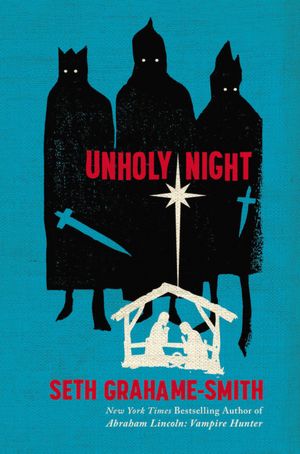
It’s an Unholy Night!

Sacralicious!

Seth Grahame-Smith first lurched into our homes with Pride and Prejudice and Zombies in 2009.

In 2010, he took a swing at presidential shenanigans with Abraham Lincoln: Vampire Hunter.

It’s now 2012, and he’s leading us on an exodus to a land that’s much less Holy than we were led to believe…

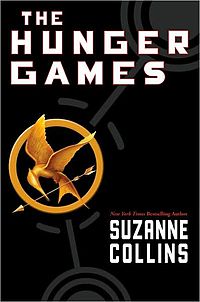
The Hunger Games–Suzanne Collins

The Hunger Games, first in the trilogy by Suzanne Collins, is the story of Katniss Everdeen, a teenage girl living in a community known as District 12, one of a dozen that make up the country of Panem.   Panem itself is a future version of North America, ravaged by war and natural disasters, a dystopian society set in the near(ish) future.

It is a society of haves and have-nots, the haves populating what is simply known as the Capital, the have-nots (or proletariat) inhabiting the rest of the country.  While citizens of the Capital have all the amenities that modern medicine and technology (and wealth) afford, those in the other regions live lives of mere subsistence, each district tasked with a distinct function by the central government.

Katniss and her family live in what was formerly called the Appalachians–coal country–and eke out an existence supplying the Capital with fuel.  Having lost her father many years before in a mining accident, Katniss has become a skilled hunter, supplementing their meagre supply of food with poached game and various nuts and berries, painstakingly collected day by day.  It is a life of fear of starvation and starvation, interspersed with the daily struggle to make sure the former does not become the latter.  Yet Katniss is content with her family, if not her situation, and shoulders the burden without much complaint. 

However, there is one other thing each district must supply the Capital.  Every year each district supplies contestants  for the spectacle which is The Hunger Games.

Inaugurated 74 years earlier after a failed rebellion by the Districts, the Hunger Games pit two teens (between the ages of 12 and 17, one male–one female) from each District in a battle royale with their counterparts from the others.  It is a battle to the death with only one possible “winner”.  Used both as a means to terrorize the populace and demonstrate their absolute authority, the government of Panem ruthlessly exploits the children to keep the people submissive.

When Katniss’ younger sister Prim is chosen for the games, she makes the choice to volunteer in her stead,  knowing that it’s a death sentence, yet willing to make that sacrifice for her kin.  Within days she and the male contender of District 12, the baker’s son Peeta, are whisked off to the Capital for a bit of training and a lot of promotion.  And then the games begin.

Dropped into an arena consisting of varied environments and climates, each competitor must rely on their wits and physical skill with (if they’re lucky) a weapon to eliminate the others.  They also have to make it a show–if things get boring, the gamemakers will “move things along” by either altering the environment in an unpleasant manner or introducing deadly obstacles such as mutated animals, flame throwers, etc.  Of course, without giving away too much, this is the story of Katniss and her time in the arena.

For a young adult novel, Collins has crafted a remarkably serious yet not overly graphic tale that manages to hold the attention of her market audience while appealing to those of us who fall into the category of adult.  Not just a story for kids, Collins manages to explore several complex themes: oppression vs. liberty; authority vs. non-conformity; proletariat vs. oligarchy, etc.

Her novel can have different meanings to the reader depending on your political persuasion.  A progressive might see it as the story of fascism stifling the free expression of the people, while a conservative might see it as an example of the intrusive nature of big government–the aforementioned liberty to live our lives without too much interference.  I think Collin’s intent falls somewhere in between–more of a cautionary tale of how easily society can be controlled once they cede authority to a small minority, and also a condemnation of today’s “reality television” society.

It’s also a ripping good read that doesn’t require a huge time investment–just an emotional investment in several appealing characters, knowing that not all will survive The Hunger Games.

B+