After reading Lavie Tidhar’sThe Bookman, I found myself hooked on his wonderful steampunk series. However, what initially drew my eye at the local bookseller wasn’t so much the title (although it certainly caught the eye) but the wonderful cover art.
Nicely bookending (some pun intended) this wonderful piece of art was the cover of the sequel, Camera Obscura:
And now comes Angry Robot’s sneak peek at the third volume, The Great Game:
Larry Correia’s third book in the Monster Hunter series comes out today. Monster Hunter Alpha tells the back-story of Earl Harbinger, MHI’s resident Hunter/Closet Werewolf, a story that’s been begging to be told since way back in ’07 when Monster Hunter International was first released.
Larry’s generated a lot of fans with this kick-ass series about a bunch of civilian contractors (read that as mercenaries) who help keep the world safe from those things that go “bump” in the night, and those fans propelled the second novel, Monster Hunter Vendetta to #27 on the New York Times bestseller’s list. Pretty impressive.
He’s also a guy who’s not shy about promoting himself or his product. Hey, why not? Writers write for the love of the craft, but they’ve also got to eat. So, about a month ago, he put out the call for all us MHI fans to put out the word, “if you’re going to buy the third installment, buy it the first week.”
Why the first week?
It’s all about stats.
From what I’ve read on the subject, the surest (and only) way to get on the NYT’s bestseller’s list is to sell a whack of books the first week after publication. Larry does a better job of explaining it than I can:
“Now, on the preorder or release week thing, let me explain. Here is a little peek behind the curtain into the publishing industry. This is a very competitive business. Making it onto a bestseller list spurs future sales and boosts your career. The biggest and toughest one to get on is the NYT. MHV made it to #27 when it came out.
Some of you may remember when I went around with an idiot about how this meant that I wasn’t a *real* bestseller. Let me break this down. The NYT is broken up into fiction, non-fiction, and young adult. We’re looking at fiction. The NYT only shows the top 35 fiction books in three categories. (hardcover, trade paperback, and mass market paperback). So I’m competing against every paperback fiction book on sale in the country.
This next part is important. It is based on books sold during that week. So you can have a book that sells ten thousand copies in a week, and zero copies the rest of the year. That book will be a NYT bestseller. You can have another book that only sells a thousand copies that week, but sells a thousand every other week of the year. That book will sell way more copies than the first one, but it will not make the NYT. That’s called velocity.
The velocity part is why the release week (and the preorders that ship that week) are so very important. A book will normally sell the most when it first comes out. So, barring something that comes along later to cause a bunch of publicity (Movie adaptation, Oprah book club) you either make the list when you release or not at all.”
So, what does all that mean for us fans of the series? It means, if you’re going to buy the book, or are just thinking about it, get off your duff and buy it NOW. You’ll be doing yourself (and him) a favour. If you’ve never read the books and are simply looking for something new in the horror/fantasy/awesome stuff category, you can’t go wrong picking up all three. Hours of monster hunting fun.
Now, before I get accused of being a shill, let it be said that I’ve already bought my copy of Monster Hunter Alpha and am waiting impatiently by the mailbox for it to arrive, so there’s no conflict of interest or monetary gain/kickback or whatnot. I’m hopping on the viral marketing bandwagon because it’s a good idea (from a marketing standpoint), because they’re great books (if you’re into that sort of thing), and as a fan, I’d like to help out.
If you’d like more insight into Larry Correia’s books, views, and publishing schedule, check out his blog at Monster Hunter Nation.
“Hermann Kermit Warm is going to die. The enigmatic and powerful man known only as the Commodore has ordered it, and his henchmen, Eli and Charlie Sisters, will make sure of it. Though Eli doesn’t share his brother’s appetite for whiskey and killing, he’s never known anything else. But their prey isn’t an easy mark, and on the road from Oregon City to Warm’s gold-mining claim outside Sacramento, Eli begins to question what he does for a living–and whom he does it for.”
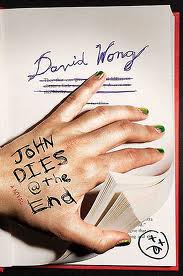
“And watch out for Molly. See if she does anything unusual. There’s something I don’t trust about the way she exploded and then came back from the dead like that.” ~David Wong.
Man, no kidding. Having your dog explode can sure mess with a dude’s head. Yet that is far from the weirdest thing that happens in David Wong’s sadistically, hilariously, horrifying(ly) great novel, John Dies at the End.
I finished this novel a couple of weeks back, but still feel like I have a hangover. The good kind, like when you wake up after a night of drinking, roll over, and there’s a beautiful brunette lying beside you. The kind of hangover that’s worth it. Having said that, trying to describe this book, hell, even just a brief synopsis, seems an impossible task. Bear with me–maybe I should start at the beginning.
So, there’s these two dudes, David Wong and the aforementioned John, living the lives of your average twenties. McJob down at the video store, partying in their spare time, trying to meet hot chicks that are willing to, if not have sex with them, at least talk to them. Well, Dave is–John doesn’t seem to have much of a problem in that department. He’s in a band, and as we all know, when you’re barely out of your teens, shit like that seems cool. Especially to the ladies.
John also likes to party, never having seen a drug he’s been unwilling to try. After what might be called the “worst trip in history” courtesy of a Rastafarian drifter (whose magic tricks are suspiciously convincing) they meet at a local bush party, life for these two slackers will never be the same again. *Note to reader–never put your buddy’s used syringe in your pocket.
You see, the drug,”soy sauce,” doesn’t just mess you up–it breaks down the wall between Universes and makes a laughingstock of the rules of time. Oh, and it’s alive.
Next thing you know, both Dave and John are down at the police station answering questions from some very perturbed cops trying to explain why they have five dead (gruesomely dead) and four missing, courtesy of a party they know John was at. Dave is tripping pretty good, reading the cop’s mind (Morgan Freeman, he calls him) and worrying about Jennifer Lopez (real name, not the actress), the girl he has a crush on and also one of the missing. At that point, “Morgan” steps out of the room (apparently John has died and it’s not even the end) and Dave realizes the other cop is not what he seems. Being attacked by a mustache (yep, you read that right) will do that to you.
From there it’s a blistering ride as Dave manages to escape the jailhouse, return to the scene of the crime, find a dog (who at one point appears to be possessed by John), get shot, get abducted to Vegas with the other missing by an acolyte of “Korrok” (more on him later), witness the creation of a wormhole to another Universe and manage to close the wormhole with the help of a preacher turned magician (Dr. Albert Marconi) and a stirring rendition of a song by John’s band Three Armed Sally: “Camel Holocaust.” That’s just the first act.
Korrok is the villain of the tale, either an elder god along the lines of Cthulu…or a sentient biological computer run amok in an alternate Universe. Either way, it wants into our Universe and if Dave, John, and a few other players cannot thwart its plans…well, we’re all fucked. Korrok has agents everywhere, known as the shadow people, has replaced many of the residents of “Undisclosed” with what can only be called replicants, and an acolyte with the charming nickname of “Shitload” trying to advance its agenda of Universal domination. All of them.
Of course, there is a girl, Amy, the one-handed sister of big Jim Sullivan (deceased) and probably the only reason Dave will do his best to save the world–not that he knew this when he first met her.
I’m not doing justice to the story with this abbreviated synopsis, but it’s just too convoluted to sum up succinctly and there’s no need to spoil the fun for you. I will say that John Dies at the End meanders at times, and reads like just a bunch of stuff that happened to these two dudes, although technically it’s Dave telling his story to a skeptical journalist. Having been written haphazardly as a series of blog posts since 2001 and ballooning into a 466 page book by the time of its publishing, it seems an understandable complaint–and yet bears no relevance to whether the reader will enjoy the novel.
From start to end it’s a huge mindf*ck (sorry, I can’t think of a better term), and every time you think you’ve got your head wrapped around the storyline, something happens to make you question where the hell this is going and what actually happened before. I was within a hundred pages of the end of the novel and began to get worried that there was no satisfactory way to tie up the loose ends in the amount remaining. Really worried.
And then he did it.
One spoiler…if John dies at the end, then it’s not at the end of this book. David Wong claims to be hard at work on the sequel but for now we’ll have to be satisfied by the upcoming movie.
It seems like you couldn’t look at a book blog the past week without seeing a post on Amazon’s recent press release, noting that they’re now selling more Kindle books than print books. From their May 19, 2011 press release:
Since April 1, for every 100 print books Amazon.com has sold, it has sold 105 Kindle books. This includes sales of hardcover and paperback books by Amazon where there is no Kindle edition. Free Kindle books are excluded and if included would make the number even higher.
So far in 2011, the tremendous growth of Kindle book sales, combined with the continued growth in Amazon’s print book sales, have resulted in the fastest year-over-year growth rate for Amazon’s U.S. books business, in both units and dollars, in over 10 years. This includes books in all formats, print and digital. Free books are excluded in the calculation of growth rates.
In the five weeks since its introduction, Kindle with Special Offers for only $114 is already the bestselling member of the Kindle family in the U.S.
Amazon sold more than 3x as many Kindle books so far in 2011 as it did during the same period in 2010.
Less than one year after introducing the UK Kindle Store, Amazon.co.uk is now selling more Kindle books than hardcover books, even as hardcover sales continue to grow. Since April 1, Amazon.co.uk customers are purchasing Kindle books over hardcover books at a rate of more than 2 to 1.
Pretty amazing, considering the Kindle has only been around since 2007. Revolutionary even. Of course, every revolution has its casualties and the eBook revolution looks to continue that trend. There will be repercussions for the publishing industry, retailers, and eventually the consumer. Let’s explore the good, the bad, and the ugly of the rise of the ebook.
The Good:
Ebooks look like they’re here to stay, either in physical format (Kindle, Nook, Kobo et al) or as apps on other platforms such as the Apple iPad or Blackberry Playbook. Great news for those of us who jumped on the bandwagon early. No more worries about “niche” markets or disappearing fads.
Now that eBooks are no longer unproven technology to publishers, maybe they’ll take a look through the back catalogs and transfer some if not all of their out of print titles to digital format. It’s always frustrating to hear of a good book only to find that you’ll have to pay through the nose to acquire a rare copy or to find that only selected books in a series have been translated to digital format. Just recently I was looking for Flashman by George MacDonald Frasier and discovered that the original is not available on Kindle but Flashman and the Tiger is. (Book eleven? Really?!)
eBooks are discounted in comparison to physical print. Generally, a new release hardcover costs the same as a pocket novel when bought in eBook format. The consumer gets a break, and the publisher certainly doesn’t have the overhead that they would with print and shipping costs.
It’s much easier for anyone to publish a book. No more book agents, rejection letters, etc. Simply write your book, pay your fees to have it digitized, set your price and go. eBooks could lead to greater variety at lower prices.
The Bad:
It’s much easier for anyone to publish a book. Think about that for a second. Bad writing, bad or nonexistent editing, spelling errors–publishers have editors work with aspiring and established writers for a reason. Sifting through a lot of crap to find that rare gem is not something to look forward to.
How is this going to affect editors, literary agents and publishers as a whole? They’ll still be working with authors to bring product to market, but many authors will forgo their services and self publish in hope of garnering a greater return. After all, why take a percentage when you can take the whole thing (minus your own minimal costs)? Furthermore, will literary agents become redundant? Remember, it was only a few years ago that travel agents were a real thing. (Okay, technically they’re still around. Used one lately?)
The Ugly:
Now that retailers such as Amazon have a foothold on the market, will they (and the publishers) still feel the need to sell eBooks at a reduced price? One of the biggest draws of eBooks (for me) is their affordability, but as eBooks proliferate the market, what’s to stop the prices from slowly increasing until they are comparable to physical print?
Physical print–with the increased pressure of eBook sales and diminished interest in a physical product–will book prices increase? Will print runs become shorter (and therefore more expensive) due to reduced demand? Who’s going to pick up that greater expense?
What of brick and mortar book stores? Are they going to go the route of the video store?
Technically, you don’t own an eBook, you lease it. Libraries have already run into problems with publishers who want them to pay up again (re-“lease” their titles) after a certain number of reads.
Finally, how long will retailers maintain your eBook catalog? Say Amazon has a couple of bad years and ends up in bankruptcy. Then what?
This is all conjecture for the moment. The industry is too new and the numbers too fluid to make anything but predictions, however, just like any revolution, the eBook revolution will radically transform the publishing industry in a very short period of time.
Awhile back I read through Kevin Maney’s Trade-Off: Why Some Things Catch On, and Others Don’t, an interesting discussion of the conflicting forces that either spell success or failure of a new product or service. It all comes down to the battle between fidelity (the quality of a consumer’s experience) and convenience (ease of use and price point). With Kobo’s launch of their new Kobo eReader Touch, they look to be attempting both an eReader that surpasses the Amazon Kindle in fidelity,or “coolness factor,” while retaining a convenient price point. Engadget has a nice little review here.
So, advantage Kobo, right?
Well, hang on a second. You wouldn’t assume the people at Amazon are snoozing at the wheel, would you? Rumours persist that Amazon is poised to launch their own nifty new touch screen device in the form of a Tablet later this year. Technology Reviewhas some neat talking points about what the screen might be like and Daemon’s Bookshas a brief post on how they might market it.
Getting back to the fidelity vs. convenience argument, the question remains, will Amazon try to trump Kobo (and hey, maybe take a run at the Blackberry Playbook and Apple iPad?) or create a touch screen just slightly cooler than Kobo’s at a similar price with maybe an App or two thrown in?
For those of you who’ve always been a little squeamish about bugs and therefore unable to appreciate Kafka’sMetamorphosis, you’ve stumbled into a bit of luck. Quirk Classics fully appreciates your fears and has endeavoured to do something about it. They commissioned Cook Coleridge to add a bit of fluff (of the furball variety) to Kafka’s tail…er, tale?
When I was a kid, I used to read a lot of Stephen King novels, and one always stood out in my mind. Misery, the story of Paul Sheldon, held against his will by the crazed Annie Wilkes and forced to resurrect the main character of a series of novels that have, shall we say, “held her attention” for a long time. During the course of his detention, he taps out Misery’s Return, and (spoiler alert) when he gets the chance, clocks her with the aforementioned typewriter. Try doing that with a laptop and doing any significant damage.
The point I took away from the story wasn’t so much that typewriters can be used as lethal weapons, but rather that I’d like to be a writer, pecking out the great Canadian novel (alas, the great American novel is beyond me, both by way of birthplace and temperament) on one of those nifty manuals, whipping out sheet after sheet of brilliant prose and leaving them in a pile to be edited later with a nice red pen. It didn’t seem too unrealistic a dream either. I’m not too young to remember manual typewriters, having been exposed to them in grade school. No power assisted key-strokes, just good old-fashioned manual labour. If you’ve ever tried to make your mark with one of these leviathans, you’ll know what I mean.
Eventually, time and progress overtook the manual typewriter. First it was the electric typewriter, later simple word processors, and finally in recent years, the laptop. I can even remember when the name “typing class” went out of fashion. Suddenly, we were taking “keyboarding” lessons, and not only the manuals, but the electrics, were quickly phased out of the local high school.
There is irony in nostalgia, however.
After all, today’s word processing programs make writing and editing so much easier than back in the day. No more reams of wasted paper, no more fiddling with either ink or eraser ribbon, not even that one letter that always seemed to rise slightly above the type. The reality is this: today it is a much easier world in which to be a word smith. Just a tap of a button and your revision is done. So, it shouldn’t come as a shock to read that the last maker of manual typewriters has finally stopped production.
“Godrej & Boyce Manufacturing Co. Ltd. has shuttered its facility in Mumbai, India, where as recently as 2009 the company was making 12,000 mechanical typewriters a year.”
So, is that all she wrote for the typewriter?
Well, not exactly. The key word here is, “manual.” The good people at the Chicago Tribune have looked further into the matter and for what it’s worth–the typewriter may be in its death throes, but it’s still got a bit of life left.
So maybe my dream of sitting in front of an old Underwood with a pile of fresh paper on one side and that great novel on the other, celebratory bottle of whiskey off to the side for the moment I declare my work done, isn’t quite a pipe-dream yet. Perhaps it’s time to browse eBay.
In another article on the subject of HarperCollins new restrictions on ebook licensing (specifically targeting library lending), Library Journal columnist Michael Kelley recounts Roberta Stevens (American Library Association president) criticisms of the new policy. From the ALA’s statement regarding HarperCollins decision to limit licenses to 26 viewings before renewal:
“Libraries have a long history of providing access to knowledge, information and the creative written works of authors…We are committed to equal and free access for the millions of people who depend on their library’s resources every day. While demand has surged, financial support has decreased. The announcement, at a time when libraries are struggling to remain open and staffed, is of grave concern. This new limitation means that fewer people will have access to an increasingly important format for delivering information.”
She furthermore vowed to work closely with publishers:
“Crafting 21st century solutions for equitable access to information while ensuring authors and publishers have a fair return on their investments is our common goal. The transition to the e-book format should not result in less availability…The marketplace for e-books is changing rapidly. We encourage publishers to look to libraries as a vehicle to reach and grow diverse audiences.”
As of this posting, HarperCollins has not changed their position regarding ebook licensing, namely that they’re acting in the interests of the authors and that ebook licensing in perpetuity will result in a reduced profit stream for both publishing houses and authors. They maintain that the “26 and out” policy is the most equitable way of solving the problem.
Frequent readers of this blog (btw, Thanks Mom!) may be wondering by now why I keep coming back to this issue. After all, I’m not a librarian, and frankly, the last time I was in a library was to rent a movie. (psst…you can rent them all you want) So, why should this issue matter to you, or me, or any ebook reader that doesn’t use the library?
Simply put…look to the future!
I don’t know about you, but I don’t want to wake up five years from now, pull out my Kindle 5.0 (Now with Holographic display!) and find that half my digital books are no longer there because all the while some virtual doomsday clock is counting down the seconds until my licenses are considered “expired.” Furthermore, with the advent of such policies as Amazon Kindle’s new lending feature, who’s to say that publishers won’t institute a similar policy for the general public?
To quote a hackneyed phrase, “It’s in Revelation, people!”
Well, it looks like messing with Librarian’s isn’t the cakewalk HarperCollins expected it to be.
As of March 7, 2011, several library consortia have decided to suspend any future purchases of ebook licenses from HarperCollins as a direct result of the publisher’s recent decision to enact a license limit of 26 check-outs on ebook titles.
In an article by Michael Kelley that can be found at Library Journal (sorry guys, I know I keep cribbing from you, but who else has the best info on Library news?), the response and concerns regarding HarperCollins actions are chronicled. Predictably, they’re not happy. From Joan Kuklinski, executive director of the Central/Western Massachusetts Automated Resource Sharing Consortium:
“The library model has always been you purchase and own it for perpetuity, and I don’t think the format should matter as long as rights are being protected,” she told LJ. “No one tells a library they have to pull their books off the shelf after a certain number of circulations so why should this be different? They are looking at consortia as a threat, and it’s totally the wrong approach,” she said.
Directors of the Upper Hudson Library system have also decided to no longer buy their ebook titles from HarperCollins, calling the decision “patently ridiculous” (oh, fun with puns!) while several other consortiums have hopped on the bandwagon (read the article, I can’t crib everything!).
The best argument against such an arbitrary move is Adri Edwards-Johnson (coordinator of the Virtual Library) video demonstrating that print books have a much longer shelf life than HarperCollins is claiming. Ouch, awkward moment for the publisher.
So, there we have it. In their efforts to secure an ongoing profit stream from ebook sales to libraries for themselves, and by extension, the authors they’re claiming to represent, HarperCollins has managed to ensure that neither they nor their authors will see a cent until this issue is resolved. Furthermore, they’ve managed to damage their brand.
I doubt we’ve heard the last of this issue, and suspect that some sort of accommodation will eventually be worked out, but for the moment, it looks like HarperCollins is locked out.


 book in the Monster Hunter series comes out today.



 Gutenberg's Son