Unknown's avatar

About gutenbergsson

A blog of books, publishing, technology, authors and the history (and future) of the printed word.

The Sister’s Brothers has a trailer.

Three things that I love:

     I love a good Western.

     I love Canadian Authors.

  •      I love book trailers.

Looks like a trifecta!


From the author’s website:

“Hermann Kermit Warm is going to die. The enigmatic and powerful man known only as the Commodore has ordered it, and his henchmen, Eli and Charlie Sisters, will make sure of it. Though Eli doesn’t share his brother’s appetite for whiskey and killing, he’s never known anything else. But their prey isn’t an easy mark, and on the road from Oregon City to Warm’s gold-mining claim outside Sacramento, Eli begins to question what he does for a living–and whom he does it for.”


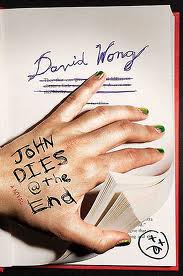
John Dies at the End–David Wong

“And watch out for Molly.  See if she does anything unusual.  There’s something I don’t trust about the way she exploded and then came back from the dead like that.” ~David Wong.

Man, no kidding.  Having your dog explode can sure mess with a dude’s head.  Yet that is far from the weirdest thing that happens in David Wong’s sadistically, hilariously, horrifying(ly) great novel, John Dies at the End.

I finished this novel a couple of weeks back, but still feel like I have a hangover.  The good kind, like when you wake up after a night of drinking, roll over, and there’s a beautiful brunette lying beside you.  The kind of hangover that’s worth it.  Having said that, trying to describe this book, hell, even just a brief synopsis, seems an impossible task.  Bear with me–maybe I should start at the beginning.

So, there’s these two dudes, David Wong and the aforementioned John, living the lives of your average twenties.  McJob down at the video store, partying in their spare time, trying to meet hot chicks that are willing to, if not have sex with them, at least talk to them.  Well, Dave is–John doesn’t seem to have much of a problem in that department.  He’s in a band, and as we all know, when you’re barely out of your teens, shit like that seems cool.  Especially to the ladies.

John also likes to party, never having seen a drug he’s been unwilling to try.  After what might be called the “worst trip in history” courtesy of a Rastafarian drifter (whose magic tricks are suspiciously convincing) they meet at a local bush party, life for these two slackers will never be the same again. *Note to reader–never put your buddy’s used syringe in your pocket.

You see, the drug,”soy sauce,” doesn’t just mess you up–it breaks down the wall between Universes and makes a laughingstock of the rules of time.  Oh, and it’s alive.

Next thing you know, both Dave and John are down at the police station answering questions from some very perturbed cops trying to explain why they have five dead (gruesomely dead) and four missing, courtesy of  a party they know John was at.  Dave is tripping pretty good, reading the cop’s mind (Morgan Freeman, he calls him) and worrying about Jennifer Lopez (real name, not the actress), the girl he has a crush on and also one of the missing.  At that point, “Morgan” steps out of the room (apparently John has died and it’s not even the end) and Dave realizes the other cop is not what he seems.  Being attacked by a mustache (yep, you read that right) will do that to you.

From there it’s a blistering ride as Dave manages to escape the jailhouse, return to the scene of the crime, find a dog (who at one point appears to be possessed by John), get shot, get abducted to Vegas with the other missing by an acolyte of “Korrok” (more on him later), witness the creation of a wormhole to another Universe and manage to close the wormhole with the help of a preacher turned magician (Dr. Albert Marconi) and a stirring rendition of a song by John’s band Three Armed Sally: “Camel Holocaust.”  That’s just the first act.

Korrok is the villain of the tale, either an elder god along the lines of Cthulu…or a sentient biological computer run amok in an alternate Universe.  Either way, it wants into our Universe and if Dave, John, and a few other players cannot thwart its plans…well, we’re all fucked.  Korrok has agents everywhere, known as the shadow people, has replaced many of the residents of “Undisclosed” with what can only be called replicants, and an acolyte with the charming nickname of “Shitload” trying to advance its agenda of Universal domination.  All of them.

Of course, there is a girl, Amy, the one-handed sister of big Jim Sullivan (deceased) and probably the only reason Dave will do his best to save the world–not that he knew this when he first met her.

I’m not doing justice to the story with this abbreviated synopsis, but it’s just too convoluted to sum up succinctly and there’s no need to spoil the fun for you.  I will say that John Dies at the End meanders at times, and reads like just a bunch of stuff that happened to these two dudes, although technically it’s Dave telling his story to a skeptical journalist.  Having been written haphazardly as a series of blog posts since 2001 and ballooning into a 466 page book by the time of its publishing, it seems an understandable complaint–and yet bears no relevance to whether the reader will enjoy the novel.

From start to end it’s a huge mindf*ck (sorry, I can’t think of a better term), and every time you think you’ve got your head wrapped around the storyline, something happens to make you question where the hell this is going and what actually happened before.  I was within a hundred pages of the end of the novel and began to get worried that there was no satisfactory way to tie up the loose ends in the amount remaining.  Really worried.

And then he did it.

One spoiler…if John dies at the end, then it’s not at the end of this book. David Wong claims to be hard at work on the sequel but for now we’ll have to be satisfied by the upcoming movie.

Pride and Prejudice and Zombies: Dreadfully Ever After- Steve Hockensmith

Darling, you’ve lost weight!

“You can have your precious honor or you can have your precious Darcy.  One or the other must be set upon the pyre. Which it shall be I leave to you.” ~Lady Catherine De Bourgh.

Traditionally, the hallmark of a great play is the three act structure, and every novel must have a beginning, a middle, and an end (unless you’re into crappy stream-of consciousness).  However, when the material cannot be sufficiently covered over the course of a novel, writers seem drawn to the idea of a trilogy.   Recently, Stieg Larsson’s  Millenium Trilogy has enthralled readers, and while not originally published as a trilogy, few would think of The Lord of the Rings otherwise.  So, when Seth Grahame-Smith’s Pride and Prejudice and Zombies (apologies to Jane) took off up the charts, what better way to bookend his work than to transform it into a trilogy?

The prequel, P & P & Z: Dawn of the Dreadfuls was a delightful introduction to the Bennett clan, a wittily crafted back story to the events of Pride and Prejudice and Zombies, and a nifty explanation of how things came to be the way they are in the “Z-land” that is Regency England.  Or Dreadful England, whichever you prefer.  And yet, one must wonder what happened to Elizabeth and Fitzwilliam Darcy after they conquered his pride and her prejudice.  Did they settle down in wedded bliss, marred only by the occasional ninja attack or Dreadful invasion?  Was Elizabeth able to content herself with the domestic life, forbidden from practicing her martial arts by the conventions of polite society?  Well wonder no more, because the answer lies in the sequel, Pride and Prejudice and Zombies: Dreadfully Ever After.

It is a time of hopeful optimism, for the Regency is to become a Monarchy again.  The madness of King George III has abated, and his re-coronation is anticipated by aristocracy and peasantry alike.  For Elizabeth Bennett, it should be a happy time, married to a man she loves, living a life of relative comfort…yet something is amiss.  Born and bred a warrior, she finds herself unable to indulge in her necrocidal urges, restrained by the sense and sensibility that must be adhered to as the wife of a nobleman.  Decapitating Dreadfuls just isn’t accepted as a skill set  a married women may practice.  Darcy understands her discontent, but finds himself unable to lighten the mood, and Elizabeth spends many a day roaming the moors in hopes of a lethal (not for her) encounter.

Yet when that encounter comes, it is Darcy who is delivered the fatal blow, the death sentence that accompanies even the slightest nibble from the recently re-animated.  Under the threat of losing the man who means everything to her, thoughts of discontent with her position in life vanish, and lead to a bargain with her personal nemesis…her aunt (through marriage), the lady Catherine De Bourgh.  It is to Darcy’s fortune, but Elizabeth’s misfortune, that her oldest enemy might hold the key to his survival in the form of, if not a cure, a stopgap until one can be found.  Elizabeth must swallow her pride and overcome her prejudice if she is to save her soul mate.

Of course, there is a price.  Catherine De Bourgh is a lady in name only, and suggests a course of action that might save Darcy, yet humble Elizabeth.  In London there is a doctor working on a cure for the Dreadful scourge, but he will not readily give up his secrets.  Subterfuge and seduction are the route to Darcy’s salvation, by way of  treachery and deception, shame and ignoble acts for Elizabeth and her family. And while they are gone, no one would expect lady De Bourgh to be idle, nor her daughter Anne.  Treachery abounds.  So off to London Elizabeth goes, in the guise of a wealthy (new money that is) spinster and accompanied by her uncouth father and sister (Hello Kitty!)

A word about London in the time of the Dreadfuls.  It is a place of walls, a fortress city, subdivided into fortified districts, tied together only by the amazing sewer system that winds its way under the city.  A place of dandies and fops, Dreadful races (literally…it does not pay to be Irish unless you can outrun a zombie) and Bedlam, both literal and figurative.  In this “hospital”, residing in the sinister section twelve central, is the cure they seek, and with the help of a daring plan, sisterly love and a few ninjas, they must breach its walls if there is any hope of obtaining the cure.


The irony of this novel is that it is not so much the story of Elizabeth and Darcy as it is the coming of age of her younger sister Kitty, historically characterized as a boy hungry air head, and the humanization of her elder sister, the ever sanctimonious and bookish Mary.  Away from the influence of the truly vacuous Lydia, Kitty is able to assert her own character, that of a young woman who looks at life in a light-hearted way, yet has an underlying sense of, well…sense.  As for Mary, once parted from her precious books and challenged by a mysterious protector as she attempts (on her own) to discover the secrets of Bedlam, her sharp edges are softened (unlike her blades) and she develops a softer touch.  For both Kitty and Mary, romance appears when least expected.

The author also introduces a variety of  antagonists for the Bennetts, from the  Monty Pythonesque Angus MacFarquhar, a mirthless scientist capable of hideous depravity (and considerable racism) in his quixotic quest to cure the land of their “troubles,” to the treacherous, yet troubled Nezu, leader of Catherine Debourgh’s ninjas.  And then there is the mysterious beggar in a box, an agent with an agenda of his own.

What I always love about a Hockensmith novel is not so much the storylines (they are great!) but rather the approach to language.  Witticisms and double entendre’s abound, and make for a smart, yet hilarious take on an otherwise somber subject.  Death and mayhem are infused with a sense of both the ludicrous and hilarious, and there were many moments when I chuckled out loud at either the banter or the situations the characters find themselves in.  My biggest complaint (probably the only one) is that the novel is not longer.  I could have read another hundred pages of the exploits of the Bennetts before coming to the conclusion and it was with a sense of both satisfaction and regret that I finally put down the book.  Like a great trilogy, it has a sense of completeness, but also leaves open the possibility of further adventures.

Steve himself speculated on the subject in a nice little interview over at Daemon’s books back in April.

And, like all Quirk Classics, it has its own  trailer:


*bloggers note:  In my short time as a reviewer, I’ve discovered that advanced copies of new novels are hard to come by up here in the great white North (yes, folks, Canada).  Publishing houses and promotional blogs simply won’t ship across the border, and for the life of me, I don’t know why.  When he saw me moaning on the subject, Steve stepped up and sent a copy for review, for which I thank him.    However, life got in the way and I have finally posted much later than expected, for which I apologize. 
 
My penance?  Downloading a copy of Naughty: Nine tales of Christmas Crime, which, when I think about it, really wasn’t any sort of punishment at all.  Trust me.
 
He also maintains a blog at stevehockensmith.com that is well worth a visit.

The Good, the Bad and the Ugly of the eBook Revolution

It seems like you couldn’t look at a book blog the past week without seeing a post on Amazon’s recent press release, noting that they’re now selling more Kindle books than print books. From their  May 19, 2011 press release:

  • Since April 1, for every 100 print books Amazon.com has sold, it has sold 105 Kindle books. This includes sales of hardcover and paperback books by Amazon where there is no Kindle edition. Free Kindle books are excluded and if included would make the number even higher.
  • So far in 2011, the tremendous growth of Kindle book sales, combined with the continued growth in Amazon’s print book sales, have resulted in the fastest year-over-year growth rate for Amazon’s U.S. books business, in both units and dollars, in over 10 years. This includes books in all formats, print and digital. Free books are excluded in the calculation of growth rates.
  • In the five weeks since its introduction, Kindle with Special Offers for only $114 is already the bestselling member of the Kindle family in the U.S.
  • Amazon sold more than 3x as many Kindle books so far in 2011 as it did during the same period in 2010.
  • Less than one year after introducing the UK Kindle Store, Amazon.co.uk is now selling more Kindle books than hardcover books, even as hardcover sales continue to grow. Since April 1, Amazon.co.uk customers are purchasing Kindle books over hardcover books at a rate of more than 2 to 1.

Pretty amazing, considering the Kindle has only been around since 2007.  Revolutionary even.  Of course, every revolution has its casualties and the eBook revolution looks to continue that trend.  There will be repercussions for the publishing industry, retailers, and eventually the consumer.  Let’s explore the good, the bad, and the ugly of the rise of the ebook.

The Good:

  • Ebooks look like they’re here to stay, either in physical format (Kindle, Nook, Kobo et al) or as apps on other platforms such as the Apple iPad or Blackberry Playbook.  Great news for those of us who jumped on the bandwagon early.  No more worries about “niche” markets or disappearing fads.
  • Now that eBooks are no longer unproven technology to publishers, maybe they’ll take a look through the back catalogs and transfer some if not all of their out of print titles to digital format.  It’s always frustrating to hear of a good book only to find that you’ll have to pay through the nose to acquire a rare copy or to find that only selected books in a series have been translated to digital format.  Just recently I was looking for Flashman by George MacDonald Frasier and discovered that the original is not available on Kindle but Flashman and the Tiger is.  (Book eleven?  Really?!)
  • eBooks are discounted in comparison to physical print.  Generally, a new release hardcover costs the same as a pocket novel when bought in eBook format.  The consumer gets a break, and the publisher certainly doesn’t have the overhead that they would with print and shipping costs.
  • It’s much easier for anyone to publish a book.  No more book agents, rejection letters, etc.  Simply write your book, pay your fees to have it digitized, set your price and go.  eBooks could lead to greater variety at lower prices.

The Bad:

  • It’s much easier for anyone to publish a book.  Think about that for a second.  Bad writing, bad or nonexistent editing, spelling errors–publishers have editors work with aspiring and established writers for a reason.  Sifting through a lot of crap to find that rare gem is not something to look forward to.
  •  How is this going to affect editors, literary agents and publishers as a whole?  They’ll still be working with authors to bring product to market, but many authors will forgo their services and self publish in hope of garnering a greater return.  After all, why take a percentage when you can take the whole thing (minus your own minimal costs)?  Furthermore, will literary agents become redundant?  Remember, it was only a few years ago that travel agents were a real thing. (Okay, technically they’re still around.  Used one lately?)

The Ugly:

  • Now that retailers such as Amazon have a foothold on the market, will they (and the publishers) still feel the need to sell eBooks at a reduced price?  One of the biggest draws of eBooks (for me) is their affordability, but as eBooks proliferate the market, what’s to stop the prices from slowly increasing until they are comparable to physical print?
  • Physical print–with the increased pressure of eBook sales and diminished interest in a physical product–will book prices increase?  Will print runs become shorter (and therefore more expensive) due to reduced demand?  Who’s going to pick up that greater expense?
  • What of brick and mortar book stores?  Are they going to go the route of the video store?
  • Technically, you don’t own an eBook, you lease it.  Libraries have already run into problems with publishers who want them to pay up again (re-“lease” their titles) after a certain number of reads.
  • Finally, how long will retailers maintain your eBook catalog?  Say Amazon has a couple of bad years and ends up in bankruptcy.  Then what?

This is all conjecture for the moment.  The industry is too new and the numbers too fluid to make anything but predictions, however, just like any revolution, the eBook revolution will radically transform the publishing industry in a very short period of time. 

 *For further reading on the subject, try John Steele Gordon’s article, ” The End of the Book?”  at the American or a really interesting article by Narasu Rebbapragada at PC World entitled, “E-Book Prices Fuel Outrage–and Innovation.”

Kobo Ereader gets a Touch of Fidelity

Kobo eReader Touch

Awhile back I read through Kevin Maney’s Trade-Off: Why Some Things Catch On, and Others Don’t, an interesting discussion of the conflicting forces that either spell success or failure of a new product or service.  It all comes down to the battle between fidelity (the quality of a consumer’s experience) and convenience (ease of use and price point).  With Kobo’s launch of their new Kobo eReader Touch, they look to be attempting both an eReader  that surpasses the Amazon Kindle in fidelity,or “coolness factor,” while retaining a convenient price point.  Engadget has a nice little review here.

So, advantage Kobo, right?

Well, hang on a second.  You wouldn’t assume the people at Amazon are snoozing at the wheel, would you?  Rumours persist that Amazon is poised to launch their own nifty new touch screen device in the form of a Tablet later this year.   Technology Review has some neat talking points about what the screen might be like and Daemon’s Books has a brief post on how they might market it. 

Getting back to the fidelity vs. convenience argument, the question remains, will Amazon try to trump Kobo (and hey, maybe take a run at the Blackberry Playbook and Apple iPad?) or create a touch screen just slightly cooler than Kobo’s at a similar price with maybe an App or two thrown in?

The Meowmorphosis: Coming to a shelf near you.

 “Gregor’s future is a bit fuzzy.”

For those of you who’ve always been a little squeamish about bugs and therefore unable to appreciate Kafka’s  Metamorphosis, you’ve stumbled into a bit of luck.  Quirk Classics fully appreciates your fears and has endeavoured to do something about it.  They commissioned Cook Coleridge  to add a bit of fluff (of the furball variety) to Kafka’s tail…er, tale?

The Meowmorphosis, on shelves May 10, 2011.

The Manual Typewriter: 1870-2011?


The end of an era?
 
 
When I was a kid, I used to read a lot of Stephen King novels, and one always stood out in my mind.  Misery, the story of Paul Sheldon, held against his will by the crazed Annie Wilkes and forced to resurrect the main character of a series of novels that have, shall we say, “held her attention” for a long time.  During the course of his detention, he taps out Misery’s Return, and (spoiler alert) when he gets the chance, clocks her with the aforementioned typewriter.  Try doing that with a laptop and doing any significant damage.
 
The point I took away from the story wasn’t so much that typewriters can be used as lethal weapons, but rather that I’d like to be a writer, pecking out the great Canadian novel (alas, the great American novel is beyond me, both by way of birthplace and temperament) on one of those nifty manuals, whipping out sheet after sheet of brilliant prose and leaving them in a pile to be edited later with a nice red pen.  It didn’t seem too unrealistic a dream either. I’m not too young to remember manual typewriters, having been exposed to them in grade school.  No power assisted key-strokes, just good old-fashioned manual labour.  If you’ve ever tried to make your mark with one of these leviathans, you’ll know what I mean.
 
Eventually, time and progress overtook the manual typewriter.  First it was the electric typewriter, later simple word processors, and finally in recent years, the laptop.  I can even remember when the name “typing class” went out of fashion.  Suddenly, we were taking “keyboarding” lessons, and not only the manuals, but the electrics, were quickly phased out of the local high school.
 
There is irony in nostalgia, however. 
 
After all, today’s word processing programs make writing and editing so much easier than back in the day.  No more reams of wasted paper, no more fiddling with either ink or eraser ribbon, not even that one letter that always seemed to rise slightly above the type. The reality is this: today it is a much easier world in which to be a word smith.  Just a tap of a button and your revision is done.  So, it shouldn’t come as a shock to read that the last maker of manual typewriters has finally stopped production. 
 

     “Godrej & Boyce Manufacturing Co. Ltd. has shuttered its facility in Mumbai, India, where as recently as 2009 the company was making 12,000 mechanical typewriters a year.”


So, is that all she wrote for the typewriter?
 
Well, not exactly.  The key word here is, “manual.”  The good people at the Chicago Tribune have looked further into the matter and for what it’s worth–the typewriter may be in its death throes, but it’s still got a bit of life left.
 
So maybe my dream of sitting in front of an old Underwood with a pile of fresh paper on one side and that great novel on the other, celebratory bottle of whiskey off to the side for the moment I declare my work done, isn’t quite a pipe-dream yet.  Perhaps it’s time to browse eBay.

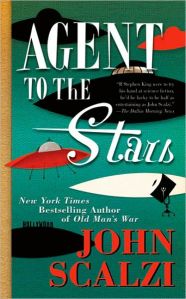
Agent to the Stars: John Scalzi

Agent to the Stars by John Scalzi is the first novel I someday hope to write.  Started as what he calls, “a practice novel” (that novel everyone tries just to see if they can do it) back in 1997 and posted to his website as “shareware” (from the preface),  there it sat, gathering fans until 2005, when he was contacted by a publisher (every writers dream) and an initial run was printed by Subterranean Press.  This time around, Agent to the Stars has been picked up in paperback format by TOR.

Now Scalzi is not new to writing, beginning his career as a film critic and humour columnist, later becoming a freelance writer and author.  Since 2005, when Agent to the Stars became his second published novel ( Old Man’s War beat Agent out of the gate by mere months but it can be accurately claimed to be his second novel), Scalzi has focused on follow-ups to OMW and his personal blog entitled “Whatever“.  So, he’s had some practice.  However, that doesn’t detract from the impressive quality of a novel he wrote on a lark.

As to the story:

Suppose you’re a member of an alien society wanting to make first contact with the silly little creatures that inhabit the third planet around a very average G-type (aka yellow dwarf) star.  Then suppose you’ve tapped into all the random information (specifically television and movies) they’ve been broadcasting into space for the past century or so.  For every E.T.  you watch, there’s a Thing, or more specific to the Yherajk (as you call yourselves), a little movie called, The Blob.  Well, you might have second thoughts about the whole thing, based on the apparent xenophobia exhibited by the local populace.  However, if you’ve spent the time and energy to come half way across the galaxy, you’re not going to let a little paranoia get in the way of first contact.  The question is how to make a good first impression?  The answer…hire a great publicist!

That, in essence, is the premise of Agent to the Stars.

When Tom Stein, an up and coming talent agent is told he has a meeting with the head of the agency, he expects that Carl Lupo (legendary agent and owner of the agency) is going to congratulate him on his latest deal.  Tom certainly doesn’t expect to take a meeting with some gelatinous goo named Joshua, sitting on the table in an aquarium.  Once he gets over the initial shock of first contact with an alien that resembles a bad b-film monster (and incidentally, smells like ass), Carl sets forth a proposition.  Find a way to market the Yherajk to humanity, a way to gently introduce the populace to a genuinely agreeable alien society wrapped in very unpleasant form.  No big deal for one of the hottest talent agents in Hollywood, right?

And with that, Tom takes home Joshua (in a water jug) to brainstorm ideas on how not to spook the entire human race when the time comes to introduce the  new neighbours.  The answer they come up with is a doozy.

If there were any comparison to make to other first contact stories, I would equate Agent to the Stars to E.T.: The Extraterrestrial, only with a really, really uncute alien.  The refreshing thing about this novel is the lack of any sinister motive.  There’s no desire on the part of the Yherajk to ingratiate themselves into earth’s society only to round earthlings up to process into tasty treats.  They don’t want our water, or to subjugate the planet.  I spent most of the novel expecting that overused plot device to crop up, so it was a pleasant surprise to see that the Yherajk have no ulterior motive.  Of course, there is also the comedic element of this entirely benign alien society that resembles something from our worst nightmares. 

The cast of secondary characters are well thought out, from Tom’s feisty assistant Miranda, to Jim Van Doren, the mildly slimy, yet talented journalist who has no idea where his snooping will eventually take him (Let’s just say, it’s not Kansas).  There’s also Michelle Beck, Tom’s biggest client, a beautiful actress long on legs but short on intelligence.  Unfortunately, she wants to stretch those legs, insisting that he get her a casting of substance, regardless of talent.  As if Tom doesn’t have enough on his plate, what with that whole, “introducing an alien species to mankind,” thing…he’s got to keep a spoiled (yet loveable) actress happy.  Which will prove harder?

By the end of the novel, Scalzi’s got the whole situation wrapped up in a satisfying bow (no spoilers here, thank you!).  Agent to the Stars is so much fun that the reader (well, this reader) couldn’t put it down, and deserves a place of note in a genre where (usually) the only good alien is a dead alien.  Very refreshing and well worth the time.

Pride and Prejudice and Zombies:The Movie

Elizabeth was not at all happy with her body double.

 Okay, technically this isn’t a “literary” post, but considering that Pride and Prejudice and Zombies is soon to be a motion picture, I’m bending the rules a bit.

Moving on.

Entertainment Weekly announced yesterday on their Inside Movies blog (story by Anthony Breznican) that the upcoming zombie flick has a director signed on in the person of Craig Gillespie, formerly director of such films as Lars and the Real Girl and the remake of Fright Night.  Principle filming is planned to begin at the end of summer 2011.  David O. Russell was originally set to direct, but backed out over what was described as a “budget dispute” (his or the film, I do not know), however, according to Gillespie, he will be working from a script penned by the former director.

Some thoughts:

David O. Russell sounded like the perfect director, coming off the Oscar-winning film, The Fighter, but as often happens, things simply didn’t pan out.  Gillespie (to me) is a bit of an unknown element, but Lars and the Real Girl managed an 81% freshness rating on rottentomatoes.com so that can’t be bad.

In the same interview, Gillespie claims that the roles of Elizabeth Bennett and Mr. Darcy have yet to be cast.  However, back in December of 2009, Natalie Portman’s name was attached as producer and star.  As things stand though, and according to her IMDB listing, there appears to be no connection to the upcoming feature.  I highly doubt there’s a dearth of English actresses capable of taking on the role, so there’s that.  All in all good news for those looking to see Pride and Prejudice and Zombies lurch from page to big screen!

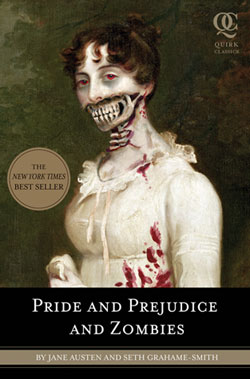
Pride and Prejudice and Zombies: Jane Austen and Seth Grahame-Smith

“Of all the weapons she had commanded, Elizabeth knew the least of love; and of all the weapons in the world, love was the most dangerous.”

 It’s always a crapshoot to re-envision a classic.  For every Pride and Prejudice starring Keira Knightly, there’s a Starship Troopers starring Casper van Diem.  It’s even more of a crapshoot to take the original author’s vision and totally turn it on its head.  So, it was with much curiosity that I picked up a copy of Pride and Prejudice and Zombies (Jane Austen and Seth Grahame Smith: copyright 2009, Quirk Books) Seth Grahame-Smith’s take on the seminal tale of the five Bennett sisters and their search for love and security in 18th century England.  It certainly takes a large amount of pride to assume oneself capable of taking a classic romance, mashing in a few zombies and some kick ass eastern fighting styles, and bringing forth what could only be described as a horrifying romance that captures the original author’s intent…but Seth Grahame-Smith was apparently the man for the job.

I imagine that anyone with a passing interest in literature has at least heard of the tale of the Bennett sisters, specifically Elizabeth, and her interactions with the mercurial Mr. Darcy.  One has an overabundance of pride, and the other finds the man’s pride so odious that she develops such a prejudice (yes, I know, hence the title) against him that the reader is left wondering how these two so obviously unsuited lovers can possibly get together. (Full disclosure–Pride and Prejudice  has been on my “to read” list for pretty much ever)  From what I gather on the subject, the original novel is a damning expose of 18th century convention and the wall between social classes, and even within them.  This version has a little fun with it.

So, let’s start with a short synopsis and go from there:

It’s been a few years since the events of Dawn of the Dreadfuls and the Bennett sisters have followed in their father’s footsteps, each of them travelling to the Orient to learn the ways of the Shaolin monks, a decidedly unladylike  action made necessary by the resurrection of the Dreadful menace, which has only gotten worse since the events of the prequel.  England is in a state of perpetual siege at the hands of the undead. London has become a walled fortress and travel around the countryside (unless it’s the dead of Winter–note to reader–the undead freeze) is a perilous affair.  However, life must go on, and the matriarch of the Bennett family is always on the lookout for possible suitors for her daughters.  With the re-habitation of Netherfield Park by the handsome (and very rich) Mr. Bingley, Mrs. Bennett sees a chance to both assure a future of comfort for her eldest daughter Jane, and by extension, the Bennetts.  When Jane endeavours to visit the Bingley’s and falls ill, Elizabeth is sent to watch over her recovery and during the course of the vigil, interacts with Fitzwilliam Darcy, whom she already has developed a grudge against, based on her initial observations at a local ball.

It’s hate at first sight, tempered by a certain appreciation of his martial qualities–ie.  he kills Zombies.  Elizabeth has devoted herself to a life of protecting her family and friends from the undead menace, telling herself that her duty allows no time for love, yet finds herself curiously drawn to Darcy.  However, events, as they often do in romance novels, conspire to keep the lovebirds apart.  The lies of Darcy’s childhood friend George Wickham influence Elizabeth greatly, as does Darcy’s treacherous (or so it seems) behaviour in coming between Jane and Charles Bingley.

All right, I’m already bored.  Suffice it to say that the reimagination of Austen’s work stays true to the original storyline, within limits.  However, Smith manages to seamlessly blend the horrific elements into the storyline, and adds a certain amount of bawdy humour that I doubt was in the original (not that Austen wasn’t a wit, it’s just that his additions are crude enough that I cannot believe Austen would have thought of them).

Examples abound of Smith’s somewhat bawdy additions to the original storyline.  When Elizabeth asks Mr. Darcy his opinion on the subject of balls (the formal dances), he responds with:

“…I may observe that private balls are much pleasanter than public ones.”

Elizabeth’s reply:

“On the contrary, I find that balls are much more enjoyable when they cease to remain private.”

Zoinks!  Double entendre anyone?

Later, when Elizabeth is entertaining Lady Catherine Debourgh and company with a demonstration of her nimbleness, walking about on her hands and finally supporting her weight on one finger, Lady Catherine observes to Darcy:

“Miss Bennet would make a fine showing of Leopard’s Claw if she practiced more, and could have the advantage of a Japanese master.  She has a very good notion of fingering.”

Darcy’s response:

“That she does.”

Ahem…cough, cough…Jane Austen would blush.

Let’s not forget Elizabeth’s younger sisters, the boy crazy Lydia and her easily influenced sister Kitty.  When the local militia regiment decamps from the area, they are disconsolate, Lydia whining that:

Only think what a miserable summer else we shall have!  With hardly any balls to be had in Meryton!”

To which Elizabeth cannot refrain from thinking:

“Yes…a summer with so few balls would be miserable indeed for a girl who thinks of little else.”

Anyway, I think you see where I’m going.  Smith has managed to channel Austen’s wit and brand it with his own (somewhat less delicate) sense of humour.

He also manages to change the essential character of Elizabeth’s relationship with lady Catherine.  In the original, lady Catherine looks down on the Bennetts as lower class and Elizabeth specifically as not worthy of her nephew’s attentions due to her diminished social status.  In this version, that is coupled with her disdain for Elizabeth’s training, shunning her Chinese training in the Shaolin ways as inferior to that of the Japanese, whose ninjitsu arts she is heavily influenced by.  She eventually goes so far as to sick her house ninjas on Elizabeth in a desperate attempt to foil their eventual union.

All in all this revised imagining of a perennial classic works, spicing up the original tale of romance with a healthy dose of both horror and the absurd, and (I would think) attracts a new audience that would likely never be exposed to the original without the addition of those horrific elements.  It’s definitely worth a read, and with the addition of both a prequel and sequel by the equally talented Steve Hockensmith, there’s plenty more for the reader to enjoy.