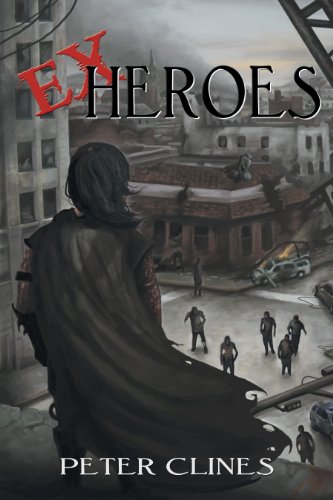
Ex Heroes–Peter Clines

“If we do this, if you want my help with it, it isn’t some stupid selection process where we pick and choose a few hundred who we decide are worth it.  We just save everyone we can.”

 St. George, a.k.a. ‘”he Dragon”, a.k.a. George Bailey (seriously?), is an ex-hero.  Just a year before, he was the darling of humanity, saving the innocent from the not so innocent of Los Angeles and making headlines everywhere he went.  Whether rescuing a woman from being raped in an alley, smacking around some gang bangers on the prowl, or attempting to deal with a strange biological outbreak that re-animates the dead, he was the best at what he did.  And what he did was be a hero.  Invulnerable, invincible, the result of a freak lab accident, the Dragon kept the city from falling into anarchy, aided by a cadre of fellow super-humans, all of whom developed their powers in the recent past.

There was Gorgon, whose gaze would tap the life force of others and convert it into super strength.  Zzap, a cripple, confined to a wheelchair, capable of becoming a being of pure energy, blessed with all the powers of a God.  Imagine the Sun with a personality.   Cerberus–a girl and her power armor.  The Regenerator—I think that one would be self explanatory.  And then there was Stealth, the supermodel vigilante, combining genius level intelligence with supermodel level sensuality.  

I did say ex-heroes though, didn’t I? 

What happens to a hero when all he (or she) has vowed to protect is gone?  When the situation goes from bad to worse (to worst) and it’s no longer a matter of keeping humanity safe, but rather keeping humanity alive?  And what could possibly bring such a situation to pass? Peter Clines’ EX-HEROES answers those questions with one answer. 

Yep, you guessed it…the answer is Zombies.

Bouncing back and forth between the times before and after the zombie apocalypse, EX-HEROES chronicles the exploits of those few super heroes that have managed to survive (they’re not the only “ex-heroes” in this story), trying to maintain a small enclave of humanity that remains uninfected.   Day by day they struggle against the hordes of undead clogging the streets of Los Angeles, ever watchful for the appearance of their undead brethren.  Dead superheroes have no control over their powers, but they have them nonetheless.

At the same time, several of their members are trying both to trace the source of the outbreak and to find a cure (or at least a vaccine) for those who are left.  They’ve known for some time that if you die—you turn.  What they don’t know is that one of them has intimate knowledge of how the outbreak began.  Complicating their search is the competition, a loose coalition of former gangs united under the aegis of “The Seventeens” who have fought tooth and nail with the heroes for the spoils of a dead civilization.  So far, it’s a dead heat.

When my copy of EX-HEROES arrived in the mail, I got a little worried.  Wrapped in an almost amateurishly bound trade paperback, it appeared as though I had been snookered into reading another author’s self-publication.  Thank God I got beyond that.  What I found inside was a first rate blend of apocalyptic zombie fiction, combined with some good old fashioned super-heroism. 

When I say old fashioned, I don’t mean to imply that the heroes are black and white cookie cutter caricatures—they’re real people, simply blessed with extraordinary abilities.  As is the fashion these days, the lines between good and evil are blurred, and no character is without flaw.  Whether it’s Stealth’s lack of empathy, or the Regenerator’s apparent cowardice, Clines treats his superheroes as flawed beings–much like the rest of us.  Hell, some of them aren’t even likeable—but then who said superheroes had to be nice?

Of course, like every good zombie novel, there’s a twist, which I’ll leave you to get to on your own. 

Once you’re done with this zombies vs. superheroes mash-up, never fear.  The fun continues in Cline’s sequel, Ex-Patriots.
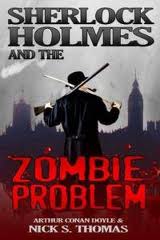
Sherlock Holmes and the Zombie Problem–Nick S. Thomas

“It is with a heavy heart that I take up my pen to write these the last words in which I shall ever record the singular gifts by which my friend Sherlock Holmes was distinguished.”~Dr John Watson.


Zombies are the least of the problems encountered in Sherlock Holmes and the Zombie Problem by author Nick S. Thomas.  Bad writing can usually be overcome by a decent plot, but sometimes you run into stuff like this:

“Shocked and in fear I stumbled to my feet and withdrew across the room, two more shots rang out from Holmes’ gun, one hitting the attacker in the shoulder, the other missing, it had no effect.”

 or this:

 “I ripped the cabinet open, taking up my recently purchased rifle, a wonder I now was pleased to have purchased just a few months before, an 1881 model Marlin under lever rifle, kept for this very type of situation which I had hoped to never face but prepared for anyway.”

Let me just say that if you’re not willing to write proper sentences, then I am not willing to read your book. 

It’s a shame really, as the idea of Sherlock Holmes fighting a Zombie horde unleashed upon him by the nefarious James Moriarty is something I’m totally on-board with.  A great idea, but in this case so poorly executed that (for the first time ever) I could not finish the novel. 

That’s how bad it is. 

If you can’t write a page without a run on sentence, then I would suggest either a refresher course in grammar, finding a half decent editor–or a career change.

The Crack In the Lens–Steve Hockensmith

“He knows who done it,” Old Red said.  “I’m sure of it.  All we gotta do is get him to say the name.”

“So find a way.  Another way.  Do it like Holmes would.  Use your brain.”

Gustav tried to spin away with the shears, but I managed to hold him in place.

“It’s Holmes brought us here!” he roared. “The Method ain’t workin’!”

“It’s what we got!”

 “It ain’t enough!”

The brothers Amlingmeyer are back in town!  That town being San Marcos, where Gustav once lived as a cow puncher, having loved and lost a girl named Adeleine.  She was a “soiled dove”, a working girl whose murder made less than any impact on the rough and tumble town, but plenty on the elder Amlingmeyer, who, having studied the “deducifying” ways of one Sherlock Holmes in the interim, has finally returned to town (his younger, and self-described, “handsomer” brother Otto in tow) to give her the justice she deserves.

San Marcos is not the town he remembers.  Proselytising bands of zealots roam the streets and law and order is the rule of the day.  Even the old whorehouse has been made over into a wallpaper shop.  Yet a good time is still to be had, those delving in the fleshly trade having been moved just outside city limits, beyond the reach of either God or his lawmen.

Yet lawmen are useless to the brothers Amlingmeyer.  Milford Bales, the local Marshal (and former friend of Gustav) wants them gone.  He has his own ideas as to what (or whom) befell Adeleine, and those suspicions fall (suspiciously) close to home.  Sheriff Rucker’s in the pocket of the pimps, Ragsdale and Bock, neither of whom wish the case to be re-opened.  Bad for business, you know.  Even Gustav is proving less than useful.  His normally well honed method has fallen by the wayside, and he himself is prone to conclusion jumping.  He’s off his game, and its going to take a clear head to sort things out.  Otto seems to have the only clear head around, so it’s up to him to step up and fill the position–before “Texas Jack” strikes again.

Once again, Steve Hockensmith delivers a tale full of quirky characters, from Brother Landrigan, leader of the local parish, an autonomous sect known as the Shepherd of the Hills Assembly of the Living God (whew!  That’s a mouthful), to big Bess, a whore whose name is a bit of an understatement.  Then there’s the Krieger’s, local librarians/death portrait photographers, and of course, Ragsdale and Bock, “honest” businessmen by day, the western equivalent of mobsters by night.

Gustav and Otto are also a  pair of characters, one the illiterate follower of the Holmesian method (and partial to big whiskers, ten gallon hats and angry mumbling), the other an aspiring author and gentleman with a quick wit and flair for things genteel.  A study in contrasts, Cowboy Holmes and a jovial Watson.  

The Crack in the Lens is the fourth novel in the Holmes on the Range series, and the least “Holmesian” of the bunch.  But that’s the point of the novel.  Gustav has lost “the method,” blinded by rage and grief and the desire for revenge, and it’s only when circumstances force him to follow the method that he’s able to recapture his rhythm and solve the crime(s).   I love a good mystery, especially a mystery where the culprit is not immediately identifiable, and in this, Hockensmith once again prevails.  An added twist, the addition of a Whitechapel connection, lends  a bit of intrigue to the novel.  Is Texas Jack a copycat, or the infamous Jack the Ripper, come to America to continue his spree in the relative anonymity of the open spaces of the West?

Another thing–generally, the rule of thumb when writing is to “show”, not “tell.”  But how does that work, when the narrator is telling a novel sized story?  In this case, pretty damn well.  Otto is not one for a lot of descriptive flair, but “tells” the story as if you were sitting around the campfire.  A lot of dialogue, not so much description.  That’s where the magic lies in a Hockensmith novel–witty banter rather than long-winded descriptions.

Steve Hockensmith is the author of the Holmes on the Range mysteries and both the prequel and sequel to Pride and Prejudice and Zombies.  He maintains a blog at www.stevehockensmith.com.

The Bookman–Lavie Tidhar

“A myth,” he said. “Oh Orphan. This is the time of myths.  They are woven into the present like silk strands from the past, like a wire mesh from the future, creating an interlacing pattern, a grand design, a repeating motif.  Don’t dismiss myth, boy.  And never, ever, dismiss the Bookman.”  ~Gilgamesh

Orphan is his namesake, living one step from the streets of what in any other age would be called Victorian England, but with the coming of Les Lezards and the subsequent fall of the house of Hannover, mad King George (the lizard) has the throne.  It is an age of wind and steam, man and automaton, order and anarchy, the last embodied in the form of a terrorist named, “The Bookman.”

When Orphan’s paramour Lucy is killed in one of the Bookman’s attacks, Orphan is devastated, but after an encounter with inspector Adler (Irene) and the Byron simulacrum, he learns that death may not be all there is, and that what small hope there is of recovering his beloved lies in running the Bookman to ground.  Barring that…vengeance.

There are many forces at play in his majesty’s empire: Prime Minister Moriarty and the Lizards; Mycroft Holmes’ shadow government floating high above London in their black airships; the Turk, an automaton among automatons who yearn for the translation, a device that they hope will make them equal to their fellows of flesh and blood; and of course, Orphan.  All believe the Bookman (or his death) holds the answer to their various problems and that Orphan is a tool to be wielded in that pursuit.

Yet when Orphan finally finds the Bookman, he is offered a choice.  Help his nemesis to stop Les Lezards from launching a device into space that may be mankind’s salvation (or doom) and Lucy shall be returned, hale and unharmed.  Don’t help, and Lucy is lost forever.  Really not much of a choice for a young man in love.

From the heart of Britannia to the depths of the Caribs, Orphan journeys on his mission, beset by danger and double dealings, culminating in one final meeting with the Bookman, which will either see Lucy returned to him or  the destruction of that which the Bookman covets the most.

The Bookman is everything one would want out of a Steampunk novel, blending both science fiction and fantasy, historical and fictional personages, all with a twist on the original source materials.  Irene Adler is now an agent of Scotland Yard, Moriarty is Prime Minister, and Jules Verne is both author and adventurer.  Lord Byron is a simulacrum, Karl Marx a revolutionary, and then there’s  Orphan, who has a greater role to play in the Empire than ever he could guess. 

Sometimes though, it felt as though the writing had a tendency to meander.  I spent a lot of time reading of Orphan wandering the streets of London moping about his lost love when (for my part) I’d rather just see the story advance.  It’s not really wasted narrative, but sometimes slowed the story to a crawl.  Tidhar also has a habit of skipping forward in the narrative and writing scenes in retrospective.  There is a moment near the end of the novel where Moriarty and Orphan come face to face…and next you know Orphan is on the run with no real explanation of what happened.  When it does get explained, what seems like it should be a pivotal moment simply comes across as trite.

There is also surprisingly little interaction with the lizards during the course of the novel, but the one time we meet one, it is a pirate named Wyvern, and he is entirely unforgettable.  More lizards please!

As for the Bookman and Les Lezards, when their background is finally revealed, I was pleasantly surprised to find that what was at first a fantasy novel had somehow morphed into science fiction with fantastical elements. 

The Bookman does leave a little too much unfinished by the end of the novel, but also leaves the reader (at least this one) with a desire to read more of Orphan’s exploits and to explore the Universe Lavie Tidhar has created.  Luckily for us, it is the first of a series of three, continuing with Camera Obscura  and the forthcoming The Great Game.  All in all, The Bookman is a wonderful novel and what minor flaws I’ve mentioned are just that– minor.

Lavie Tidhar maintains his own blog if ever you’d like to check out what’s new in his world.

John Dies at the End–David Wong

“And watch out for Molly.  See if she does anything unusual.  There’s something I don’t trust about the way she exploded and then came back from the dead like that.” ~David Wong.

Man, no kidding.  Having your dog explode can sure mess with a dude’s head.  Yet that is far from the weirdest thing that happens in David Wong’s sadistically, hilariously, horrifying(ly) great novel, John Dies at the End.

I finished this novel a couple of weeks back, but still feel like I have a hangover.  The good kind, like when you wake up after a night of drinking, roll over, and there’s a beautiful brunette lying beside you.  The kind of hangover that’s worth it.  Having said that, trying to describe this book, hell, even just a brief synopsis, seems an impossible task.  Bear with me–maybe I should start at the beginning.

So, there’s these two dudes, David Wong and the aforementioned John, living the lives of your average twenties.  McJob down at the video store, partying in their spare time, trying to meet hot chicks that are willing to, if not have sex with them, at least talk to them.  Well, Dave is–John doesn’t seem to have much of a problem in that department.  He’s in a band, and as we all know, when you’re barely out of your teens, shit like that seems cool.  Especially to the ladies.

John also likes to party, never having seen a drug he’s been unwilling to try.  After what might be called the “worst trip in history” courtesy of a Rastafarian drifter (whose magic tricks are suspiciously convincing) they meet at a local bush party, life for these two slackers will never be the same again. *Note to reader–never put your buddy’s used syringe in your pocket.

You see, the drug,”soy sauce,” doesn’t just mess you up–it breaks down the wall between Universes and makes a laughingstock of the rules of time.  Oh, and it’s alive.

Next thing you know, both Dave and John are down at the police station answering questions from some very perturbed cops trying to explain why they have five dead (gruesomely dead) and four missing, courtesy of  a party they know John was at.  Dave is tripping pretty good, reading the cop’s mind (Morgan Freeman, he calls him) and worrying about Jennifer Lopez (real name, not the actress), the girl he has a crush on and also one of the missing.  At that point, “Morgan” steps out of the room (apparently John has died and it’s not even the end) and Dave realizes the other cop is not what he seems.  Being attacked by a mustache (yep, you read that right) will do that to you.

From there it’s a blistering ride as Dave manages to escape the jailhouse, return to the scene of the crime, find a dog (who at one point appears to be possessed by John), get shot, get abducted to Vegas with the other missing by an acolyte of “Korrok” (more on him later), witness the creation of a wormhole to another Universe and manage to close the wormhole with the help of a preacher turned magician (Dr. Albert Marconi) and a stirring rendition of a song by John’s band Three Armed Sally: “Camel Holocaust.”  That’s just the first act.

Korrok is the villain of the tale, either an elder god along the lines of Cthulu…or a sentient biological computer run amok in an alternate Universe.  Either way, it wants into our Universe and if Dave, John, and a few other players cannot thwart its plans…well, we’re all fucked.  Korrok has agents everywhere, known as the shadow people, has replaced many of the residents of “Undisclosed” with what can only be called replicants, and an acolyte with the charming nickname of “Shitload” trying to advance its agenda of Universal domination.  All of them.

Of course, there is a girl, Amy, the one-handed sister of big Jim Sullivan (deceased) and probably the only reason Dave will do his best to save the world–not that he knew this when he first met her.

I’m not doing justice to the story with this abbreviated synopsis, but it’s just too convoluted to sum up succinctly and there’s no need to spoil the fun for you.  I will say that John Dies at the End meanders at times, and reads like just a bunch of stuff that happened to these two dudes, although technically it’s Dave telling his story to a skeptical journalist.  Having been written haphazardly as a series of blog posts since 2001 and ballooning into a 466 page book by the time of its publishing, it seems an understandable complaint–and yet bears no relevance to whether the reader will enjoy the novel.

From start to end it’s a huge mindf*ck (sorry, I can’t think of a better term), and every time you think you’ve got your head wrapped around the storyline, something happens to make you question where the hell this is going and what actually happened before.  I was within a hundred pages of the end of the novel and began to get worried that there was no satisfactory way to tie up the loose ends in the amount remaining.  Really worried.

And then he did it.

One spoiler…if John dies at the end, then it’s not at the end of this book. David Wong claims to be hard at work on the sequel but for now we’ll have to be satisfied by the upcoming movie.

Pride and Prejudice and Zombies: Dreadfully Ever After- Steve Hockensmith

Darling, you’ve lost weight!

“You can have your precious honor or you can have your precious Darcy.  One or the other must be set upon the pyre. Which it shall be I leave to you.” ~Lady Catherine De Bourgh.

Traditionally, the hallmark of a great play is the three act structure, and every novel must have a beginning, a middle, and an end (unless you’re into crappy stream-of consciousness).  However, when the material cannot be sufficiently covered over the course of a novel, writers seem drawn to the idea of a trilogy.   Recently, Stieg Larsson’s  Millenium Trilogy has enthralled readers, and while not originally published as a trilogy, few would think of The Lord of the Rings otherwise.  So, when Seth Grahame-Smith’s Pride and Prejudice and Zombies (apologies to Jane) took off up the charts, what better way to bookend his work than to transform it into a trilogy?

The prequel, P & P & Z: Dawn of the Dreadfuls was a delightful introduction to the Bennett clan, a wittily crafted back story to the events of Pride and Prejudice and Zombies, and a nifty explanation of how things came to be the way they are in the “Z-land” that is Regency England.  Or Dreadful England, whichever you prefer.  And yet, one must wonder what happened to Elizabeth and Fitzwilliam Darcy after they conquered his pride and her prejudice.  Did they settle down in wedded bliss, marred only by the occasional ninja attack or Dreadful invasion?  Was Elizabeth able to content herself with the domestic life, forbidden from practicing her martial arts by the conventions of polite society?  Well wonder no more, because the answer lies in the sequel, Pride and Prejudice and Zombies: Dreadfully Ever After.

It is a time of hopeful optimism, for the Regency is to become a Monarchy again.  The madness of King George III has abated, and his re-coronation is anticipated by aristocracy and peasantry alike.  For Elizabeth Bennett, it should be a happy time, married to a man she loves, living a life of relative comfort…yet something is amiss.  Born and bred a warrior, she finds herself unable to indulge in her necrocidal urges, restrained by the sense and sensibility that must be adhered to as the wife of a nobleman.  Decapitating Dreadfuls just isn’t accepted as a skill set  a married women may practice.  Darcy understands her discontent, but finds himself unable to lighten the mood, and Elizabeth spends many a day roaming the moors in hopes of a lethal (not for her) encounter.

Yet when that encounter comes, it is Darcy who is delivered the fatal blow, the death sentence that accompanies even the slightest nibble from the recently re-animated.  Under the threat of losing the man who means everything to her, thoughts of discontent with her position in life vanish, and lead to a bargain with her personal nemesis…her aunt (through marriage), the lady Catherine De Bourgh.  It is to Darcy’s fortune, but Elizabeth’s misfortune, that her oldest enemy might hold the key to his survival in the form of, if not a cure, a stopgap until one can be found.  Elizabeth must swallow her pride and overcome her prejudice if she is to save her soul mate.

Of course, there is a price.  Catherine De Bourgh is a lady in name only, and suggests a course of action that might save Darcy, yet humble Elizabeth.  In London there is a doctor working on a cure for the Dreadful scourge, but he will not readily give up his secrets.  Subterfuge and seduction are the route to Darcy’s salvation, by way of  treachery and deception, shame and ignoble acts for Elizabeth and her family. And while they are gone, no one would expect lady De Bourgh to be idle, nor her daughter Anne.  Treachery abounds.  So off to London Elizabeth goes, in the guise of a wealthy (new money that is) spinster and accompanied by her uncouth father and sister (Hello Kitty!)

A word about London in the time of the Dreadfuls.  It is a place of walls, a fortress city, subdivided into fortified districts, tied together only by the amazing sewer system that winds its way under the city.  A place of dandies and fops, Dreadful races (literally…it does not pay to be Irish unless you can outrun a zombie) and Bedlam, both literal and figurative.  In this “hospital”, residing in the sinister section twelve central, is the cure they seek, and with the help of a daring plan, sisterly love and a few ninjas, they must breach its walls if there is any hope of obtaining the cure.


The irony of this novel is that it is not so much the story of Elizabeth and Darcy as it is the coming of age of her younger sister Kitty, historically characterized as a boy hungry air head, and the humanization of her elder sister, the ever sanctimonious and bookish Mary.  Away from the influence of the truly vacuous Lydia, Kitty is able to assert her own character, that of a young woman who looks at life in a light-hearted way, yet has an underlying sense of, well…sense.  As for Mary, once parted from her precious books and challenged by a mysterious protector as she attempts (on her own) to discover the secrets of Bedlam, her sharp edges are softened (unlike her blades) and she develops a softer touch.  For both Kitty and Mary, romance appears when least expected.

The author also introduces a variety of  antagonists for the Bennetts, from the  Monty Pythonesque Angus MacFarquhar, a mirthless scientist capable of hideous depravity (and considerable racism) in his quixotic quest to cure the land of their “troubles,” to the treacherous, yet troubled Nezu, leader of Catherine Debourgh’s ninjas.  And then there is the mysterious beggar in a box, an agent with an agenda of his own.

What I always love about a Hockensmith novel is not so much the storylines (they are great!) but rather the approach to language.  Witticisms and double entendre’s abound, and make for a smart, yet hilarious take on an otherwise somber subject.  Death and mayhem are infused with a sense of both the ludicrous and hilarious, and there were many moments when I chuckled out loud at either the banter or the situations the characters find themselves in.  My biggest complaint (probably the only one) is that the novel is not longer.  I could have read another hundred pages of the exploits of the Bennetts before coming to the conclusion and it was with a sense of both satisfaction and regret that I finally put down the book.  Like a great trilogy, it has a sense of completeness, but also leaves open the possibility of further adventures.

Steve himself speculated on the subject in a nice little interview over at Daemon’s books back in April.

And, like all Quirk Classics, it has its own  trailer:


*bloggers note:  In my short time as a reviewer, I’ve discovered that advanced copies of new novels are hard to come by up here in the great white North (yes, folks, Canada).  Publishing houses and promotional blogs simply won’t ship across the border, and for the life of me, I don’t know why.  When he saw me moaning on the subject, Steve stepped up and sent a copy for review, for which I thank him.    However, life got in the way and I have finally posted much later than expected, for which I apologize. 
 
My penance?  Downloading a copy of Naughty: Nine tales of Christmas Crime, which, when I think about it, really wasn’t any sort of punishment at all.  Trust me.
 
He also maintains a blog at stevehockensmith.com that is well worth a visit.

Agent to the Stars: John Scalzi

Agent to the Stars by John Scalzi is the first novel I someday hope to write.  Started as what he calls, “a practice novel” (that novel everyone tries just to see if they can do it) back in 1997 and posted to his website as “shareware” (from the preface),  there it sat, gathering fans until 2005, when he was contacted by a publisher (every writers dream) and an initial run was printed by Subterranean Press.  This time around, Agent to the Stars has been picked up in paperback format by TOR.

Now Scalzi is not new to writing, beginning his career as a film critic and humour columnist, later becoming a freelance writer and author.  Since 2005, when Agent to the Stars became his second published novel ( Old Man’s War beat Agent out of the gate by mere months but it can be accurately claimed to be his second novel), Scalzi has focused on follow-ups to OMW and his personal blog entitled “Whatever“.  So, he’s had some practice.  However, that doesn’t detract from the impressive quality of a novel he wrote on a lark.

As to the story:

Suppose you’re a member of an alien society wanting to make first contact with the silly little creatures that inhabit the third planet around a very average G-type (aka yellow dwarf) star.  Then suppose you’ve tapped into all the random information (specifically television and movies) they’ve been broadcasting into space for the past century or so.  For every E.T.  you watch, there’s a Thing, or more specific to the Yherajk (as you call yourselves), a little movie called, The Blob.  Well, you might have second thoughts about the whole thing, based on the apparent xenophobia exhibited by the local populace.  However, if you’ve spent the time and energy to come half way across the galaxy, you’re not going to let a little paranoia get in the way of first contact.  The question is how to make a good first impression?  The answer…hire a great publicist!

That, in essence, is the premise of Agent to the Stars.

When Tom Stein, an up and coming talent agent is told he has a meeting with the head of the agency, he expects that Carl Lupo (legendary agent and owner of the agency) is going to congratulate him on his latest deal.  Tom certainly doesn’t expect to take a meeting with some gelatinous goo named Joshua, sitting on the table in an aquarium.  Once he gets over the initial shock of first contact with an alien that resembles a bad b-film monster (and incidentally, smells like ass), Carl sets forth a proposition.  Find a way to market the Yherajk to humanity, a way to gently introduce the populace to a genuinely agreeable alien society wrapped in very unpleasant form.  No big deal for one of the hottest talent agents in Hollywood, right?

And with that, Tom takes home Joshua (in a water jug) to brainstorm ideas on how not to spook the entire human race when the time comes to introduce the  new neighbours.  The answer they come up with is a doozy.

If there were any comparison to make to other first contact stories, I would equate Agent to the Stars to E.T.: The Extraterrestrial, only with a really, really uncute alien.  The refreshing thing about this novel is the lack of any sinister motive.  There’s no desire on the part of the Yherajk to ingratiate themselves into earth’s society only to round earthlings up to process into tasty treats.  They don’t want our water, or to subjugate the planet.  I spent most of the novel expecting that overused plot device to crop up, so it was a pleasant surprise to see that the Yherajk have no ulterior motive.  Of course, there is also the comedic element of this entirely benign alien society that resembles something from our worst nightmares. 

The cast of secondary characters are well thought out, from Tom’s feisty assistant Miranda, to Jim Van Doren, the mildly slimy, yet talented journalist who has no idea where his snooping will eventually take him (Let’s just say, it’s not Kansas).  There’s also Michelle Beck, Tom’s biggest client, a beautiful actress long on legs but short on intelligence.  Unfortunately, she wants to stretch those legs, insisting that he get her a casting of substance, regardless of talent.  As if Tom doesn’t have enough on his plate, what with that whole, “introducing an alien species to mankind,” thing…he’s got to keep a spoiled (yet loveable) actress happy.  Which will prove harder?

By the end of the novel, Scalzi’s got the whole situation wrapped up in a satisfying bow (no spoilers here, thank you!).  Agent to the Stars is so much fun that the reader (well, this reader) couldn’t put it down, and deserves a place of note in a genre where (usually) the only good alien is a dead alien.  Very refreshing and well worth the time.

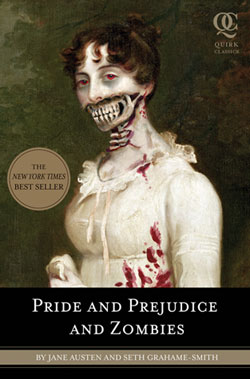
Pride and Prejudice and Zombies: Jane Austen and Seth Grahame-Smith

“Of all the weapons she had commanded, Elizabeth knew the least of love; and of all the weapons in the world, love was the most dangerous.”

 It’s always a crapshoot to re-envision a classic.  For every Pride and Prejudice starring Keira Knightly, there’s a Starship Troopers starring Casper van Diem.  It’s even more of a crapshoot to take the original author’s vision and totally turn it on its head.  So, it was with much curiosity that I picked up a copy of Pride and Prejudice and Zombies (Jane Austen and Seth Grahame Smith: copyright 2009, Quirk Books) Seth Grahame-Smith’s take on the seminal tale of the five Bennett sisters and their search for love and security in 18th century England.  It certainly takes a large amount of pride to assume oneself capable of taking a classic romance, mashing in a few zombies and some kick ass eastern fighting styles, and bringing forth what could only be described as a horrifying romance that captures the original author’s intent…but Seth Grahame-Smith was apparently the man for the job.

I imagine that anyone with a passing interest in literature has at least heard of the tale of the Bennett sisters, specifically Elizabeth, and her interactions with the mercurial Mr. Darcy.  One has an overabundance of pride, and the other finds the man’s pride so odious that she develops such a prejudice (yes, I know, hence the title) against him that the reader is left wondering how these two so obviously unsuited lovers can possibly get together. (Full disclosure–Pride and Prejudice  has been on my “to read” list for pretty much ever)  From what I gather on the subject, the original novel is a damning expose of 18th century convention and the wall between social classes, and even within them.  This version has a little fun with it.

So, let’s start with a short synopsis and go from there:

It’s been a few years since the events of Dawn of the Dreadfuls and the Bennett sisters have followed in their father’s footsteps, each of them travelling to the Orient to learn the ways of the Shaolin monks, a decidedly unladylike  action made necessary by the resurrection of the Dreadful menace, which has only gotten worse since the events of the prequel.  England is in a state of perpetual siege at the hands of the undead. London has become a walled fortress and travel around the countryside (unless it’s the dead of Winter–note to reader–the undead freeze) is a perilous affair.  However, life must go on, and the matriarch of the Bennett family is always on the lookout for possible suitors for her daughters.  With the re-habitation of Netherfield Park by the handsome (and very rich) Mr. Bingley, Mrs. Bennett sees a chance to both assure a future of comfort for her eldest daughter Jane, and by extension, the Bennetts.  When Jane endeavours to visit the Bingley’s and falls ill, Elizabeth is sent to watch over her recovery and during the course of the vigil, interacts with Fitzwilliam Darcy, whom she already has developed a grudge against, based on her initial observations at a local ball.

It’s hate at first sight, tempered by a certain appreciation of his martial qualities–ie.  he kills Zombies.  Elizabeth has devoted herself to a life of protecting her family and friends from the undead menace, telling herself that her duty allows no time for love, yet finds herself curiously drawn to Darcy.  However, events, as they often do in romance novels, conspire to keep the lovebirds apart.  The lies of Darcy’s childhood friend George Wickham influence Elizabeth greatly, as does Darcy’s treacherous (or so it seems) behaviour in coming between Jane and Charles Bingley.

All right, I’m already bored.  Suffice it to say that the reimagination of Austen’s work stays true to the original storyline, within limits.  However, Smith manages to seamlessly blend the horrific elements into the storyline, and adds a certain amount of bawdy humour that I doubt was in the original (not that Austen wasn’t a wit, it’s just that his additions are crude enough that I cannot believe Austen would have thought of them).

Examples abound of Smith’s somewhat bawdy additions to the original storyline.  When Elizabeth asks Mr. Darcy his opinion on the subject of balls (the formal dances), he responds with:

“…I may observe that private balls are much pleasanter than public ones.”

Elizabeth’s reply:

“On the contrary, I find that balls are much more enjoyable when they cease to remain private.”

Zoinks!  Double entendre anyone?

Later, when Elizabeth is entertaining Lady Catherine Debourgh and company with a demonstration of her nimbleness, walking about on her hands and finally supporting her weight on one finger, Lady Catherine observes to Darcy:

“Miss Bennet would make a fine showing of Leopard’s Claw if she practiced more, and could have the advantage of a Japanese master.  She has a very good notion of fingering.”

Darcy’s response:

“That she does.”

Ahem…cough, cough…Jane Austen would blush.

Let’s not forget Elizabeth’s younger sisters, the boy crazy Lydia and her easily influenced sister Kitty.  When the local militia regiment decamps from the area, they are disconsolate, Lydia whining that:

Only think what a miserable summer else we shall have!  With hardly any balls to be had in Meryton!”

To which Elizabeth cannot refrain from thinking:

“Yes…a summer with so few balls would be miserable indeed for a girl who thinks of little else.”

Anyway, I think you see where I’m going.  Smith has managed to channel Austen’s wit and brand it with his own (somewhat less delicate) sense of humour.

He also manages to change the essential character of Elizabeth’s relationship with lady Catherine.  In the original, lady Catherine looks down on the Bennetts as lower class and Elizabeth specifically as not worthy of her nephew’s attentions due to her diminished social status.  In this version, that is coupled with her disdain for Elizabeth’s training, shunning her Chinese training in the Shaolin ways as inferior to that of the Japanese, whose ninjitsu arts she is heavily influenced by.  She eventually goes so far as to sick her house ninjas on Elizabeth in a desperate attempt to foil their eventual union.

All in all this revised imagining of a perennial classic works, spicing up the original tale of romance with a healthy dose of both horror and the absurd, and (I would think) attracts a new audience that would likely never be exposed to the original without the addition of those horrific elements.  It’s definitely worth a read, and with the addition of both a prequel and sequel by the equally talented Steve Hockensmith, there’s plenty more for the reader to enjoy.


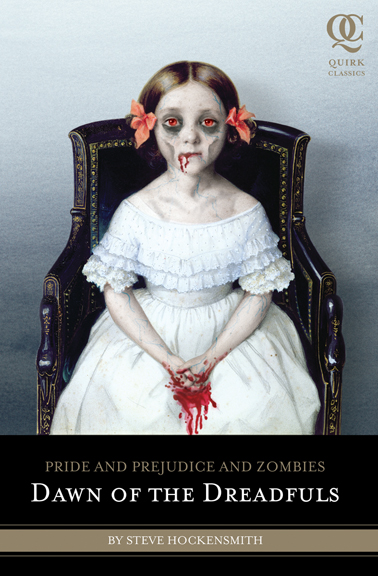
Pride and Prejudice and Zombies: Dawn of the Dreadfuls-Steve Hockensmith

“Wishful thinking is a sin all England stands guilty of today, your fool of a father included.  We told ourselves our long nightmare was over, that a new day had dawned.  Alas, that was the real dream.”  ~Mr. Bennett.

And thus begins, Pride and Prejudice and Zombies: Dawn of the Dreadfuls (Steve Hockensmith: copyright © 2010 Quirk Books), a story of Regency England facing  a threat it had thought long since past.  In polite society, one does not talk of the scourge, and if necessary, refers to them as “the Unmentionables“.  Less polite society calls them “the Dreadfuls” and if one loses one’s propriety altogether, “Zombies!”

And propriety is under siege in this novel, as respectable society tries (and fails) to go about business as usual, ignoring the threat that has literally come upon their doorsteps.

Dawn of the Dreadfuls was written as a prequel to Seth Grahame-Smith’s Pride and Prejudice and Zombies, itself a mash-up of Jane Austen’s Pride and Prejudice, chronicling the events that led to the Bennett sisters becoming the undead killing machines of Smith’s novel.  It begins with a funeral (quite apt) and ends with a ballroom dance being crashed by some uninvited (and undead) guests.  Along the way we are introduced to the Bennett family, a family of more status than means.  While Mrs. Bennett seeks an amicable union for her daughters so as to assure a future of comfort and sensibility, Mr. Bennett curses himself for both not having sons and neglecting his daughters martial education.

The daughters themselves are a curious bunch. 

Jane, the eldest, is a demure portrait in modesty (so much so that you need use both words to describe her), yet equipped with a quick wit and an even quicker katana.  She’s the model of civility in such an age, yet  not above doing whatever needs to be done in pursuit of the greater good, whether allowing herself to be courted by an awful English dandy to satisfy her mother, or lopping the head of any dreadful to satisfy her father.  Elizabeth, our protagonist, is much less demure, possibly a quicker wit, and  has a much more realistic view of the world and people around her.  She’s also less mindful of modesty and more willing to ascribe to the axiom that life is, “nasty, brutish and short.”  Unless you strike first.  Mary, the self-absorbed bookworm, lost in her desire to show everyone up, whatever the issue, and finally Lydia and Kitty, too girls with nothing but air between their ears, yet natural skill with implements of death.

You can’t have a family of women in such a novel without a bevy of possible suitors, and Dawn of the Dreadfuls is chock full of them.  Remember, this is pre-Darcy, and Netherfield Park was not yet to be occupied by the Bingsley’s. No, in this prequel Netherfield is the domain of Lord Lumpley, a libertine of the worst sort, whose desperate pursuit of wine and women rules all his actions, and in this case, the object of his pursuit is Jane.  Such a beauty cannot only be the desire of one chunky lord, and his nemesis arrives in the form of Lt. Tindall, charged with protecting the small hamlet of Meryton from the recently unearthed.  He’s the model of a soldier, brave and talented, yet hidebound by the social convention that women are delicate flowers and hobbled by a regiment of recent inductees who barely know one end of a musket from the other. Nevertheless he knows how to put down a dreadful and learns to recognize that convention is all fine and good, ’til it stands between you and continuing life.

Of course, this novel is primarily about Elizabeth Bennett, and while she is cynical of men as a gender, her views are only enhanced by the vices exhibited by the two men in her life.  The first is the seemingly flawless master Hawksworth, an expert of the martial arts and belonging to an order that once put the dreadfuls in their place.  While demonstrating all the physical ability and military talent to deal with the threat, over time Hawksworth’s fatal flaw becomes apparent, both to the reader and Ms. Bennett.  His counterpart is the intellectually superior yet emotionally stunted  Dr. Kekilpenny, a man who would rather play around in his makeshift laboratory trying to rehabilitate the dreadfuls into proper English gentlemen than stand up and fight.  His bravery is obvious, but it’s born of obliviousness.

So, the scene is set, the characters have their places, and the reader is more than likely to be amused and enthralled by this surprisingly entertaining period piece.  Hockensmith manages to capture much of the subtle humour and most of the style  of Austen’s writing.  When talking of Mrs. Bennett’s personality, he inserts such thoughts as, “As always, she found facts antithetical to good conversation.” (pp. 142)  When writing of lord Lumpley’s excesses, such lines as:

“You and I must return to Netherfield at once Ms. Bennett.  Balls don’t throw themselves, you know, and I’m certain you will prove yourself ever so helpful with mine.” (pp. 180)

leap out at the reader and elicit a good chuckle. 

But it’s not all chuckles and wit.  If you’re looking for horror and mayhem, or simply relief from the boredom that comes from sense and sensibility in a time of polite society and debutante’s balls, then Pride and Prejudice and Zombies: Dawn of the Dreadfuls is a must read.  Especially since Hockensmith has been commissioned to bookend Pride and Prejudice and Zombies with both this prequel and the forthcoming sequel, Pride and Prejudice and Zombies: Dreadfully Ever After, leaping off shelves to feast on the brains of horror readers March 22 of this year.


Monster Hunter Vendetta-Larry Correia

“When Monsters have nightmares, they’re dreaming about us.”  MHI Company Handbook

When we last met with Owen Zavasta Pitt, he was still reeling from the discovery that the world as he knew it was not the world as it is.  Monsters are real, the government has a black ops division of the F.B.I. that deals with them, and after a nasty run in with his manager at work (who was also a recent convert to lycanthropy), Pitt discovers that the life of an accountant may not be for him.   Monster Hunter-yes; middle management drone-no.

Fast forward a year, and we find Owen in a state of relative contentment.  He’s managed to save the World at least once, met (and courted) the girl of his dreams, and does a job that he loves for a salary that makes life quite comfortable.  Everything should be gravy, right?

Well, not so much.

You see, during the course of saving the world from the evil forces of another dimension, Owen attracted the attention of an elder God.  Apparently, destroying the artifact that would allow it to enter our dimension and slaying a multitude of its acolytes merits attention, as did the tactical nuclear weapon delivered into its posterior, courtesy of the U. S. government.  Owen’s not to blame for that, but someone’s got to take the fall, and the Old One (picture Lovecraft’s Cthulu) has decided Owen shall be the one.  Ironic that a bounty hunter should have his own bounty. 

Owen is blissfully unaware of  either the nuke or the bounty, contentedly hunting down chupacabras  and keeping the Mexican Riviera safe for both the locals and drunken Spring break kids.  So, it comes as a surprise to him when he gets a knock on the door, and then a subsequent knock on the head, from a mysterious Englishman, a shadowman of sorts, who remains incorporeal in the shade, but packs a real punch in the light of day.  Nor does it help that he’s brought a truckload of Zombies with him and released them on the resort’s party-goers.

Fast forward a couple of hours and poor Owen is stuck in a Mexican prison accused of multiple murder and disavowed by his own government.  If that’s not enough, while there, he gets a visit from his in-laws.  At the best of times that can be a pain in the neck, but when your in-laws are also Vampires of the nastiest sort, metaphor and reality can become mixed up.  Lucky for him though, they subscribe to the adage that, “the enemy of my enemy is my friend,” and have come to Owen with a proposition. 

The Englishman is a necromancer, and being Undead themselves, they don’t really want to become enthralled to him, hence, a truce and an alliance.  However, Owen has a problem being allied with the Undead, subscribing to the less known adage that, “the enemy of my enemy is sometimes also my enemy,” so that idea is a no go. 

You really don’t want to say “no” to Owen’s mother in law.  You. Really. Don’t.

Okay, Evil necromancer on one side, Evil Undead on the other.  Should be enough to deal with, right?

Aha, let’s not forget about the United States government.

Yep, that’s right, that same government that ticked off the Elder God.  Specifically, the Monster Control Bureau, a subsidiary of the Department of Justice and royal pain in the ass under the leadership of one Agent Myers, himself a former MHI alumni (with a grudge).  They’ve been following the movements of the shadowman and his cult organization, “The Sanctified Church of the Temporary Mortal Condition,” and now want to use Owen as bait to draw out their leader.  With that, the stage is set for a rollicking story full of non-stop action as Owen and his compatriots try to thwart the plans of the Death Cult, deal with a government agency that would rather see them disbanded, and as a byproduct of stopping the shadowman, keep him alive. 

 There are a lot of things to love in a Correia novel.  His writing is both witty and so fast paced that you don’t want to put the book down for any reason while you’re reading it, and feel a sense of dissatisfaction when you get to the end and realize it’s over.  His take on the supernatural is both quirky and refreshing, taking accepted mythology and turning it on its head.  In the first novel, we’re introduced to the Trailer Park Elves; this time around, it’s a gang of garden Gnomes.  And I do mean, “Gang.”  (If those THUG LIFE tats don’t tip it off, the sawed off shotguns and turf wars will.)  Fans of his first novel also get several questions answered, such as:

  • What’s the deal with Agent Franks? (and really, shame on me for not figuring it out earlier)
  • Why the animosity between Agent Myers and Earl Harbinger, and what does it have to do with one Martin Hood?
  • What’s the reason for Owen’s dad training him from birth to be a survivalist?
  • Who is Mr. Trash Bags, anyway?

Honestly, the Monster Hunter series reminds me a lot of Jim Butcher’s Dresden Files, with Owen playing a role very similar to Harry Dresden, the difference being that while Owen is a bounty hunter, Harry is a detective.   Both series are thoroughly enjoyable and a great addition to the genre.  It’s going to kill me to wait until July of this year for the release of the third book of the series, Monster Hunter AlphaIn the meantime, if you’d like to keep abreast of Larry’s writing projects (and other interesting stuff), he maintains a blog at Monster Hunter Nation that you can check out.

(p.s. Want to read about the Trailer Park Elve’s?  Larry’s got a nice little story about them over at Baen Books)